

Iran Claims Downing of Two US Warplanes as Conflict Enters Critical Phase
By Juba Global News Network | JubaGlobal.com April 4, 2026 In a significant escalation of the ongoing US-Israel war against Iran, now in its sixth week, Ir
By Juba Global News Network | JubaGlobal.com
April 4, 2026
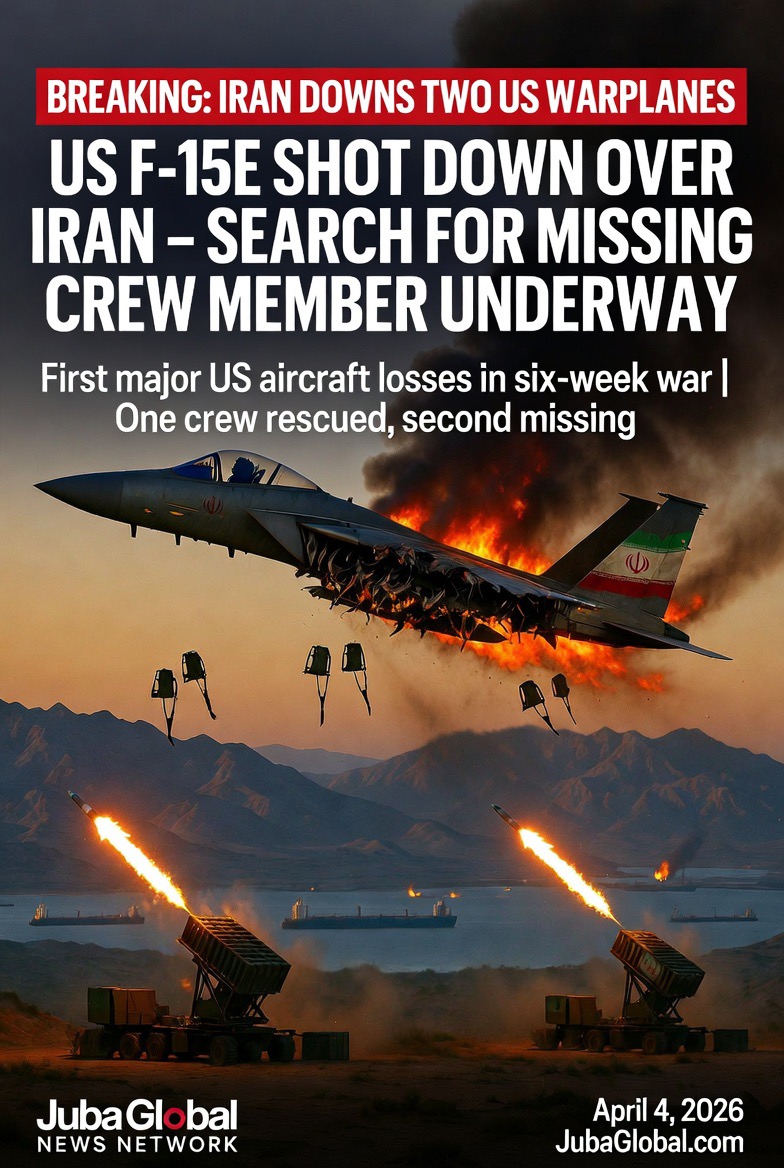
In a significant escalation of the ongoing US-Israel war against Iran, now in its sixth week, Iranian forces announced on Friday that they successfully shot down two American military aircraft. This marks the first confirmed instance of Iran downing manned US warplanes since the conflict began on February 28, 2026, with Operation Epic Fury.
Iranian military spokespersons, via state media and the Khatam al-Anbiya Central Headquarters, claimed that air defense systems destroyed an F-15E Strike Eagle fighter jet over Kohgiluyeh and Boyer-Ahmad province in southwestern Iran. A second combat aircraft, identified by some reports as an A-10 Thunderbolt II close air support plane, was struck near the Strait of Hormuz, with the pilot ejecting and the plane crashing in or near the Persian Gulf.
US officials have confirmed the loss of the F-15E, noting that the two-person crew ejected safely. One crew member was rescued by US search-and-rescue teams, while the fate of the second remains unknown, prompting an active and urgent search operation. A separate incident involving the second aircraft saw the pilot eject safely outside Iranian territory.
Background of the Conflict
The war erupted on February 28, 2026, when the United States and Israel launched nearly 900 coordinated airstrikes in the first 12 hours alone. These targeted Iranian nuclear facilities, ballistic missile sites, air defenses, military infrastructure, and high-level leadership. The opening salvo resulted in the assassination of Supreme Leader Ali Khamenei and several other top officials, triggering massive Iranian retaliation with hundreds of drones and ballistic missiles aimed at Israel and US bases across the Gulf region.
Iran has maintained control over the Strait of Hormuz, imposing tolls in Chinese yuan on passing oil tankers and disrupting global energy supplies. This has led to volatile oil prices, supply chain issues, and broader economic ripple effects worldwide. Despite US claims of degrading Iranian capabilities by up to 90% in missile launches, Tehran continues to demonstrate resilience through sporadic counterattacks, including strikes on Gulf energy facilities and infrastructure.
Details of the Aircraft Incidents
• F-15E Strike Eagle: This twin-engine, two-seat fighter jet is a versatile multirole aircraft used for air-to-air combat, ground strikes, and deep interdiction missions. It was reportedly brought down by Iranian surface-to-air defenses over Iranian territory. Both crew members ejected, but one remains unaccounted for as of April 4.
• Second Aircraft (A-10 or similar): Iranian reports mention an A-10 being hit near the Hormuz area during what may have been a search-and-rescue or close air support mission. The pilot ejected safely outside Iranian territory.
US sources emphasize that these are the first known losses of manned American aircraft to enemy fire in this conflict, though previous drone or unmanned systems may have been lost. The incidents occurred amid intensified US-Israeli operations, including recent strikes on bridges and other infrastructure.
Iranian media has framed the downings as a major propaganda victory, screening videos and calling on civilians to assist in locating any downed pilots. US military analysts note that while Iranian air defenses have been heavily degraded, pockets of capability remain, particularly in southern and southwestern regions.
Reactions and Implications
US Side: President Donald Trump has been briefed on the incidents. In statements, he acknowledged the losses but maintained that they would not derail ongoing negotiations or US objectives. Trump has previously signaled openness to talks if Iran ends nuclear enrichment and reopens the Strait of Hormuz, while also threatening further “heavy blows” if demands are not met by early April deadlines. The White House continues to assert that the war is progressing toward US goals, though some analysts warn of a prolonged conflict potentially extending through April or beyond.
Search-and-rescue operations are ongoing, with US forces racing against time and Iranian efforts to locate the missing personnel. Military experts highlight the risks of such operations in hostile airspace, including potential additional losses.
Iranian Side: Tehran portrays the shoot-downs as evidence of its enduring defensive strength despite weeks of bombardment. With Mojtaba Khamenei reportedly elected as the new Supreme Leader following his father’s death, Iranian leadership appears unified in resistance. The incidents come as Iran faces internal challenges, including civilian impacts from strikes, but continues asymmetric responses.
International and Regional Fallout: The events have heightened concerns across the Gulf. Allies hosting US bases remain on high alert. Israel has conducted additional strikes in southern Lebanon amid the parallel escalation with Hezbollah. Global markets reacted with oil price volatility, as any prolongation threatens further disruptions to energy flows.
Humanitarian organizations have raised alarms about the growing civilian toll, displacement, and infrastructure damage across Iran, Lebanon, Israel, and Gulf states. UN officials have described the conflict as having disproportionate effects on non-combatants.
Strategic Analysis
The downing of US aircraft represents a potential turning point in the air campaign phase of the war. While the US and Israel maintain air superiority, these losses underscore that Iranian integrated air defense systems—though degraded—are not entirely neutralized. They could embolden Iranian forces, complicate US rescue missions, and influence public opinion and negotiations.
Analysts suggest a strong possibility that the war continues through the end of April, depending on diplomatic breakthroughs or further military pressure on energy sites. The Strait of Hormuz remains the critical chokepoint: Iran’s control there gives it leverage, but sustained closure risks broader international intervention.
Questions remain about the long-term objectives. The US has spoken of regime change or significant degradation of Iran’s nuclear and missile programs, yet talks have been hinted at. Iran demands reparations and recognition of its regional role.
As rescue efforts continue and both sides assess the damage, the world watches closely. This incident injects new uncertainty into a conflict that has already reshaped Middle East dynamics, disrupted global energy markets, and claimed thousands of lives.
