The 2026 Iran War: Tragedy Strikes as Six U.S. Service Members Killed in Refueling Plane Crash in Iraq; Pentagon Deploys Thousands More Troops
By Joseph | Juba Global News Network | JubaGlobal.com
March 14, 2026 – 04:15 AM EDT (Updated live as details emerge)
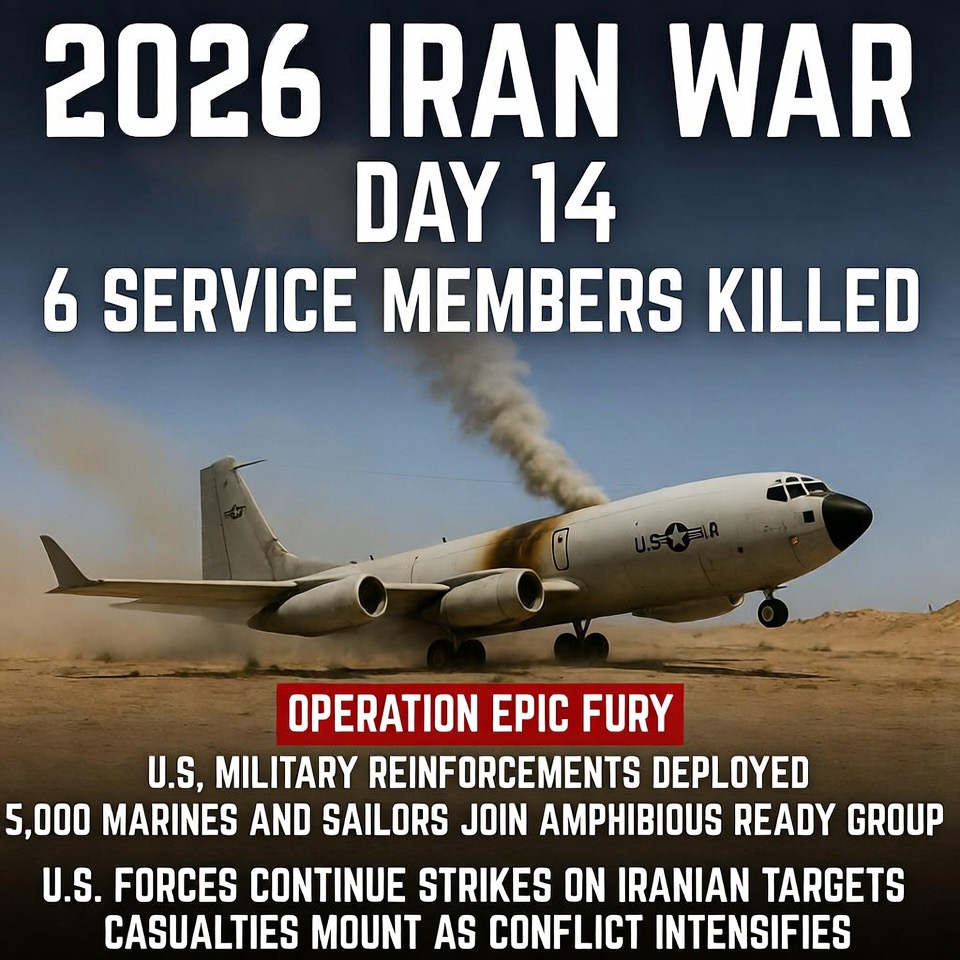
In a somber development on Day 14 of the U.S.-Israel-Iran conflict, the Pentagon has confirmed that all six crew members aboard a U.S. Air Force KC-135 Stratotanker refueling aircraft were killed when the plane crashed in western Iraq on Thursday, March 12. The incident, which occurred during support operations for Operation Epic Fury, has raised the total U.S. death toll in the war to at least 13 service members—seven previously killed in direct combat actions, and now these six from the non-hostile crash.
U.S. Central Command (CENTCOM) issued a statement Friday morning: “All six crew members aboard a U.S. KC-135 refueling aircraft that went down in western Iraq are now confirmed deceased. The aircraft was lost while flying over friendly airspace March 12 during Operation Epic Fury.” The crash involved two aircraft; the second landed safely. Chairman of the Joint Chiefs of Staff Gen. Dan Caine emphasized during a Pentagon briefing that the incident was “not the result of hostile or friendly fire,” describing it as occurring in “friendly territory.”
The cause remains under active investigation by military authorities, with recovery and identification efforts ongoing. Names of the fallen will not be released until next-of-kin notifications are complete. Early reports indicate some crew members hailed from states like Ohio (including at least one from Columbus and others linked to the Ohio Air National Guard’s 121st Air Refueling Wing) and possibly other regions, though official details are pending.
Conflicting Claims and Proxy Involvement
Despite the Pentagon’s assertion of no enemy action, the pro-Iran Islamic Resistance in Iraq—an umbrella group of militias aligned with Tehran—claimed responsibility for downing the aircraft, stating it targeted the KC-135 “in defense of our country’s sovereignty and airspace.” The group also asserted a second tanker was forced into an emergency landing. U.S. officials have dismissed these claims as unverified and inconsistent with evidence from the crash site and flight data.
The tragedy underscores the persistent risks to U.S. forces even in “secure” airspace, as Iranian-backed proxies in Iraq continue sporadic attacks on American positions amid the broader war. Over 140 U.S. service members have been injured since late February, including eight severely, highlighting the human cost of sustaining air operations over the region.
Rapid Reinforcement: 5,000 Marines and Sailors Headed to the Middle East
In direct response to the intensifying conflict—including Iranian missile strikes on U.S. bases, disruptions in the Strait of Hormuz, and proxy threats—Defense Secretary Pete Hegseth approved a CENTCOM request to deploy additional forces. Reports confirm the movement of an Amphibious Ready Group (ARG) and attached Marine Expeditionary Unit (MEU), typically comprising around 5,000 Marines and sailors across several warships.
Key assets include the amphibious assault ship USS Tripoli (departing from its homeport in Sasebo, Japan), along with vessels like the USS San Diego and USS New Orleans. The 31st MEU—primarily based in Okinawa—features a battalion landing team of about 1,100 Marines, aviation assets (including F-35 fighters), and support elements for rapid crisis response.
Officials describe the deployment as providing “expanded options” for commanders: protecting embassies, securing key maritime routes, enabling potential civilian evacuations, and bolstering defensive postures against Iranian retaliation. The move comes as the U.S. works to reopen safe passage through the Strait of Hormuz, where Iranian mines and attacks have halted nearly all commercial traffic, driving oil prices to record levels.
Broader Context: Mounting Toll and Strategic Shifts
The plane crash and troop surge arrive as the war—now in its third week—shows no signs of abating. Joint U.S.-Israeli airstrikes continue to target Iranian military infrastructure, while Tehran launches retaliatory barrages and maintains its blockade threats. President Trump has described operations as “way ahead of schedule,” but the loss of life has renewed scrutiny in Washington over the campaign’s scope and duration.
Humanitarian fallout grows: millions displaced in Iran and Lebanon, severe shortages, and economic shocks from energy disruptions. With reinforcements en route and investigations underway, the coming days could see heightened U.S. naval presence in the Gulf—potentially escalating tensions further or deterring additional proxy attacks.
Our thoughts are with the families of the fallen service members and all those affected by this conflict. Juba Global News Network will provide updates as more information becomes available.
Sources: CENTCOM statements, Reuters, The New York Times, CNN, Al Jazeera, ABC News, The Wall Street Journal, Military Times, and others. This is a developing story—stay informed and verify independently.