

South Korea’s $350 Billion US Investment Deal Delayed Until Late 2026: Currency Pressures and Legal Uncertainties Stall Major Trade Pact Rollout
By: Juba Global News Network | JubaGlobal.com Published: January 16, 2026 South Korea’s ambitious $350 billion strategic investment pledge in the United St
By: Juba Global News Network | JubaGlobal.com
Published: January 16, 2026
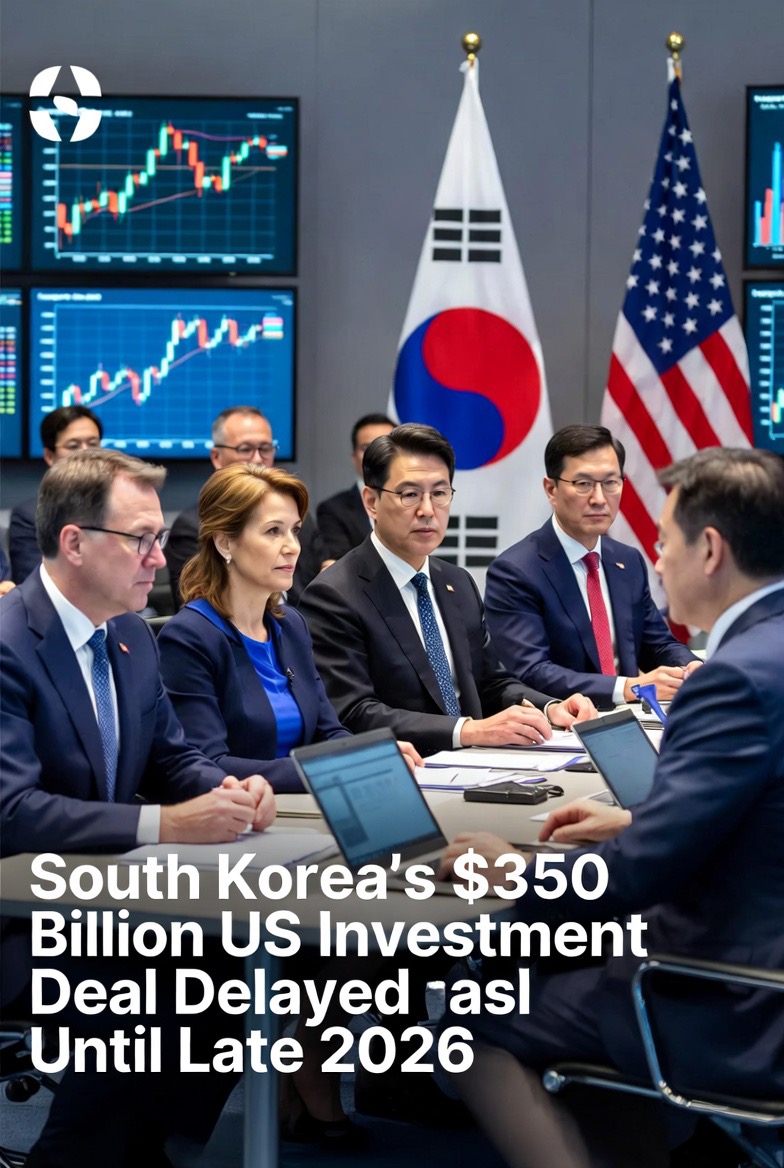
South Korea’s ambitious $350 billion strategic investment pledge in the United States—part of a landmark November 2025 trade agreement aimed at securing lower U.S. tariffs—will not begin in the first half of 2026, Finance Minister Koo Yun-cheol confirmed in an exclusive Reuters interview on January 16, 2026. The delay, driven by concerns over the weakening Korean won, foreign exchange volatility, and pending U.S. legal challenges to President Donald Trump’s tariff framework, provides short-term relief to Seoul’s currency markets but raises questions about the pace and enforceability of one of the most significant bilateral economic commitments in recent U.S.-Asia relations.
The deal, finalized after months of tense negotiations following Trump’s return to office, saw South Korea commit to investing $350 billion in U.S. strategic sectors in exchange for a reduction in country-specific “reciprocal” tariffs from 25% to 15% on qualifying Korean exports. The package breaks down into $200 billion in direct cash investments (capped at $20 billion annually to mitigate FX outflows) and $150 billion earmarked for bilateral cooperation, particularly in shipbuilding, nuclear energy, semiconductors, AI, and critical minerals—areas aligned with the Trump administration’s focus on rebuilding U.S. industrial and military capabilities.
Minister Koo stated bluntly: “It’s unlikely” the investments would commence in H1 2026, citing the current foreign exchange environment as unsuitable for large-scale dollar outflows. The Korean won has faced persistent depreciation pressure in early 2026, exacerbated by global risk aversion, U.S. interest rate dynamics, and domestic political uncertainties following the transition to the Lee Jae-myung administration. Seoul’s central bank and finance ministry have prioritized won stabilization efforts, including verbal interventions and readiness to combat “herd-driven” selling, making an immediate surge in outward investment politically and economically untenable.
The agreement includes built-in safeguards: South Korea may request adjustments to the amount and timing of funding if outflows threaten “disorderly movements” in the FX market, with the U.S. agreeing to consider such requests “in good faith.” Deputy Finance Minister Choi Ji-young emphasized that recent comments from U.S. Treasury officials (including Secretary Scott Bessent) underscoring the importance of FX stability reflect mutual recognition that currency turmoil could derail implementation. This clause has effectively become a pressure valve, allowing Seoul to delay without formally breaching the pact.
Implementation hurdles extend beyond currency concerns. No specific projects have been finalized, though potential areas include nuclear power plant construction (flagged by U.S. Commerce Secretary Howard Lutnick) and expanded shipbuilding capacity to address U.S. naval backlogs. Domestic legislative steps remain incomplete: a bill to establish a special fund for the investment package, introduced late last year, is slated for parliamentary review starting in February 2026, but progress could be slowed by opposition scrutiny or competing fiscal priorities.
Adding complexity is ongoing U.S. legal uncertainty surrounding Trump’s use of emergency powers (under the International Emergency Economic Powers Act) to impose reciprocal tariffs. The U.S. Supreme Court is expected to rule soon on related challenges, with analysts warning that an adverse decision could prompt Trump to pivot to alternative legal tools to maintain tariff leverage. Such a development might reopen domestic debate in South Korea over whether the investment commitment—viewed by critics as disproportionately favorable to the U.S.—remains justified if tariff relief is not fully secured.
Broader geopolitical and economic context
The delay comes amid a year of recalibrating the U.S.-South Korea alliance under Trump’s second term. Bilateral summits in August and October 2025 produced the Joint Fact Sheet outlining the trade-investment framework, but turning high-level pledges into concrete action has proven challenging. Similar dynamics are evident in parallel deals with Japan ($550 billion investment pledge) and Taiwan ($250 billion tech-focused commitment), where tariff reductions were traded for massive capital commitments to U.S. strategic industries.
For South Korea, the pact is double-edged. On one hand, it averts higher tariffs that would hit key export sectors (automobiles, semiconductors, steel) and strengthens alliance ties amid North Korean threats and regional tensions. On the other, critics argue the structure—where Korean investors provide capital and know-how while sharing profits heavily with U.S. partners (up to 90% post-recovery in some interpretations)—risks industrial hollowing-out and long-term competitiveness erosion. Business groups, including Samsung and Hyundai, have responded by announcing parallel domestic investment surges (e.g., Hyundai’s 125 trillion won plan through 2030 for AI and robotics) to offset potential outflows.
Market reaction has been cautiously positive in the short term: the won steadied slightly after Koo’s comments, with analysts noting reduced immediate dollar demand pressure. However, longer-term questions linger about execution timelines, project viability, and the impact of any Supreme Court ruling on tariff legality.
As Seoul prepares to push the special fund bill through parliament and Washington awaits judicial clarity, the $350 billion commitment remains a cornerstone of the evolving U.S.-ROK economic-security partnership—but one whose full realization now appears deferred well into late 2026 or beyond. Juba Global News Network will continue tracking legislative developments, FX movements, and any U.S. court outcomes as this pivotal deal evolves.
Sources: Reuters, Yonhap News Agency, Korea Times, Chosun Ilbo, U.S. Trade Representative fact sheets, Federal Register notices, and statements from South Korean Finance Ministry and U.S. Treasury officials.
