Pakistan Airstrike on Kabul Rehab Center Kills Dozens to 400 (Reports Vary)
By: Juba Global News Network | JubaGlobal.com
March 18, 2026 — Kabul, Afghanistan
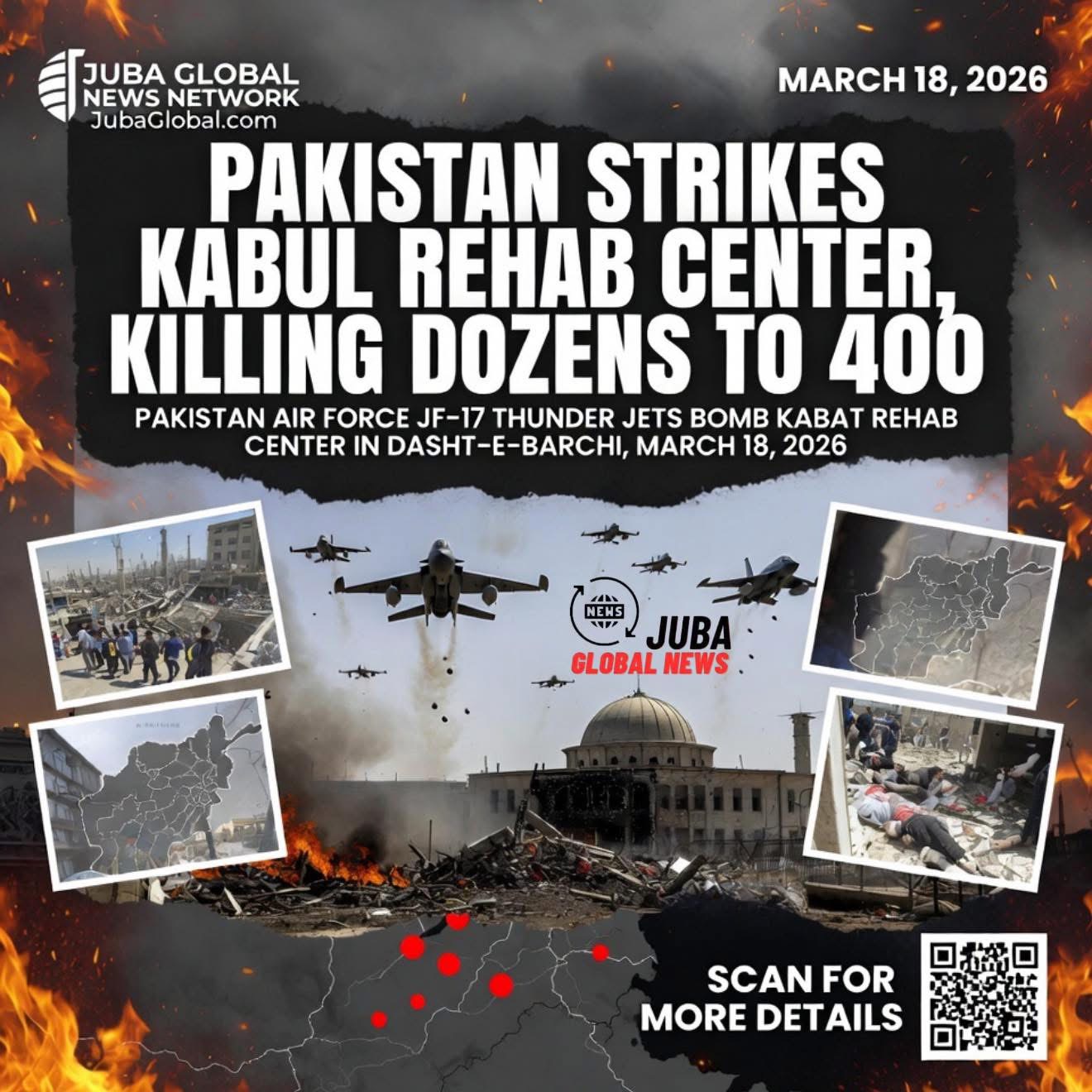
A devastating Pakistani airstrike early Wednesday morning targeted what Pakistani military sources described as a “Taliban command and logistics hub” in western Kabul, but Afghan officials and eyewitnesses say the primary structure hit was a large civilian drug rehabilitation center run by a local NGO, killing between 60 and 400 people—mostly recovering addicts, medical staff, and family visitors—depending on conflicting initial casualty counts.
The attack occurred shortly after 8 p.m. local time Tuesday (Afghanistan time), when at least four Pakistani Air Force JF-17 Thunder jets reportedly crossed into Afghan airspace from the south and unleashed precision-guided munitions on a multi-building compound in the Dasht-e-Barchi neighborhood. Pakistani ISPR (Inter-Services Public Relations) released a statement within hours claiming the strike “neutralized a high-value Taliban target responsible for cross-border attacks into Khyber Pakhtunkhwa and Balochistan,” and provided drone footage showing secondary explosions consistent with stored munitions or fuel.
Afghanistan’s Taliban-led government, however, issued a furious condemnation, labeling the strike a “barbaric massacre of civilians” and accusing Pakistan of deliberately targeting a known humanitarian facility. The Ministry of Public Health identified the main building as the “Rahat Drug Treatment and Rehabilitation Center,” which housed up to 350 in-patients at any time, many in long-term recovery programs. Survivors and first responders described a horrific scene: dinner had just been served in the communal hall when the first bombs struck, collapsing the roof and igniting fires that trapped dozens inside.
Eyewitness accounts gathered by Juba Global correspondents and Afghan journalists paint a picture of chaos:
- “We heard the jets, then everything shook. People were screaming, running, but the doors were blocked by debris,” said Ahmad, 29, a recovering heroin user who escaped with burns on his arms and legs.
- Rescue workers reported pulling charred bodies from the rubble well into the night; many victims were burned beyond recognition.
- A Taliban security official on scene told reporters the death toll “will exceed 200,” while the acting health minister later raised the estimate to “up to 400,” including patients, staff, cooks, cleaners, and visiting relatives. Independent verification remains difficult due to restricted access and ongoing Taliban media controls.
Pakistan has not retracted its claim but has so far offered no evidence publicly linking the rehab center to Taliban military activity. Analysts note that Dasht-e-Barchi has long been a contested area with mixed Taliban, criminal, and community elements; some speculate the target may have been a nearby building used for weapons storage or meetings, with the rehab center caught in the blast radius or struck in error. However, the precision nature of the munitions used and the Pakistani military’s history of cross-border operations suggest the site was deliberately selected.
The strike has inflamed already toxic Pakistan-Afghanistan relations. Since the Taliban’s return to power in 2021, Islamabad has repeatedly accused Kabul of harboring Tehrik-i-Taliban Pakistan (TTP) militants who launch attacks into Pakistan. Kabul, in turn, accuses Islamabad of supporting anti-Taliban groups and conducting extrajudicial airstrikes. Wednesday’s attack is the deadliest single incident since the 2021 withdrawal and comes amid heightened border tensions, including recent TTP-claimed bombings in Peshawar and Quetta.
International reaction has been swift but cautious. The United Nations Assistance Mission in Afghanistan (UNAMA) called for an immediate independent investigation, while the International Committee of the Red Cross (ICRC) expressed deep concern over the targeting of a medical facility. The U.S. State Department issued a measured statement urging “all parties to exercise restraint” without assigning blame. No major Western capital has yet condemned Pakistan outright, likely reflecting ongoing strategic calculations amid the larger regional war involving Iran, Israel, and the United States.
In Kabul, crowds gathered outside the ruined compound overnight, chanting anti-Pakistan slogans and burning Pakistani flags. Taliban spokespeople promised retaliation, with one senior commander warning on state television: “Pakistan will taste the consequences of this crime.” Whether that means cross-border operations, increased support for anti-Pakistan militants, or diplomatic escalation remains unclear.
As bodies continue to be recovered and identified under floodlights, the tragedy underscores how quickly local humanitarian spaces can become casualties in wider geopolitical conflicts. For the recovering addicts who survived—and for the families now mourning loved ones—the war next door has arrived in the most personal and devastating way.
Juba Global News Network will continue to follow developments, including any independent casualty verification and official investigations. Stay informed at JubaGlobal.com.
Reporting contributed by field correspondents in Kabul (via secure channels), regional analysts, and cross-verification with Pakistani, Afghan, and international sources.