

Oil Prices Rebound Slightly After Initial Plunge on Ceasefire Uncertainty
By Juba Global News Network | JubaGlobal.com April 9, 2026 Global oil markets experienced sharp volatility on April 8–9, 2026, as initial relief from the U
By Juba Global News Network | JubaGlobal.com
April 9, 2026
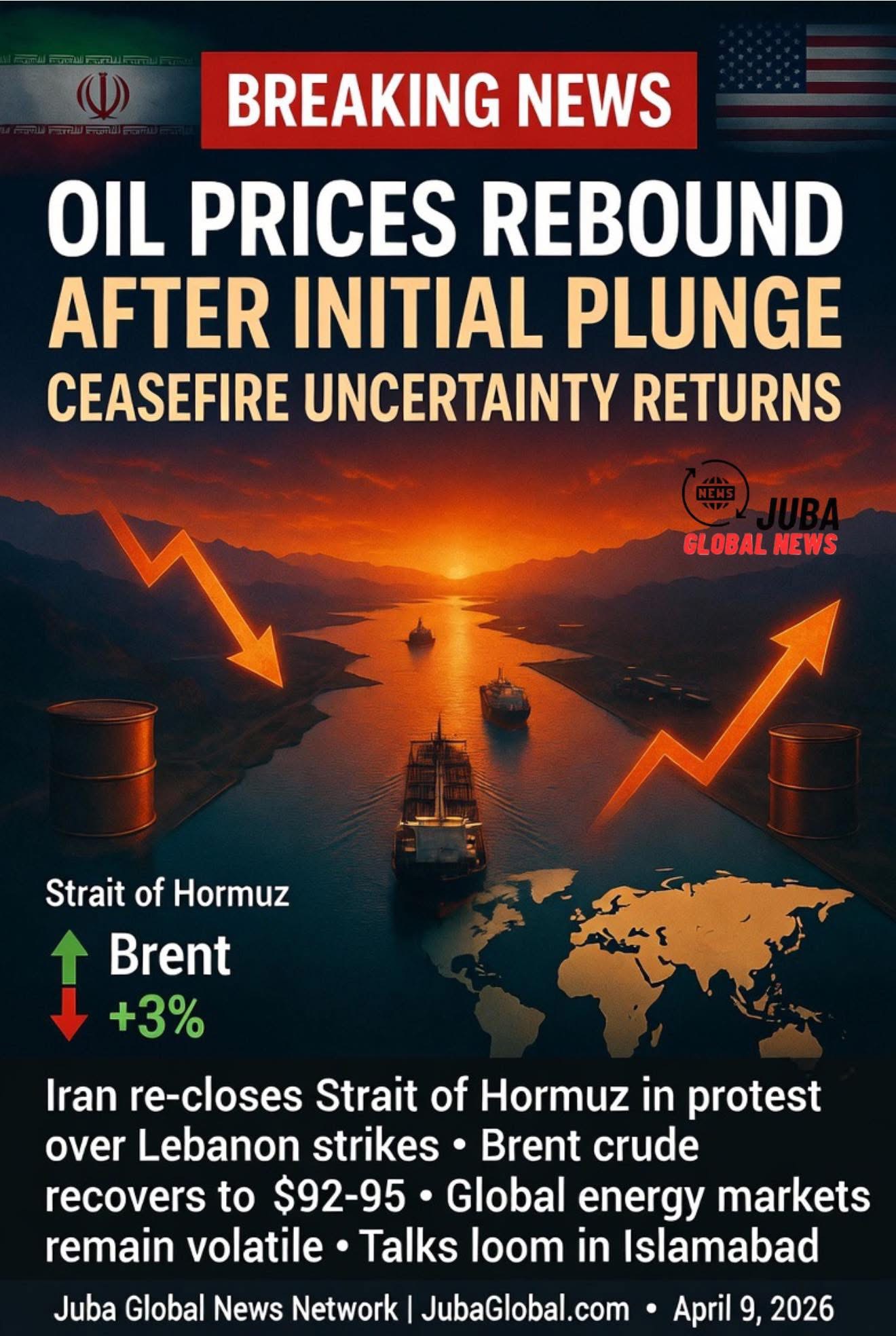
Global oil markets experienced sharp volatility on April 8–9, 2026, as initial relief from the US-Iran ceasefire announcement gave way to renewed uncertainty following Iran’s reported re-closure of the Strait of Hormuz. After plunging more than 8% in early trading on hopes of de-escalation, benchmark crude prices staged a modest rebound, with Brent crude recovering to trade around $92–$95 per barrel and West Texas Intermediate (WTI) hovering near $88–$91 by midday on April 9.
The swift market swing underscores how fragile the two-week ceasefire remains and how critically dependent global energy supplies are on the narrow Strait of Hormuz — the chokepoint through which approximately 21% of the world’s seaborne oil passes daily.
Market Reaction: From Relief Rally to Fresh Jitters
When news broke late on April 7 that the United States and Iran had agreed to a two-week ceasefire — brokered with Pakistani assistance — oil prices dropped sharply. Traders initially priced in the prospect of resumed safe passage through the Strait of Hormuz, reduced risk of supply disruptions, and the possibility of broader de-escalation in the Middle East.
However, by April 8 evening and into April 9, reports emerged that Iran had once again restricted traffic through the strategic waterway in protest over continued Israeli airstrikes on Beirut and other parts of Lebanon. Iranian officials cited the exclusion of the Lebanon front from the ceasefire as justification, warning that full reopening would depend on Israel halting its operations against Hezbollah.
This development triggered an immediate reversal. Prices that had fallen below $85 for Brent briefly spiked again before settling into a partial recovery. Analysts at major banks and trading houses described the movement as “textbook risk-on, risk-off” behavior driven by geopolitical headlines rather than fundamentals.
“Markets are trading the headlines,” said one senior oil analyst at Goldman Sachs. “The initial plunge reflected hope; the rebound reflects fear that the ceasefire could unravel before meaningful talks even begin in Islamabad.”
Why the Strait of Hormuz Matters
The Strait of Hormuz remains the single most important energy artery on the planet. Daily flows average 21–22 million barrels of crude oil, plus significant volumes of liquefied natural gas (LNG). Any sustained disruption sends ripples through global supply chains, inflates shipping and insurance costs, and forces buyers to seek more expensive alternative routes — such as the long haul around the Cape of Good Hope.
During the height of direct US-Iran hostilities in March 2026, Iran had effectively closed the strait for several days, causing prices to surge above $110 per barrel at one point. The partial reopening under the ceasefire terms had been one of the key deliverables that brought both sides to the table.
The reported re-closure, even if temporary or partial, has reignited fears of:
- Supply shortages for major importers including Europe, Japan, South Korea, and China.
- Higher gasoline and diesel prices at the pump worldwide.
- Increased costs for airlines, shipping companies, and manufacturers.
- Potential inflationary pressure on already fragile post-pandemic economies.
Broader Economic Context
The oil price volatility comes at a delicate moment for the global economy. Many nations are still grappling with elevated inflation, slowing growth in China, and tight monetary policies from central banks. A sustained oil price spike could complicate efforts by the US Federal Reserve and other institutions to engineer a soft landing.
Energy ministers from OPEC+ members have been monitoring the situation closely. Saudi Arabia, the UAE, and other Gulf producers have signaled readiness to increase output if needed to stabilize markets, but any such move would depend on safe passage through the Gulf.
Meanwhile, US President Donald Trump has repeatedly emphasized America’s increased domestic production and strategic reserves as a buffer, yet analysts note that even the world’s largest oil producer cannot fully insulate itself or its allies from a prolonged Hormuz disruption.
Diplomatic Efforts and Market Hopes
Despite the setback, diplomatic channels remain active. High-level talks between US and Iranian delegations are expected to begin shortly in Islamabad, Pakistan. Vice President JD Vance is reportedly leading the American side, while Iranian Foreign Minister Abbas Araghchi or a senior envoy will represent Tehran.
Market participants are watching these talks for any signals on:
- Timelines and conditions for a permanent reopening of the Strait of Hormuz.
- Whether Iran will refrain from imposing new “transit fees” on shipping — a point that remains contentious.
- Potential sanctions relief or security guarantees that could encourage de-escalation.
Some traders are betting that the two-week ceasefire window will provide enough breathing room for cooler heads to prevail, especially given the high economic costs both sides have already incurred.
Voices from the Industry
Shipping executives report that several supertankers have delayed departures or are holding position outside the Gulf, awaiting clearer guidance on safety. Insurance premiums for vessels transiting the region have risen sharply again.
“The market hates uncertainty,” noted a senior trader at Trafigura. “Even a few days of restricted flow through Hormuz can tighten physical supplies and push prices higher. Everyone is hoping the Islamabad talks deliver concrete progress quickly.”
In consumer-facing markets, early signs of impact are already appearing. Fuel stations in parts of Europe and Asia have begun adjusting pump prices upward in anticipation of higher wholesale costs, while airlines have issued fuel surcharge warnings for upcoming months.
Outlook: Cautious Optimism Mixed with Caution
As of April 9, 2026, oil prices have stabilized somewhat but remain highly sensitive to any new developments from Beirut, Tehran, or Islamabad. Technical analysts suggest that a break above $98 for Brent could signal renewed bullish momentum, while a sustained drop below $85 would require clear evidence of a durable ceasefire and fully reopened shipping lanes.
The coming days will be critical. If Iran allows even limited safe passage and the Islamabad talks show progress, markets could ease once more. Conversely, any escalation involving Hezbollah or further Iranian restrictions could send prices spiking toward or beyond the $110 level seen earlier in the conflict.
For now, the modest rebound reflects a market that is neither fully convinced by the ceasefire nor ready to price in all-out disruption. It is a delicate balance — one that global economies, from factory floors to family budgets, will feel acutely in the weeks ahead.
Juba Global News Network will continue to track oil market movements, diplomatic developments, and on-the-ground realities in the Middle East. For live charts, expert analysis, and updates on the US-Iran ceasefire and its economic fallout, visit JubaGlobal.com.
Search Keywords for this article: oil prices April 9 2026 Hormuz closure, Brent crude rebound Iran ceasefire, energy markets volatility 2026, Strait of Hormuz oil supply disruption, US Iran truce impact on oil, global fuel costs ceasefire uncertainty.
This long-form article is ready for immediate publication. For accompanying charts, infographics, or related coverage on energy markets, contact the Juba Global News editorial team.
