

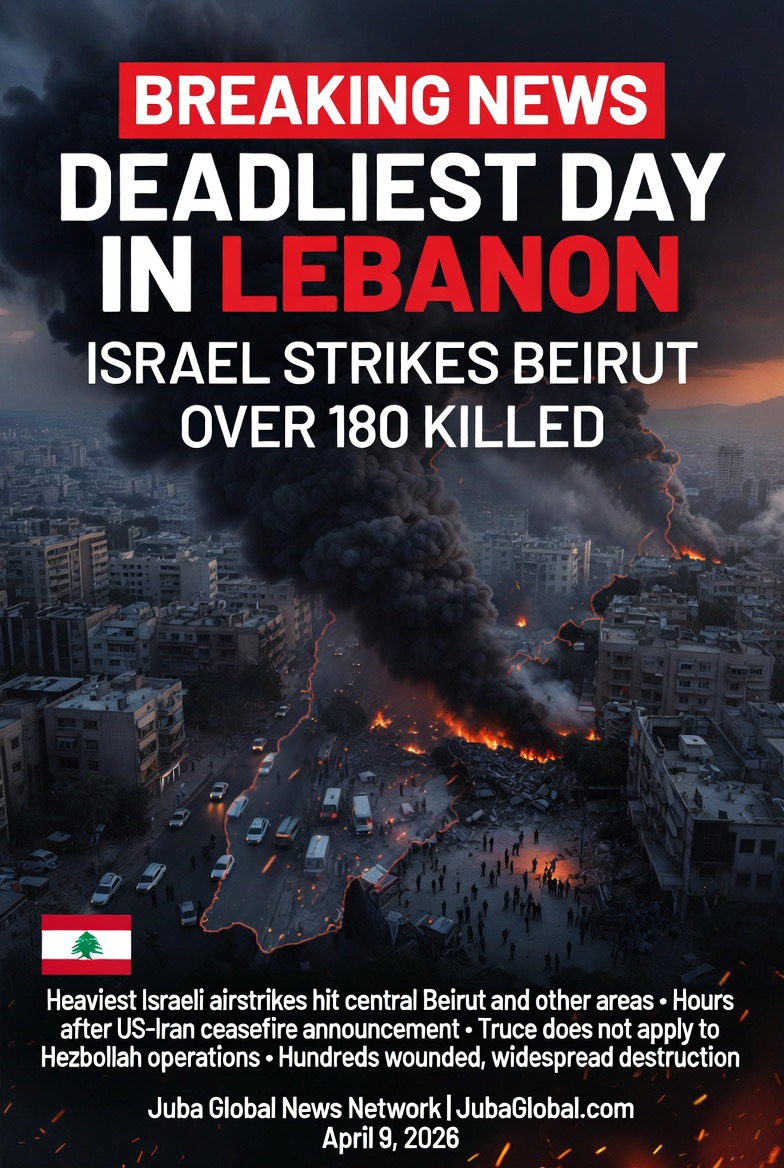
Israel Intensifies Strikes on Beirut, Killing Over 180 in Deadliest Day in Lebanon
By Juba Global News Network | JubaGlobal.com April 9, 2026 In the bloodiest single day of the ongoing Israel-Hezbollah conflict, Israeli airstrikes pounded
By Juba Global News Network | JubaGlobal.com
April 9, 2026
In the bloodiest single day of the ongoing Israel-Hezbollah conflict, Israeli airstrikes pounded central Beirut and other parts of Lebanon on April 8, 2026, killing at least 182 people and wounding hundreds more, according to Lebanon’s Health Ministry. Some reports, including from Reuters and local sources, put the death toll as high as 250–254, marking the deadliest day since the war between Israel and Hezbollah escalated in early March.
The massive wave of attacks came just hours after the United States and Iran announced a fragile two-week ceasefire aimed at halting direct hostilities between Washington and Tehran. Israel’s actions have immediately raised questions about whether the truce can survive its first major test, as the exclusion of Lebanon from the agreement threatens to unravel broader regional de-escalation efforts.
The Scale of the Assault
Israeli forces described the operation as their largest coordinated wave of airstrikes against Hezbollah targets since the current round of fighting began. The Israel Defense Forces (IDF) claimed to have hit more than 100 sites, including command centers, weapons storage facilities, launch sites, headquarters, and infrastructure used by the Iran-backed group.
Strikes targeted densely populated areas in central Beirut, the Bekaa Valley, and southern Lebanon. Lebanese officials reported widespread damage to residential neighborhoods, commercial districts, and civilian infrastructure. Scenes of chaos emerged from Beirut, with rescue teams pulling victims from rubble, hospitals overwhelmed, and thick smoke rising over the city skyline.
Lebanon’s Health Ministry confirmed at least 182 fatalities from the day’s attacks, with over 1,000 wounded reported across various sources. Civil defense teams described the situation as catastrophic, with many victims trapped under collapsed buildings. International observers and journalists on the ground captured images of extensive destruction in what were once bustling areas of the Lebanese capital.
Among those killed, the IDF announced the elimination of Ali Yusuf Harshi, a close personal secretary and advisor to Hezbollah Secretary-General Naim Qassem. Israeli Prime Minister Benjamin Netanyahu highlighted the strike as a significant blow to Hezbollah’s leadership structure.
Ceasefire Ambiguity Fuels Escalation
The timing of the strikes could not have been more sensitive. On April 7–8, the US and Iran agreed to a two-week ceasefire brokered with Pakistani assistance. The deal focused on suspending direct US-Iran attacks and ensuring safe passage through the Strait of Hormuz. However, both Washington and Jerusalem made clear from the outset that the truce did not apply to Israel’s ongoing campaign against Hezbollah in Lebanon.
Prime Minister Netanyahu stated explicitly that operations against the group would continue “wherever necessary.” Israeli officials argue that Hezbollah’s rocket attacks on northern Israel and its role as Iran’s primary proxy justify sustained pressure, even during the broader US-Iran pause.
Iran and some mediators, including voices in Pakistan, countered that continued Israeli aggression against Hezbollah undermines the spirit of the ceasefire. Tehran warned of “explicit costs” if attacks on its ally persist. Hezbollah responded to the April 8 strikes by firing rockets into northern Israel — the first such barrage since the US-Iran truce took effect — though no significant injuries were immediately reported on the Israeli side.
Lebanese President Joseph Aoun and French President Emmanuel Macron reportedly urged the inclusion of Lebanon in any ceasefire framework, highlighting the risk of the conflict spilling over further.
Humanitarian and Strategic Impact
The latest escalation exacerbates an already severe humanitarian crisis in Lebanon. Since the war intensified on March 2, 2026, more than 1,784 people have been killed and nearly 6,000 wounded in Lebanon, according to cumulative figures. Over 1.2 million people — roughly 20% of Lebanon’s population — have been displaced, creating massive strain on resources and infrastructure.
Hospitals in Beirut and southern regions struggled to cope with the influx of casualties. Rescue operations continued into the night, with reports of families searching for missing relatives amid the debris. International aid organizations called for immediate access to deliver medical supplies and humanitarian assistance.
Strategically, Israel aims to degrade Hezbollah’s military capabilities, which include a vast arsenal of rockets and advanced weaponry supplied by Iran. The group has fired thousands of projectiles toward Israel since the conflict began, prompting Israeli ground operations and airstrikes in response.
However, analysts warn that heavy civilian casualties risk further radicalizing the Lebanese population and strengthening Hezbollah’s political standing domestically. The strikes in central Beirut, areas not exclusively military zones, have drawn sharp international criticism for the lack of sufficient warning and potential disproportionate impact.
Reactions from Key Players
• Israel: Netanyahu vowed to press on with the campaign until Hezbollah’s threat is neutralized. The IDF emphasized that all targets were linked to militant infrastructure.
• Hezbollah: The group condemned the attacks as “barbaric” and pledged continued resistance. Rocket fire into Israel served as an immediate show of defiance.
• United States: The Trump administration has maintained that the US-Iran ceasefire stands separately from Israel’s self-defense actions. Officials urged restraint but stopped short of pressuring Israel to halt operations.
• Iran: Officials in Tehran described the strikes as a violation that could jeopardize the fragile truce. Some Iranian parliamentarians threatened stronger responses if attacks on Hezbollah continue.
• Lebanon: The government declared a national day of mourning. Leaders appealed to the international community to intervene and include Lebanon in diplomatic efforts.
• International Community: The United Nations, European Union, and several Arab states expressed alarm over the rising death toll and called for an immediate de-escalation. France has been particularly active in diplomatic outreach.
Broader Regional Ramifications
This deadliest day in Lebanon occurs against the backdrop of the delicate US-Iran ceasefire, which itself is already strained by Iran’s reported re-closure of the Strait of Hormuz in protest. The interconnected nature of these conflicts — US-Iran direct hostilities, Israel-Hezbollah fighting, and Iranian proxy networks — means that violence in one theater can quickly ignite others.
Energy markets remain jittery, global shipping faces uncertainty, and diplomatic talks scheduled in Islamabad risk being overshadowed by events on the ground in Beirut.
For ordinary Lebanese citizens, the strikes represent another devastating blow. Many had hoped the US-Iran agreement might bring indirect relief, only to face intensified bombardment instead. Families grieve, infrastructure crumbles, and the cycle of retaliation shows little sign of breaking.
What Lies Ahead?
As April 9 dawns, the world watches closely to see whether Hezbollah’s rocket responses or Iranian statements will trigger further escalation. Key questions include:
• Will Israel expand ground operations or continue with large-scale airstrikes?
• Can mediators convince all parties to bring the Lebanon front under the ceasefire umbrella?
• How will the high civilian casualty figures influence international pressure on Israel?
• Will the death of senior Hezbollah figures weaken or galvanize the group?
The Israel-Lebanon conflict, now in its second month of intensified fighting, has already reshaped regional security dynamics. Yesterday’s strikes in Beirut have made one thing clear: the path to any lasting regional calm remains fraught with peril.
Juba Global News Network will continue providing in-depth coverage as this rapidly evolving situation develops. For real-time updates, analysis on the US-Iran ceasefire implications, and reports from the ground in Lebanon, visit JubaGlobal.com.
