

Oil Prices Climb, Stocks Slide as Asia Struggles with Fuel Shortages from Plummeting Middle East Exports
By: Juba Global News Network | JubaGlobal.comMarch 6, 2026 – 05:45 AM EST Update The global energy market is in turmoil on day seven of the US-Israel-Iran
By: Juba Global News Network | JubaGlobal.comMarch 6, 2026 – 05:45 AM EST Update
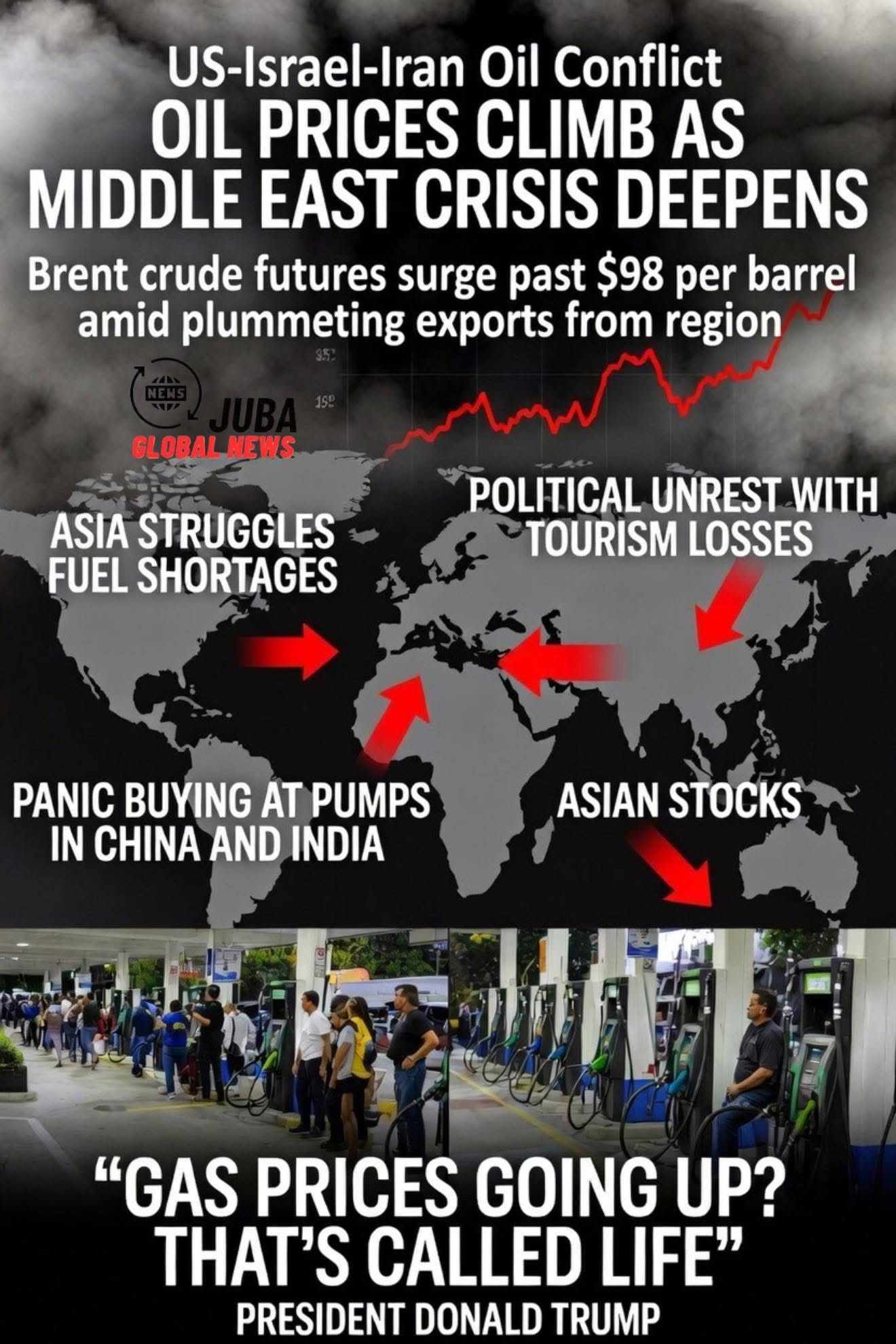
The global energy market is in turmoil on day seven of the US-Israel-Iran war. Brent crude futures surged past $98 per barrel overnight (up 7–9% in the past 24 hours), while West Texas Intermediate briefly touched $95 before settling around $93–94. Asian stock indices opened sharply lower—Nikkei 225 down 3.1%, Hang Seng -2.8%, Kospi -2.4%, Shanghai Composite -1.9%—as traders priced in severe and potentially prolonged disruptions to Middle East oil and gas flows. The combination of halted Iranian exports, threatened Strait of Hormuz transit, damaged Saudi facilities from overnight drone/missile attacks, and fear of wider Gulf escalation has triggered the sharpest energy-market shock since the 2022 Russia-Ukraine invasion.
Supply Shock: Middle East Exports in Freefall
- Iran — Tehran has effectively ceased nearly all crude and condensate exports (previously ~1.3–1.5 million barrels per day, mostly to China via “dark fleet” tankers). Loading operations at Kharg Island, Bandar Abbas, and other terminals have stopped; several tankers are reported idling offshore or diverting.
- Strait of Hormuz — Iran closed parts of the strait to commercial traffic on March 4–5 (ostensibly for “naval exercises”); even partial restrictions have forced rerouting around Africa, adding 15–20 days and millions in costs per voyage.
- Saudi Arabia & neighbors — While no major production facilities were hit in the latest attacks, precautionary shutdowns, heightened insurance premiums, and crew refusals to enter the Gulf have slashed loadings from Ras Tanura, Yanbu, and other terminals by an estimated 20–40% in recent days.
- Iraq & UAE — Both countries report delays and force-majeure declarations on some contracts; Basra Light and Upper Zakum loadings are down sharply.
Combined, analysts estimate a loss of 3.5–5 million barrels per day of immediate supply from the region—roughly 3.5–5% of global production—with the potential for far worse if the conflict escalates.
Asia Hit Hardest: Fuel Shortages and Panic Buying
Asia, which imports over 80% of its crude from the Middle East, is bearing the brunt:
- China — The world’s largest oil importer declared an emergency stockpile release and urged refiners to maximize domestic output. Spot jet fuel and diesel prices in Singapore jumped 15–20% in 48 hours; some independent “teapot” refineries in Shandong have idled due to feedstock shortages.
- India — The government activated its strategic petroleum reserve and quietly approved higher purchases of sanctioned Russian and Venezuelan crude under US waivers. Retail fuel prices rose overnight; queues formed at pumps in several states amid rumors of shortages.
- Japan & South Korea — Both nations activated emergency protocols. Japanese refiners are burning more LNG and coal for power generation to conserve oil stocks; Korean petrochemical plants face feedstock rationing.
- Southeast Asia — Indonesia, Malaysia, Thailand, and the Philippines report panic buying, hoarding, and black-market surges. Singapore, the region’s refining and bunkering hub, saw marine fuel (bunker) prices spike to record levels.
Trump’s Dismissive Stance on Gas Prices
In a Fox News interview late March 5, President Donald Trump downplayed the domestic impact:
- “If gas prices rise, they rise. People understand we’re fighting a necessary war to stop Iran from getting nuclear weapons and threatening the world. Short-term pain for long-term safety.”
- “We have plenty of American oil. Drill, baby, drill—let’s unleash our own energy.”
US retail gasoline averages climbed to $3.89/gallon nationally (up ~28 cents in a week), with California stations already above $5. The president’s comments drew swift criticism from Democrats and consumer groups, who warn of political blowback if pump prices continue rising into spring.
Global Economic Ripples
- Inflation fears — Central banks (Fed, ECB, BoE) face renewed pressure; higher energy costs feed directly into goods transport, manufacturing, and food prices.
- Stock markets — Energy stocks rallied (Exxon +4.2%, Chevron +3.8%), while airlines, shipping, and consumer discretionary names plunged. Global supply-chain managers are rerouting vessels and stockpiling wherever possible.
- Safe-haven flows — Gold hit $2,780/oz, 10-year US Treasury yields dipped, and the US dollar strengthened sharply against most currencies.
Outlook: Fragile Balance
Traders are watching three key flashpoints:
- Whether Iran/Houthi/PMF proxies attempt another major strike on Saudi or UAE oil infrastructure.
- If the US and allies escort tankers through the Strait of Hormuz (potentially provoking direct confrontation).
- Diplomatic efforts (UN, China-mediated talks) to secure even a temporary humanitarian/energy corridor.
For now, the market is pricing in weeks—if not months—of elevated prices and volatility. Asia’s fuel shortages are already real; the rest of the world may soon follow if the war does not de-escalate quickly.
Juba Global News Network is tracking developments from Bloomberg, Reuters, S&P Global Platts, Argus Media, the International Energy Agency, and regional sources. Energy markets move fast—consult live data feeds for the most current prices. Stay informed and prepared amid this historic shock.
