North Korea Justifies Nuclear Arsenal Using Iran War as Precedent
By Juba Global News Network | JubaGlobal.comMarch 25, 2026 In a strongly worded statement on March 25, 2026, North Korean leader Kim Jong Un cited the ongo
By Juba Global News Network | JubaGlobal.comMarch 25, 2026
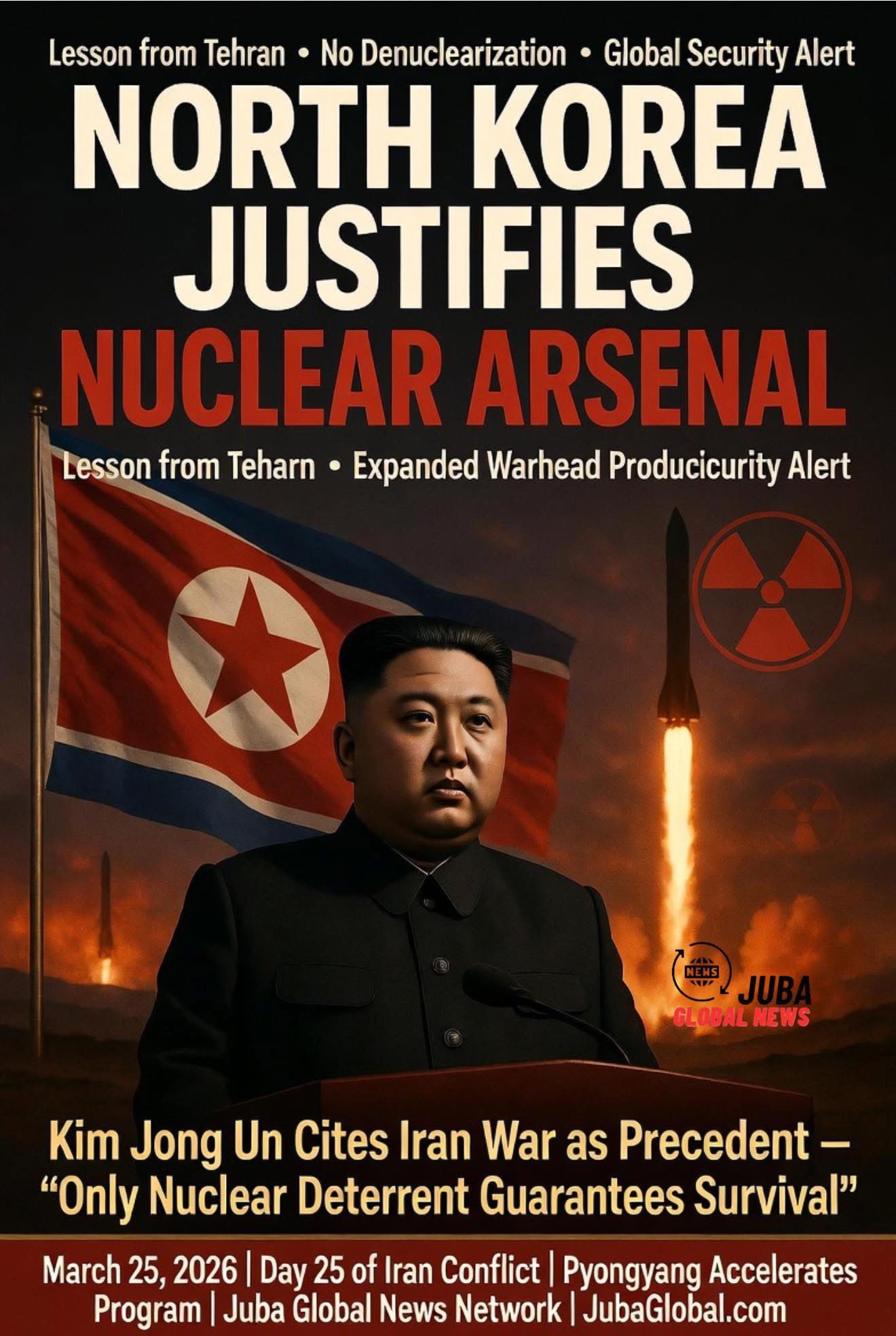
In a strongly worded statement on March 25, 2026, North Korean leader Kim Jong Un cited the ongoing US-Israel military campaign against Iran as direct justification for maintaining and expanding Pyongyang’s nuclear weapons program.
Speaking during a high-level meeting of the Workers’ Party of Korea, Kim declared that the current war in the Middle East proves “the only reliable guarantee of sovereignty and security is a powerful nuclear deterrent.” He pointed to Iran’s vulnerability after decades of forgoing a full nuclear breakout as a cautionary tale for North Korea.
Key Excerpts from Kim’s Statement
According to the official Korean Central News Agency (KCNA):
- “The imperialists are now brutally attacking Iran, which did not possess a complete nuclear force. This is clear proof that giving up nuclear weapons means giving up one’s right to exist.”
- “Our nuclear arsenal is not for negotiation — it is the cornerstone of our eternal security.”
- Kim ordered accelerated production of nuclear warheads and long-range ballistic missiles capable of reaching the continental United States.
North Korean state media published images of Kim inspecting new missile production lines and nuclear facilities, emphasizing that the program would continue “without the slightest hesitation.”
Timing and Strategic Context
The statement comes on Day 25 of the US-Israel-Iran conflict, which began with massive strikes on Iranian nuclear sites, missile bases, and leadership targets. North Korea has closely monitored the war, viewing it as a real-time demonstration of what happens when a nation lacks an operational nuclear deterrent against superior conventional forces.
Pyongyang sees clear parallels:
- Iran’s nuclear facilities were heavily damaged despite years of international diplomacy.
- The US and Israel acted decisively once they perceived an existential threat.
- Even indirect negotiations have not stopped the military campaign.
For Kim Jong Un, the lesson is simple: only a credible, survivable nuclear force prevents such attacks.
North Korea’s Nuclear Posture in 2026
North Korea currently possesses an estimated 50–90 nuclear warheads and is rapidly expanding its arsenal. Recent developments include:
- Successful tests of solid-fuel ICBMs (Hwasong-18 and Hwasong-19).
- Deployment of tactical nuclear weapons along the border with South Korea.
- Advances in submarine-launched ballistic missiles (SLBMs) and hypersonic glide vehicles.
Kim has repeatedly rejected any form of denuclearization, calling previous talks with the United States “a waste of time.”
Reactions from the International Community
- United States: The Trump administration condemned the statement as “dangerous and provocative.” Officials noted that the Iran operation was specifically targeted at a regime actively pursuing nuclear weapons and supporting terrorism, whereas North Korea already possesses them.
- South Korea: Seoul expressed deep concern, calling on the international community to strengthen sanctions and deterrence on the Korean Peninsula.
- China: Beijing urged “restraint on all sides” while privately worrying that heightened tensions could lead to more North Korean provocations, including missile tests over Japan or closer to US bases in the region.
- Russia: Moscow, already aligned with Pyongyang through arms deals and joint military exercises, offered muted support, framing North Korea’s stance as a legitimate response to “US aggression.”
Broader Implications for Global Non-Proliferation
Analysts warn that Kim’s explicit use of the Iran war as justification could undermine international efforts to prevent nuclear proliferation elsewhere. Countries such as Saudi Arabia, Turkey, and even Japan may quietly reassess their own security doctrines if they perceive that nuclear weapons provide the ultimate insurance policy against great-power intervention.
The timing is particularly sensitive because the US is currently engaged in high-stakes negotiations with Iran over a 15-point peace plan that demands complete dismantlement of Tehran’s nuclear infrastructure. North Korea’s statement sends a clear message: once a nation crosses the nuclear threshold, reversing course becomes nearly impossible.
Connection to the Wider 2026 Crises
North Korea’s declaration adds another layer of complexity to an already volatile global security environment:
- Russia continues massive drone and missile attacks on Ukraine.
- The Middle East faces risks of new fronts in Lebanon and the Gulf.
- Energy markets remain unstable due to disruptions in the Strait of Hormuz.
In this context, Pyongyang appears to be opportunistically raising its profile, possibly seeking new concessions or simply reminding the world of its existence as a nuclear power.
What Comes Next?
Intelligence agencies in Washington, Seoul, and Tokyo are closely watching for signs of imminent North Korean provocations — such as a new nuclear test, ICBM launch, or border incident. Any such move could further stretch US military resources already committed to the Middle East.
Kim Jong Un’s latest rhetoric reinforces a long-held belief in Pyongyang: in a world of great-power competition, nuclear weapons are not a bargaining chip — they are survival insurance.
Juba Global News Network will continue to monitor developments on the Korean Peninsula and their intersection with the ongoing conflicts in the Middle East and Ukraine. For live updates and in-depth analysis, visit JubaGlobal.com.
This comprehensive report captures the latest provocative development from Pyongyang. Stay informed with Juba Global News Network.