

Israel Plans Occupation of Southern Lebanon Parts as Hezbollah Exchanges Fire
By Juba Global News Network | JubaGlobal.comMarch 25, 2026 As the US-Israel-Iran war enters its 25th day, Israel is preparing for a potential ground occupa
By Juba Global News Network | JubaGlobal.comMarch 25, 2026
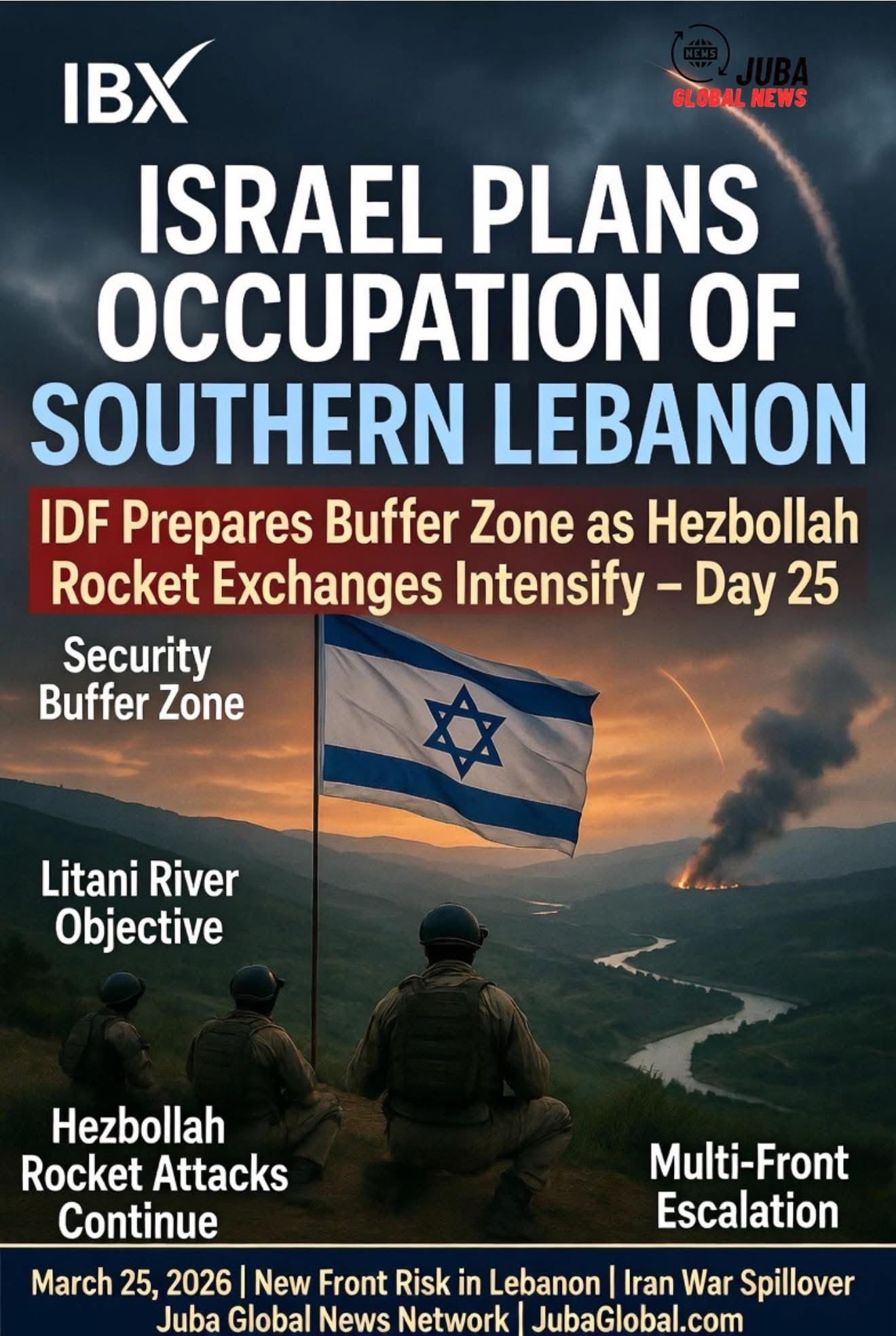
As the US-Israel-Iran war enters its 25th day, Israel is preparing for a potential ground occupation of parts of southern Lebanon, according to senior Israeli officials and military sources. The move comes amid intensified cross-border exchanges with Hezbollah, which has continued to fire rockets and drones into northern Israel in solidarity with Iran.
Israeli Defense Minister Israel Katz signaled the shift in policy, stating that the Israel Defense Forces (IDF) are “preparing for the possibility of occupying parts of southern Lebanon” to create a permanent security buffer zone. This would mark a significant escalation on the northern front, even as the primary focus remains on the Iranian theater.
Background: The Northern Front Heats Up
Hezbollah, Iran’s most powerful proxy, has maintained steady rocket and drone attacks on Israel since the outbreak of the broader conflict on February 28. While the group has avoided all-out war so far, it has increased the tempo of strikes in recent days, targeting Israeli military positions and civilian communities in the Galilee and Golan Heights.
In response, the IDF has conducted hundreds of airstrikes on Hezbollah targets in southern Lebanon, destroying rocket launchers, command posts, and weapons depots. However, Israeli military leaders now argue that airstrikes alone are insufficient to neutralize the threat, especially as Hezbollah continues to receive support and guidance from Tehran.
Details of the Planned Occupation
According to reports from Israeli media and defense officials:
- The IDF is drawing up plans for a limited ground incursion into southern Lebanon, potentially up to the Litani River — a long-standing Israeli security objective.
- The goal is to establish a buffer zone that pushes Hezbollah forces several kilometers away from the Israeli border, preventing rocket fire and infiltration attempts.
- Occupation would likely involve seizing key villages, high ground, and strategic roads used by Hezbollah for resupply and launching attacks.
- Israeli forces would aim to hold the territory until a permanent ceasefire and security arrangements are in place, possibly under international supervision.
Prime Minister Benjamin Netanyahu has reportedly approved preliminary planning, though no final decision for a full-scale invasion has been made. The operation, if launched, would be framed as defensive and temporary, though history shows such “temporary” occupations can last years.
Hezbollah’s Response and Capabilities
Hezbollah has vowed to respond forcefully to any Israeli ground incursion. The group still possesses tens of thousands of rockets, including precision-guided missiles capable of striking deep into Israel. Its fighters are battle-hardened from years of conflict in Syria and previous clashes with Israel.
On March 24–25, Hezbollah launched multiple barrages into northern Israel, triggering sirens in cities such as Haifa and Safed. Israeli air defenses intercepted most projectiles, but some caused damage and minor injuries. Hezbollah leader Hassan Nasrallah has warned that any occupation attempt would turn southern Lebanon into a “graveyard” for Israeli soldiers.
Regional and International Reactions
- Iran: Tehran has publicly encouraged Hezbollah to increase pressure on Israel, describing the Lebanese front as a critical “second front” to relieve military pressure on Iran itself.
- United States: The Trump administration has expressed understanding for Israel’s security needs but is urging restraint to avoid opening a major new front while negotiations with Iran are reportedly advancing.
- Lebanon: The weak Lebanese government has appealed for calm, warning that a new Israeli occupation could destabilize the entire country and trigger a humanitarian crisis.
- United Nations: UNIFIL peacekeepers in southern Lebanon are on high alert, with concerns that their positions could be caught in the crossfire.
Humanitarian Concerns
Southern Lebanon already hosts hundreds of thousands of displaced Lebanese civilians who fled earlier fighting. A new Israeli ground operation would likely cause further mass displacement, damage to infrastructure, and civilian casualties. Aid organizations are preparing for a potential new wave of refugees.
Strategic Calculus for Israel
Israeli leaders face a difficult choice. Continuing only with airstrikes risks allowing Hezbollah to maintain its threat posture indefinitely. Launching a ground occupation, however, carries the risk of a prolonged and costly conflict that could divert resources from the Iranian campaign and stretch the IDF thin across multiple fronts.
The decision may ultimately depend on the progress of US-brokered talks with Iran and whether Hezbollah’s attacks can be sufficiently deterred through other means.
Outlook on Day 25
With Iranian missiles still striking Israeli cities, US paratroopers deploying to the region, and now the threat of a new front in Lebanon, the 2026 Middle East conflict continues to expand in scope and danger.
Whether Israel proceeds with occupation plans in southern Lebanon could determine if the war remains a contained (though intense) confrontation with Iran or spirals into a multi-front regional war involving Lebanon, Syria, and beyond.
Juba Global News Network will continue to monitor developments on the Israel-Lebanon border and provide updates as the situation evolves. For the latest analysis and live coverage of the 2026 Iran war and its ripple effects, visit JubaGlobal.com.
This in-depth report provides comprehensive context on a rapidly developing escalation. Stay informed with Juba Global News Network.