Israeli Airstrikes Pound Beirut Suburbs After Mass Evacuation Warnings – Hezbollah Vows Retaliation
By: Juba Global News Network | JubaGlobal.comMarch 6, 2026 – 04:50 AM EST Update The US-Israel-Iran war, now in its seventh day, has dramatically expanded
By: Juba Global News Network | JubaGlobal.comMarch 6, 2026 – 04:50 AM EST Update
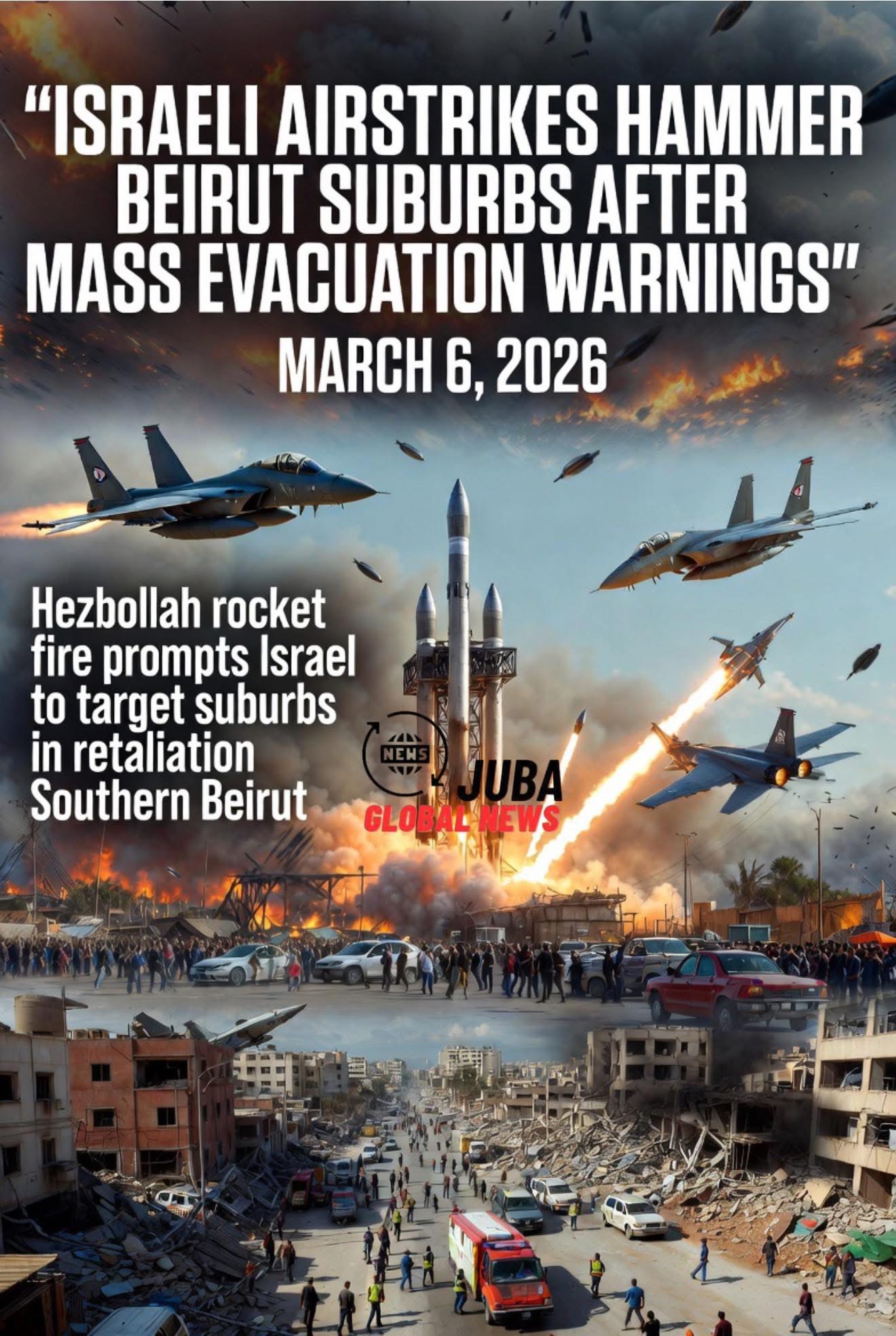
The US-Israel-Iran war, now in its seventh day, has dramatically expanded into Lebanon as Israeli Air Force jets launched a sustained and intense bombing campaign against southern Beirut suburbs and southern Lebanon overnight into early March 6. The strikes followed mass evacuation warnings issued by the Israel Defense Forces (IDF) to tens of thousands of civilians in densely populated Shiite-majority neighborhoods, triggering widespread panic, massive traffic jams, and scenes reminiscent of previous escalations between Israel and Hezbollah.
The Trigger: Hezbollah Activation and Israeli Response
Since the war’s opening hours on February 28, Hezbollah— Iran’s most powerful proxy—has fired hundreds of rockets, missiles, and drones into northern Israel in solidarity with Tehran. While the volume has been lower than in past conflicts, several barrages have penetrated Israeli defenses, causing civilian casualties, fires in Haifa and Kiryat Shmona, and significant disruption.
In response, Israel declared a new phase of operations against Hezbollah infrastructure on March 5. The IDF issued Arabic-language evacuation warnings via phone messages, social media, leaflets, and loudspeaker announcements, ordering residents of Beirut’s southern suburbs (Dahiyeh), parts of the Bekaa Valley, and southern border villages to leave areas “near Hezbollah military sites” within hours.
The warnings cited intelligence indicating Hezbollah was preparing large-scale rocket and drone attacks, storing precision-guided munitions, and operating command centers in civilian buildings. Israel emphasized that “anyone remaining does so at their own risk.”
The Bombardment: Scope and Immediate Impact
Beginning late March 5 and continuing into the early hours of March 6, Israeli F-15I, F-16I, and F-35 aircraft—supported by drones and artillery—struck dozens of targets:
- Underground rocket storage and launch sites
- Command-and-control bunkers
- Weapons production and assembly facilities
- Senior Hezbollah operatives’ residences and meeting points
- Tunnel networks and cross-border infiltration routes
Explosions lit up the night sky over Beirut’s southern suburbs, with thick plumes of smoke rising from Dahiyeh, Haret Hreik, Ghobeiry, and Bourj el-Barajneh. Residents reported multi-story apartment blocks collapsing, fires engulfing vehicles, and streets filled with debris. Lebanese Civil Defense reported at least 47 killed and over 200 injured in the initial waves, with numbers expected to rise as rescue operations continue under blackout conditions and ongoing strikes.
Traffic on major highways out of Beirut became gridlocked as families fled north toward the city center, the mountains, or toward Syria. Many reported running out of fuel, food, and water amid panic buying and communication disruptions.
Hezbollah’s Response and Escalation Threats
Hezbollah Secretary-General Hassan Nasrallah appeared in a pre-recorded video message broadcast shortly after the first strikes, vowing a “harsh and painful” retaliation:
- “The Zionist enemy thinks it can return us to 2006. They will pay a heavy price. Every bomb on Beirut will be answered tenfold.”
- “Our rockets are ready, our fighters are in position. The coming days will prove that the resistance is alive and stronger than ever.”
Within hours, Hezbollah launched multiple barrages—estimated at over 150 projectiles—targeting Israeli military bases, settlements, and energy infrastructure in the Galilee and Golan Heights. Sirens sounded across northern Israel; Iron Dome intercepted most, but several impacts were reported near Haifa’s port and industrial zones.
Analysts note Hezbollah retains a massive arsenal (estimated 130,000–150,000 rockets pre-war, with thousands already fired) including precision-guided Fateh-110 derivatives, drones, and anti-tank missiles. While Israeli preemptive strikes have degraded parts of this inventory, the group’s decentralized structure and underground facilities make complete neutralization difficult.
Regional and Humanitarian Fallout
- Lebanon: Already economically devastated, the country faces a new refugee crisis within its borders. The government appealed for international aid and called for an immediate ceasefire. Power outages worsened as strikes hit electrical substations.
- Israel: Home Front Command extended shelter-in-place orders in the north; schools remain closed; thousands evacuated from border communities.
- International community: The UN, France (former colonial power with strong Lebanon ties), and Arab states urged de-escalation. The US reiterated support for Israel’s right to self-defense but called for “proportionality” and protection of civilians.
Broader War Context
The Beirut strikes represent the most significant direct Israel-Hezbollah confrontation since the 2006 war, now intertwined with the larger US-Israel campaign against Iran. With Iran’s navy largely destroyed, its missile stocks depleted, and leadership in disarray after Khamenei’s assassination, Hezbollah has become Tehran’s primary remaining retaliatory arm.
Whether this front escalates into a full-scale war on two axes—or remains contained as a punishing but limited exchange—will likely shape the next phase of the regional conflict. As smoke still rises over Beirut’s suburbs and sirens echo in northern Israel, the risk of a wider conflagration grows by the hour.
Juba Global News Network continues to follow developments from Reuters, Al Jazeera, BBC, Haaretz, L’Orient-Le Jour, and the Institute for the Study of War. The situation is extremely fluid—rely on verified sources for the latest information. Stay safe and informed.