Israel Holds Off Further Strikes on Iran’s South Pars Gas Field After Trump-Netanyahu Call
By Juba Global News Network
JubaGlobal.com
March 20, 2026
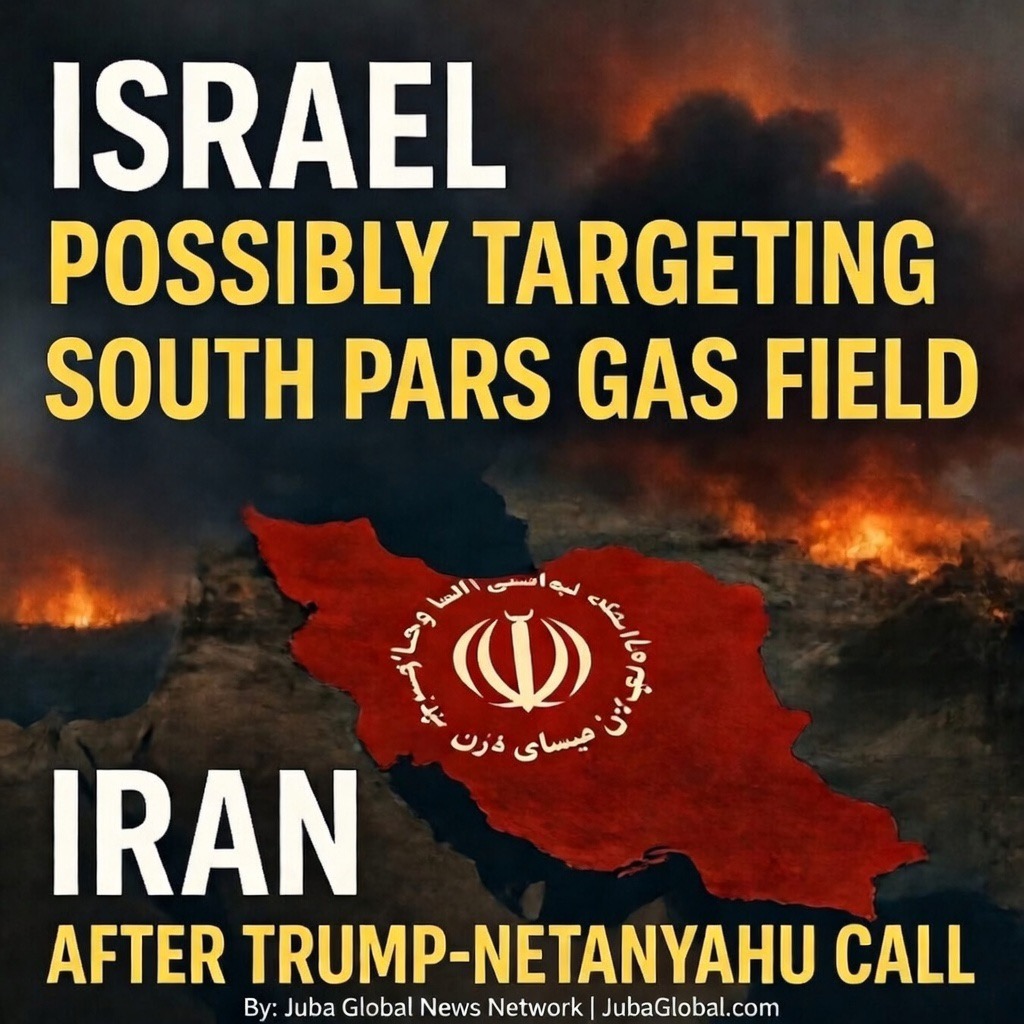
In a dramatic turn amid the intensifying U.S.-Israeli war against Iran, Israeli Prime Minister Benjamin Netanyahu announced late Thursday that Israel would hold off on additional attacks targeting Iran’s critical energy infrastructure, specifically the massive South Pars natural gas field. The decision follows a direct conversation with U.S. President Donald Trump, who reportedly urged restraint to prevent further escalation in global energy markets already reeling from days of tit-for-tat strikes.
The announcement came during a high-profile press conference in Jerusalem, where Netanyahu emphasized that Israel had “acted alone” in its initial strike on the South Pars facilities but would now heed Trump’s request. “President Trump asked us to hold off on future attacks, and we’re holding off,” Netanyahu stated firmly, addressing both domestic audiences and international observers. He rejected suggestions that Israel had “dragged” the United States into deeper involvement, insisting, “Does anyone really think that someone can tell President Trump what to do? I misled no one.”
The Strike That Shook Global Energy Markets
The controversy traces back to Israel’s airstrike on March 18, 2026, targeting processing facilities at Asaluyeh—the onshore hub linked to Iran’s portion of the South Pars/North Field complex, the world’s largest natural gas reserve. Shared between Iran and Qatar, South Pars supplies a significant portion of global liquefied natural gas (LNG) exports, with Qatar alone accounting for roughly 20% of the world’s LNG trade through its adjacent North Field.
Israeli forces struck key infrastructure, igniting fires and temporarily taking units offline. Iranian officials reported damage to multiple processing plants, describing the attack as a direct assault on the nation’s economic lifeline. The strike marked a sharp escalation from earlier phases of the conflict, which began nearly three weeks ago with joint U.S.-Israeli air campaigns targeting Iranian military command structures, ballistic missile sites, and nuclear-related facilities.
President Trump initially distanced the U.S. from the operation, posting on Truth Social that Washington “knew nothing about” the strike and that Israel had acted “out of anger.” He warned, however, that any continued Iranian attacks on allied energy sites—particularly in Qatar—would prompt a severe American response: “The United States of America… will massively blow up the entirety of the South Pars Gas Field at an amount of strength and power that Iran has never seen or witnessed before.”
Conflicting accounts emerged quickly. Israeli officials briefed media that the U.S. had been informed in advance, suggesting coordination despite Trump’s public denial. This apparent discrepancy highlighted potential strains in U.S.-Israeli alignment on war aims, with Trump prioritizing de-escalation on energy fronts to stabilize oil and gas prices, while Netanyahu has hinted at the need for broader measures—including a possible “ground component”—to decisively weaken the Iranian regime.
Iran’s Retaliation and the Energy Shockwave
Iran responded swiftly and ferociously. On March 19, Iranian forces launched missile and drone barrages against energy infrastructure across the Persian Gulf, setting ablaze facilities in Qatar’s Ras Laffan LNG hub, Saudi Arabian refineries, Kuwaiti gas units, and sites in the UAE. QatarEnergy reported “extensive damage,” warning that recovery could take years and severely impacting global LNG supplies.
The attacks sent Brent crude surging to nearly $119 per barrel before easing slightly to around $108 as markets digested Netanyahu’s pledge. Natural gas prices spiked regionally in Europe, Asia, and the U.S., exacerbating fears of prolonged shortages and inflation. The Strait of Hormuz—through which roughly 20% of global oil flows—remains effectively choked by security threats, further amplifying the crisis.
Tehran’s Islamic Revolutionary Guard Corps (IRGC) has vowed “zero restraint” if energy sites face further hits, while regime spokespeople described the South Pars strike as crossing a red line. The IRGC itself suffered a blow with the reported killing of spokesperson Ali Mohammad Naeini in related U.S.-Israeli operations.
Diplomatic Maneuvering and Broader War Context
The Trump-Netanyahu call represents a rare public moment of U.S. pressure on Israel to pull back from energy targeting, even as the broader air campaign continues unabated. Overnight into March 20, Israeli strikes pounded Tehran amid Nowruz celebrations—the Persian New Year—while Iranian missiles impacted northern Israel, and fresh barrages targeted Haifa refineries and other sites.
Trump reiterated no U.S. ground troops would deploy to Iran, focusing instead on air superiority and naval operations to degrade capabilities. Analysts note the energy truce could buy time for diplomacy or de-escalation, but underlying tensions persist: Netanyahu’s comments about regime change requiring boots on the ground contrast with Washington’s more limited objectives.
Global observers warn that continued strikes risk environmental catastrophe in the Gulf, refugee surges into Europe, and wider economic fallout. The UN Security Council is set to address energy security and humanitarian impacts amid the chaos.
As the war enters its third week, the hold on South Pars strikes offers a fragile pause in one theater—but the conflict shows no signs of abating elsewhere. Oil markets remain volatile, and the world watches nervously for Iran’s next move.
For ongoing coverage of the Middle East crisis, visit JubaGlobal.com. Stay informed—because in today’s world, energy is power, and power is at stake.
Juba Global News Network — Reporting from the front lines of global affairs.