

Iran Strikes CIA Station in US Embassy Compound in Riyadh: A Bold Retaliatory Drone Attack Amid Reports of CIA Plans to Arm Kurdish Forces for Regime Change
By Juba Global News Network | JubaGlobal.com March 4, 2026 In a dramatic escalation of the ongoing shadow war between Iran and the United States, a suspect
By Juba Global News Network | JubaGlobal.com
March 4, 2026
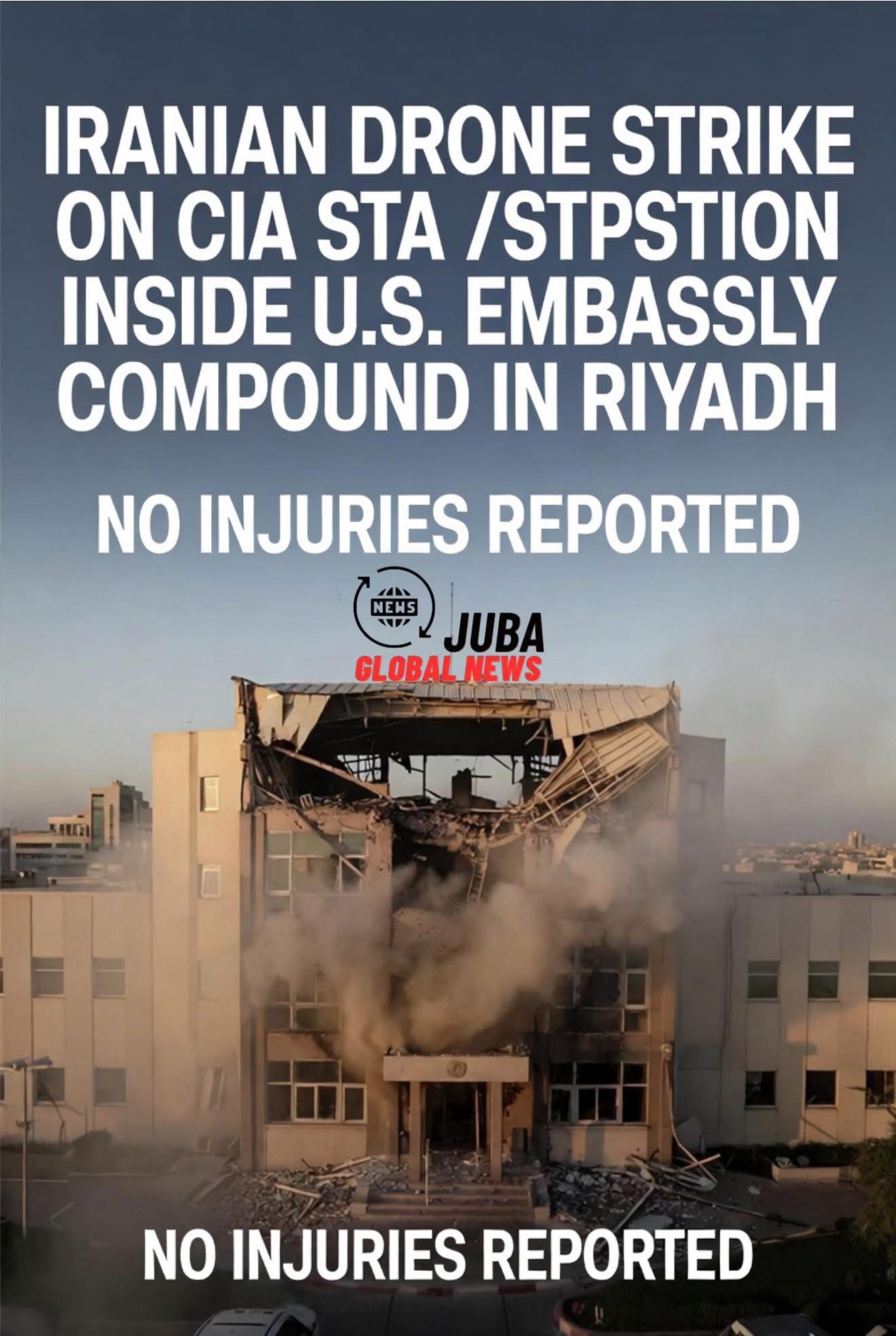
In a dramatic escalation of the ongoing shadow war between Iran and the United States, a suspected Iranian drone strike has targeted the CIA’s station inside the U.S. Embassy compound in Riyadh, Saudi Arabia. The attack, which occurred on Monday, March 3, has sent shockwaves through diplomatic circles and underscored Tehran’s determination to hit back at American intelligence assets following a series of U.S.- and Israeli-led strikes on Iranian soil.
According to multiple U.S. and Saudi sources, two drones slammed into the embassy complex, one of them directly impacting the CIA station. The assault caused significant structural damage, including a partially collapsed roof and heavy smoke filling the interior of the building. Embassy personnel were ordered to shelter in place as emergency responders contained a limited fire. Remarkably, there were no confirmed injuries among CIA staff or other personnel, though the psychological impact and symbolic blow to U.S. prestige are undeniable.
Saudi Arabia’s Defense Ministry quickly confirmed the incident, stating that the U.S. Embassy in Riyadh was struck by two unmanned aerial vehicles (UAVs), resulting in “a limited fire and some material damage.” The U.S. Embassy in Riyadh subsequently issued a security alert, warning Americans to avoid the compound until further notice and canceling all routine and emergency citizen services. A separate alert highlighted ongoing threats of missile and drone attacks in areas like Dhahran.
Retaliation in a Widening Regional War
This strike does not occur in isolation. It forms part of Iran’s rapidly expanding retaliation campaign across the Middle East, triggered by U.S. and Israeli airstrikes that began on February 28. Those operations reportedly targeted high-value Iranian sites, including facilities linked to the Islamic Revolutionary Guard Corps (IRGC), and have been described by some reports as having eliminated key figures in Tehran’s leadership structure. Iran has since unleashed waves of missiles and drones against U.S., Israeli, and Gulf targets, including oil infrastructure in Saudi Arabia, diplomatic compounds in Kuwait, and even a U.S. consulate area in Dubai.
The Riyadh attack is widely viewed as a calculated message to Washington. By hitting a CIA station — a hub for U.S. intelligence operations in the kingdom — Tehran is signaling that it can reach sensitive American assets even in heavily defended allied territory. Analysts note that targeting intelligence facilities is highly unusual and represents a significant escalation, as embassies and spy hubs are traditionally treated as off-limits under international norms. One U.S. official familiar with the matter stated there was “no indication” the CIA station was the intended target, but the precision of the strike suggests otherwise to many observers.
President Donald Trump, speaking shortly after the incident, vowed swift revenge. “You’ll find out soon” what form that retaliation will take, he said, while emphasizing that the U.S. is already inflicting “significant damage” on Iran and is close to achieving its objectives without needing “boots on the ground.” The White House has begun pulling non-essential staff from several Middle Eastern posts, and shipping routes through the Strait of Hormuz remain under threat.
CIA’s Secret Kurdish Strategy Exposed by CNN
The timing of the Iranian strike is particularly striking because it coincides with explosive reporting from CNN revealing that the CIA is actively exploring plans to arm Kurdish forces as part of a broader strategy to ignite an internal uprising against Iran’s central authorities.
According to the investigation, citing multiple people familiar with the plan, the CIA has been working to equip Iranian Kurdish militias — along with Iraqi Kurdish partners — with weapons and support to “foment a popular uprising” inside Iran. The goal is explicit: pin down IRGC security forces in western Iran, create chaos that stretches Tehran’s military thin, and enable unarmed civilian protesters in major cities to rise up without facing the massacres seen during January unrest.
Discussions between the Trump administration and Kurdish leaders have intensified in recent days. President Trump personally spoke with Mustafa Hijri, president of the Democratic Party of Iranian Kurdistan (KDPI), on Tuesday. He also held calls with Iraqi Kurdish officials on Sunday to coordinate potential ground operations. Weapons have reportedly been smuggled toward Kurdish armed groups along the Iraq-Iran border since last summer’s “Twelve-Day War,” and Iranian Kurdish opposition forces are expected to participate in a ground offensive in western Iran “in the coming days.”
A senior Iranian Kurdish official stated that their fighters are preparing to take on Iranian security forces directly, with the aim of making it safer for urban Iranians to protest. U.S. and Israeli warplanes are expected to provide air support, while Israeli strikes on Iranian border outposts have already intensified to lay the groundwork. One U.S. national security analyst described the move as the administration’s attempt to “jump-start the process of Iranians overthrowing the regime.”
However, the plan is not without risks or critics. Former State Department official Jen Gavito warned that empowering armed Kurdish militias could undermine Iraqi sovereignty and set unpredictable forces in motion. Kurdish groups themselves are fractured, with competing ideologies and a deep historical distrust of the U.S. after past perceived abandonments. Iranian intelligence has already responded by striking Kurdish positions with drones on Tuesday.
Historical Parallels and the Danger of Proxy Escalation
This is not the first time the U.S. has looked to Kurdish fighters as proxies. During the fight against ISIS, Washington armed and trained Kurdish forces in Iraq and Syria with great success — only to later withdraw support, leaving allies vulnerable. Tehran has long accused Washington of using Kurdish separatists to destabilize Iran, pointing to groups like the KDPI and PJAK (Party for a Free Life in Kurdistan), which operate from bases in Iraq’s Kurdistan Region.
By publicly linking the Riyadh strike to the CIA’s Kurdish gambit, Iranian state media and officials are framing the attack as preemptive self-defense. “The Americans are openly plotting to dismember Iran through proxies,” one IRGC-affiliated commentator declared on Tuesday. Tehran has also warned Saudi Arabia against allowing its territory to be used as a launchpad for U.S. operations.
Regional Fallout and Global Implications
Saudi Arabia finds itself in a precarious position. Riyadh has maintained a delicate balance since the Abraham Accords and recent diplomatic openings with Iran, yet the kingdom’s airspace and territory are now directly involved. The Defense Ministry’s swift confirmation of the drone strike suggests Riyadh is keen to avoid being dragged deeper into the conflict, but the presence of the CIA station inside its capital leaves little room for neutrality.
Oil markets reacted sharply to the news, with Brent crude jumping more than 4% in early trading on fears of supply disruptions. Shipping companies have begun rerouting vessels away from the Gulf, and several Gulf states — including the UAE, Qatar, and Kuwait — have reported similar low-level drone incidents or heightened alerts.
For the broader Middle East, the convergence of these two stories — the physical strike in Riyadh and the covert CIA plan — signals a dangerous new phase. What began as targeted U.S.-Israeli airstrikes has morphed into a multi-front conflict involving proxy militias, drone swarms, and the very real possibility of ground incursions into Iranian territory.
What Comes Next?
U.S. officials have not confirmed the full extent of the CIA’s Kurdish arming program, and the agency declined comment when asked by major outlets. But sources close to the Trump administration suggest the strategy is already in motion, with weapons flows and intelligence sharing accelerating.
Iran, meanwhile, has mobilized additional IRGC units along its western borders and issued fresh threats against U.S. bases from Iraq to the Arabian Peninsula. Supreme Leader succession remains unclear following the reported death of Ayatollah Ali Khamenei, adding another layer of instability to Tehran’s decision-making.
As smoke still lingers over the damaged U.S. Embassy in Riyadh, one thing is certain: the region stands on the brink of a wider conflagration. The Iranian drone that struck the CIA station was more than a tactical blow — it was a warning that Tehran will not sit idly by while Washington attempts to engineer regime change from afar through Kurdish proxies.
Juba Global News Network will continue to monitor developments as this fast-moving story unfolds. For the latest updates, visit JubaGlobal.com.
