ICC Hands Down Landmark 20-Year Sentence to Ali Kushayb: Justice for Darfur Takes a Major Step Forward
By: Juba Global News Network December 10, 2025 In The Hague’s crowded courtroom today, the International Criminal Court (ICC) handed Sudanese militia leade
By: Juba Global News Network
December 10, 2025
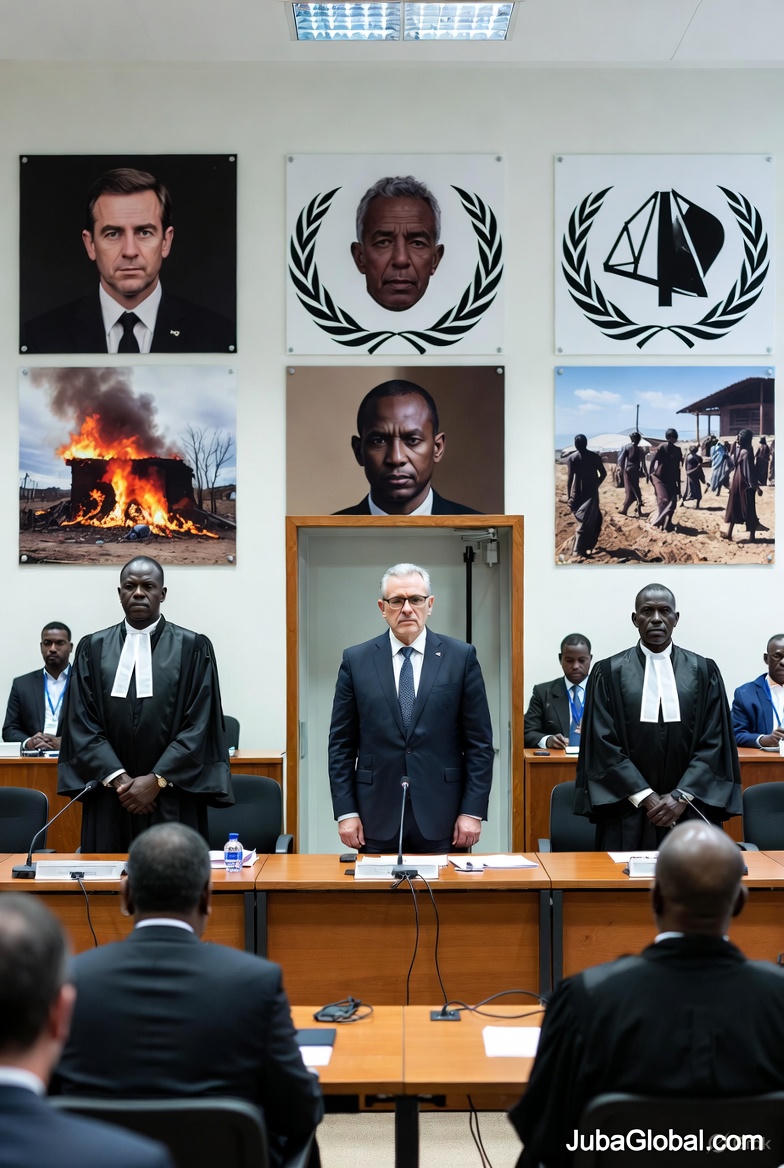
In The Hague’s crowded courtroom today, the International Criminal Court (ICC) handed Sudanese militia leader Ali Muhammad Ali Abd-Al-Rahman—familiarly known as Ali Kushayb—a 20-year prison term for war crimes and crimes against humanity committed in Darfur from 2003 to 2004. Delivered precisely 21 years after the United Nations first referred the Darfur crisis to the ICC, the decision stands as the court’s very first conviction and sentencing over atrocities from Sudan’s darkest era in recent memory.
Presiding Judge Althea Violet Alexis-Windsor stated that Kushayb, once a Janjaweed commander, carried “significant responsibility” in orchestrating a terror campaign that left thousands dead, hundreds of thousands uprooted, and whole communities wiped off the map. While the sentence fell short of the 30 years the Prosecution was pushing for, it’s still the harshest penalty the ICC has meted out so far for Darfur-related crimes.
From Darfur’s Ravaged Villages to The Hague: The Long Road of Case 02/05-01/07
Ali Kushayb’s name first started appearing in United Nations reports back in 2004, with investigators describing him as possibly the most feared Janjaweed commander operating in Wadi Salih and Mukjar areas of West Darfur. Eyewitnesses told UN researchers he personally led assaults on Kodoom, Bindisi, Mukjar, and Arawala, sending fighters to burn homes, execute villagers, rape women and girls, and steal livestock.
In April 2007, ICC Pre-Trial Chamber I issued its very first arrest warrants relating to Darfur, charging Kushayb with 22 counts of war crimes and another 28 counts of crimes against humanity. A second warrant, this time for Sudan’s president at the time, Omar al-Bashir, came in 2009—making Sudan the first place where a sitting head of state was indicted by the ICC.
For thirteen years, Kushayb managed to sidestep justice. He moved freely in Sudan, living in Nyala, then later in Khartoum, even landing some minor government roles under Bashir’s rule. It wasn’t until the 2019 revolution—which ousted Bashir—that transitional authorities, feeling both international and domestic pressure, finally arrested Kushayb in June 2020 up in North Darfur. He was handed over to the ICC later that month.
The Evidence: A Towering Mountain of Survivor Testimony
The trial, which kicked off on April 5, 2022, stretched across 118 hearings, featuring testimony from 52 Prosecution witnesses, 16 for the Defense, and 3 representatives for the victims. Despite Kushayb’s constant denials and his insistence that he was “just a simple farmer,” the Trial Chamber determined there was overwhelming proof he had actually been the de facto leader of thousands of Janjaweed fighters, systematically targeting civilians from the Fur, Masalit, and Zaghawa ethnicities—groups assumed to back the rebel SLM and JEM movements.
Some of the testimony was truly harrowing:
- Survivors from the Kodoom attack (August 2003) described Kushayb personally gunning down civilians lined up outside a mosque.
- Women from Bindisi recalled being raped in front of their families, while Kushayb and his fighters laughed and egged on the assaults.
- One ex-Janjaweed fighter, now an insider witness, testified that Kushayb got his orders straight from Musa Hilal, the infamous Janjaweed commander, and regularly coordinated with Sudanese military intelligence.
The Chamber ended up convicting Kushayb on 30 out of the 31 original charges, including murder, rape, persecution, pillage, and attacks on civilians. He was acquitted on just one count—“other inhumane acts”—because there wasn’t quite enough evidence linking him directly to that particular incident.
The Sentence: 20 Years—But Does It Fit?
When it came time to determine the sentence, judges pointed to the extreme severity of the crimes—calling them “among the most serious known to humanity”—as well as Kushayb’s central part in carrying them out. Aggravating factors included the sheer cruelty of the attacks, the vulnerability of the victims (children and pregnant women among them), and the deep, lasting trauma survivors now live with.
Mitigating factors? His age (around 68), the circumstances of his surrender (which were disputed), and the fact that he’s already spent more than five years in ICC detention.
The 20-year term will be served at the same time as his existing time in custody, so in theory, Kushayb could walk free in about 15 years if he’s granted early release.
Victims’ representatives had mixed feelings. “Twenty years isn’t enough for all the blood he’s spilled,” said Fatima Ahmed, a Darfuri activist who lost fourteen family members in Mukjar. “But this is the first time a Janjaweed leader is actually behind bars. That has to count for something.”
Beyond Kushayb: What’s Next for Darfur and the ICC?
This conviction is only the ICC’s second ever for Darfur crimes (after Ahmad Harun’s 2016 conviction), with fugitives like Omar al-Bashir, Abdallah Banda, and others still at large. The verdict comes at a time when Sudan is, once again, engulfed in war: ongoing conflict between the Sudanese Armed Forces (SAF) and Rapid Support Forces (RSF)—the latter a direct descendant of the Janjaweed—has killed tens of thousands and displaced more than 12 million since April 2023.
Many observers see an unsettling continuity. The RSF, led by Mohamed Hamdan “Hemedti” Dagalo, includes former Janjaweed elements and stands accused of new massacres in Darfur, including ethnic killings in El Geneina during 2023–2024, which the U.S. has labeled genocide.
Mohamed Osman, Human Rights Watch’s Sudan researcher, called the sentence “a stark reminder that the culture of impunity that spawned the RSF must come to an end.” ICC Prosecutor Karim Khan took the opportunity to call on Sudan to surrender the four remaining Darfur suspects—including al-Bashir, who’s still in military custody.
A Message to Survivors—and the Region
In Darfur’s sprawling displaced persons camps—from Nyala to El Fasher and Zalingei—survivors clustered around radios, anxious to hear the verdict. “Today, at long last, our voices were heard after 21 years,” said Adam Ismail, a community leader from Otash camp near Nyala. But the sense of closure wasn’t universal.
“Kushayb was a commander, not the real mastermind,” argued Halima Yakub, who testified against him. “The true architects—Bashir, Harun, Hilal, and now Hemedti—need to face this court, too.”
As the ICC flag flew at half-mast in honor of the hundreds of thousands lost in Darfur, today’s sentence stands as both a historic milestone and a bittersweet reminder: justice delayed is still justice, but for millions of Darfuris, the quest for real accountability is far from over.
For now, Ali Kushayb—the man who once terrified West Darfur—will spend the last years of his life behind bars in The Hague, living proof that even the most feared warlords can be brought to justice. Whether this precedent will actually put a stop to today’s crimes in Sudan and elsewhere remains, honestly, one of the most pressing questions we all face.
© JubaGlobal.com – Reporting truth straight from the heart of Africa.