

General Paul Nang Majok’s Strategic Visit to Heglig: Safeguarding South Sudan’s Lifeline Amid Sudan’s Escalating Civil War
Introduction: A High-Stakes Deployment in a Powder Keg Region On December 10, 2025, as the sun rose over the arid borderlands between South Sudan and Sudan
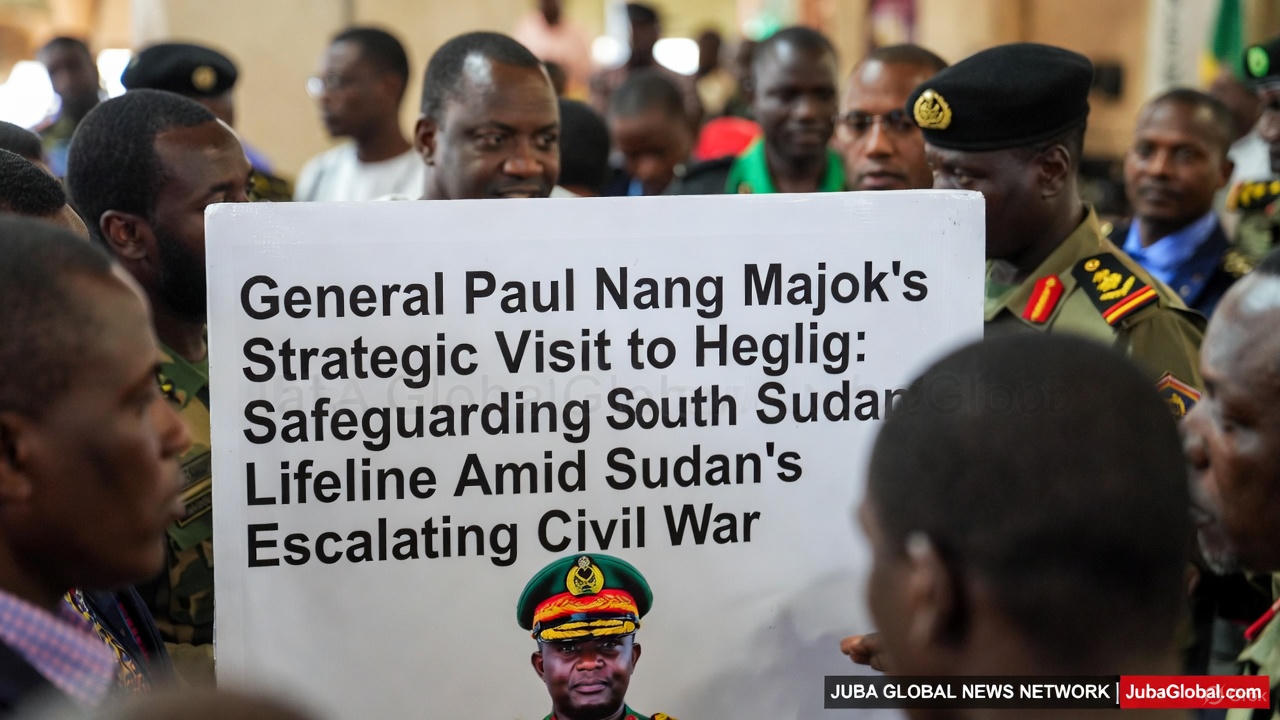
Introduction: A High-Stakes Deployment in a Powder Keg Region
On December 10, 2025, as the sun rose over the arid borderlands between South Sudan and Sudan, General Dr. Paul Nang Majok, the Chief of Defense Forces (CDF) of the South Sudan People’s Defense Forces (SSPDF), stepped onto the dusty soil of Heglig. This unassuming town, nestled in Sudan’s West Kordofan state, is no ordinary frontier outpost. Heglig is the beating heart of the region’s oil economy, home to Sudan’s largest oil processing and export facility, which handles the majority of South Sudan’s crude exports. General Nang’s arrival was not a ceremonial tour but a calculated military maneuver, born out of a tripartite agreement between South Sudanese President Salva Kiir, Sudan’s Transitional Sovereignty Council Chair and Sudanese Armed Forces (SAF) Commander-in-Chief General Abdel Fattah al-Burhan, and Rapid Support Forces (RSF) leader General Mohamed “Hemedti” Dagalo.
The visit underscores a precarious balancing act: protecting vital economic infrastructure from sabotage and collapse while navigating the treacherous fault lines of Sudan’s raging civil war, now spilling perilously close to South Sudan’s borders. In an era where resource control can dictate the survival of nations, Nang’s presence in Heglig symbolizes South Sudan’s resolve to defend its sovereignty, economic stability, and regional influence. This article delves deeply into the multifaceted reasons behind this visit, weaving together historical context, geopolitical imperatives, economic imperatives, security dynamics, and broader implications for the Horn of Africa. At its core, the deployment is a testament to pragmatic diplomacy and military foresight in the face of existential threats.
The Shadow of History: Heglig’s Legacy of Conflict and Oil-Fueled Tensions
To understand why General Nang’s boots hit the ground in Heglig today, one must first rewind the clock to the early 20th century, when colonial cartographers arbitrarily drew lines across Africa’s vast landscapes, often ignoring ethnic, cultural, and economic realities. Heglig, straddling what would become the Sudan-South Sudan border, emerged as a flashpoint long before South Sudan’s independence in 2011. During the Second Sudanese Civil War (1983–2005), the Sudan People’s Liberation Army (SPLA)—the precursor to the SSPDF—fought a grueling guerrilla campaign against the Khartoum regime, with oil fields like Heglig symbolizing both the spoils of war and the fuel for it. Khartoum’s discovery of vast oil reserves in the mid-1970s transformed the region into a strategic prize, drawing billions in investments and arming the conflict with petrodollars.
The 2005 Comprehensive Peace Agreement (CPA) brought a fragile truce, partitioning oil revenues 50-50 between north and south while deferring border demarcation. But Heglig remained a bone of contention. In March 2012, just months after South Sudan’s birth, Juba seized Heglig in a preemptive strike, claiming it as part of its territory under the 2009 Abyei Arbitration ruling. The incursion halted oil production for over a month, costing South Sudan an estimated $800 million in lost revenues—equivalent to half its annual budget at the time. Sudan retaliated with airstrikes, and the brief “Heglig War” ended with Juba’s withdrawal under international pressure. This episode scarred the bilateral relationship, leading to a 15-month oil shutdown that nearly bankrupted South Sudan.
Fast-forward to 2025, and history echoes louder than ever. Sudan’s civil war, ignited in April 2023 between the SAF and RSF, has devolved into a brutal stalemate, with both sides accused of war crimes, ethnic cleansing, and famine-inducing blockades. The RSF’s lightning capture of Heglig on December 9, 2025, after SAF forces fled into South Sudanese territory, wasn’t mere opportunism; it was a masterstroke in resource warfare. 3 By controlling Heglig, the RSF gains leverage over Sudan’s last major functioning oil hub, processing up to 150,000 barrels per day—much of it South Sudanese crude piped north for export via Port Sudan. Production has halted, workers evacuated southward, and the facility teeters on the brink of sabotage. 12 For South Sudan, which relies on these fields for 98% of its export earnings, the stakes are existential. General Nang’s visit is thus a direct response to this historical pattern: when borders bleed and oil flows turn to fire, military intervention becomes the guardian of national survival.
The Immediate Catalyst: RSF’s Seizure and the Tripartite Accord
The spark that propelled Nang to Heglig was the RSF’s audacious takeover on December 8-9, 2025. Amid SAF’s retreat—prompted by RSF advances and a devastating SAF drone strike on RSF positions in Heglig’s Fama area that killed dozens, including tribal leader Hamdan Gar al-Naby—the paramilitaries swept in unchallenged. 3 Eyewitness accounts describe RSF fighters securing the oil separation station, pumping facilities, and export pipelines with alarming speed. For Juba, this was no abstract threat; Heglig’s fall disrupted the Unity-Petroleum Pipeline, which carries 80% of South Sudan’s 160,000 barrels-per-day output northward. Revenues plummeted overnight, exacerbating Juba’s chronic fiscal woes: unpaid salaries for civil servants and soldiers, ballooning debt, and a humanitarian crisis displacing millions.
Enter the tripartite agreement, hammered out in emergency talks involving Presidents Kiir and Burhan, and Hemedti—mediated by undisclosed regional actors, possibly the Intergovernmental Authority on Development (IGAD) or even UAE backchannels, given Hemedti’s Gulf ties. 0 The deal’s essence: mutual withdrawal of SAF and RSF from Heglig to create a neutral zone, with SSPDF forces deploying as interim custodians. Nang’s arrival on December 10 was the operational linchpin, overseeing the influx of South Sudanese troops to fortify perimeters, evacuate remaining personnel, and inventory assets. SSPDF units, already prepositioned under prior joint security pacts, advanced from border garrisons like Pariang and Bentiu, their armored vehicles rumbling through contested scrubland.
This accord isn’t altruism; it’s realpolitik. For Burhan’s SAF, it prevents a humiliating rout and buys time to regroup in Kordofan. For Hemedti’s RSF, withdrawal avoids direct confrontation with SSPDF—South Sudan’s 185,000-strong army, battle-hardened from internal strife—while preserving face as a “stabilizing” force. For Kiir, it’s a lifeline: SSPDF control ensures oil restarts swiftly, potentially within weeks, under Juba’s watchful eye. Nang’s on-site command—coordinating logistics, intelligence, and de-escalation—prevents the RSF from embedding fighters or planting explosives, a tactic they’ve employed elsewhere in Darfur.
Economic Imperatives: Oil as South Sudan’s Economic Oxygen
At the heart of Nang’s mission lies economics, unvarnished and unforgiving. South Sudan, Africa’s youngest nation, is an oil-dependent petrostate: petroleum accounts for 90% of GDP, 98% of exports, and over 60% of government revenue. Heglig isn’t just a Sudanese asset; it’s the nexus of a shared infrastructure forged in the CPA era. Crude from fields like Block 3 (Thar Jath) and Block 5A (Adar Yale) in Unity State flows 1,600 kilometers north through the Greater Nile Petroleum Operating Company (GNPOC) pipeline, processed at Heglig, and shipped from Bashayer on the Red Sea. Transit fees to Khartoum—pegged at $11 per barrel plus 15% of production—net Sudan $500 million annually, but for Juba, any disruption is catastrophic.
The 2012 shutdown taught bitter lessons: GDP contracted 46%, inflation soared to 70%, and food riots erupted in Juba. Today, with Sudan’s war inflating transit costs and global oil prices hovering at $75 per barrel (down from 2022 peaks but volatile amid Middle East tensions), Heglig’s paralysis threatens a repeat. South Sudan’s 2025 budget, already slashed to $2.5 billion amid floods and rebel skirmishes, can’t absorb another hit. Nang’s deployment secures not just pipes and pumps but the fiscal artery feeding social services, military payrolls, and peace dividends under the 2018 Revitalized Agreement on the Resolution of the Conflict in South Sudan (R-ARCSS).
Moreover, this visit advances long-term diversification. Under Nang’s broader mandate—reaffirmed by Kiir in December 2024 to professionalize the SSPDF—securing Heglig buys time for alternatives like the $4.4 billion Lamu Port-South Sudan-Ethiopia Transport (LAPSSET) corridor, which could bypass Sudan entirely. 10 By demonstrating reliability, Juba strengthens ties with TotalEnergies and China National Petroleum Corporation (CNPC), key operators in Blocks 1-5A, potentially unlocking $2 billion in stalled investments.
Security and Military Rationale: Neutralizing Spillover Risks
Security isn’t ancillary; it’s the visit’s gravitational force. Sudan’s war has already metastasized: RSF incursions into White Nile State displaced 50,000 Sudanese refugees into South Sudan’s Upper Nile, straining resources and igniting proxy clashes. In Ruweng Administrative Area—just 50 kilometers from Heglig—Nang visited on December 7, 2025, to quell SPLA-IO ambushes that killed 20 SSPDF soldiers, underscoring border vulnerabilities. 7 Heglig’s seizure amplifies these risks: RSF fighters, battle-tested in Khartoum’s siege, could exploit the field as a staging ground for raids into Unity State, recruiting amid Dinka-Nuer ethnic fissures.
Nang, a Dinka from Lakes State with a PhD in strategic studies, embodies Kiir’s vision for a “transformed” army: disciplined, apolitical, and expeditionary. 10 His Heglig command tests this ethos. SSPDF troops, equipped with Chinese Type 96 tanks and Mi-24 helicopters, establish buffer zones, conduct joint patrols with Sudanese remnants, and monitor drone threats—vital after the Fama strike exposed aerial vulnerabilities. 3 This isn’t occupation; it’s stabilization, aligning with UN Security Council Resolution 2724 (2024), which urges cross-border cooperation against warlordism.
Critics, including SPLA-IO voices, decry it as adventurism, risking entanglement in Sudan’s quagmire. Yet Nang’s open letter responses emphasize sovereignty: “Our borders, forged in martyrs’ blood, shall not yield.” 8 By securing Heglig, he deters RSF adventurism, protects 10,000 South Sudanese workers in the fields, and signals to domestic rebels that Juba prioritizes external threats without neglecting internal peace.
Diplomatic Dimensions: Balancing Alliances in a Fractured Region
Nang’s visit is diplomatic chess. South Sudan, IGAD’s linchpin, walks a tightrope: Kiir’s government-in-exile ties with Burhan clash with Hemedti’s outreach to Riek Machar’s SPLA-IO, who eye Sudanese support. The tripartite deal, welcomed by RSF as a “joint security” boon, thaws frosty Juba-Khartoum relations post-2023 border closures. 3 Nang’s oversight—flanked by advisors from Juba’s Foreign Ministry—facilitates quiet confidence-building: shared intel on RSF movements, humanitarian corridors for Kordofan’s starving masses, and economic pacts to resume fees.
Regionally, it counters Ethiopia’s Red Sea ambitions and Uganda’s anti-RSF stance, positioning South Sudan as a neutral broker. Globally, it nods to U.S. sanctions on Hemedti (for Darfur atrocities) and EU calls for de-escalation, potentially unlocking $1.5 billion in World Bank aid tied to stability. 12 For Nang personally, this burnishes his credentials ahead of 2026 elections, where Kiir’s succession looms.
Broader Implications: A Turning Point for Regional Stability?
General Nang’s Heglig foray could reshape the Horn. If SSPDF holds the line, oil flows resume by January 2026, stabilizing currencies (South Sudan’s pound has depreciated 40% this year) and funding R-ARCSS milestones like army unification. Yet perils abound: RSF non-compliance could ignite firefights, drawing in SPLA-IO opportunists or SAF revenge strikes. Humanitarian fallout—West Kordofan’s collapse, with RSF drones killing 100 in South Kordofan—demands Nang coordinate aid convoys, blending soldier and statesman. 3
In essence, this visit fortifies South Sudan’s precarious peace, proving that in Africa’s resource wars, vigilance is victory. As Nang surveys the humming pumps under SSPDF watch, he embodies a nation’s defiance: Heglig may straddle borders, but its security is indelibly South Sudanese.
Conclusion: Vigilance as Legacy
General Paul Nang Majok’s arrival in Heglig on December 10, 2025, is more than a military footnote; it’s a strategic masterstroke defending economic veins, border integrity, and diplomatic capital. Rooted in history’s scars, propelled by crisis, and aimed at future prosperity, it reminds us that in the Sahel’s shadows, leaders like Nang don’t just react—they redefine resilience. As Sudan burns, South Sudan’s guardian stands firm, ensuring that oil, once a curse, becomes a cornerstone of hope. The world watches: will this deployment avert catastrophe, or ignite it? Only time, and Nang’s resolve, will tell.