France & Allies Plan ‘Defensive’ Mission to Reopen Strait of Hormuz as War Escalates
By Juba Global News Network | JubaGlobal.comMarch 10, 2026 With the US-Israel war against Iran now in its second week and the Strait of Hormuz effectively
By Juba Global News Network | JubaGlobal.comMarch 10, 2026
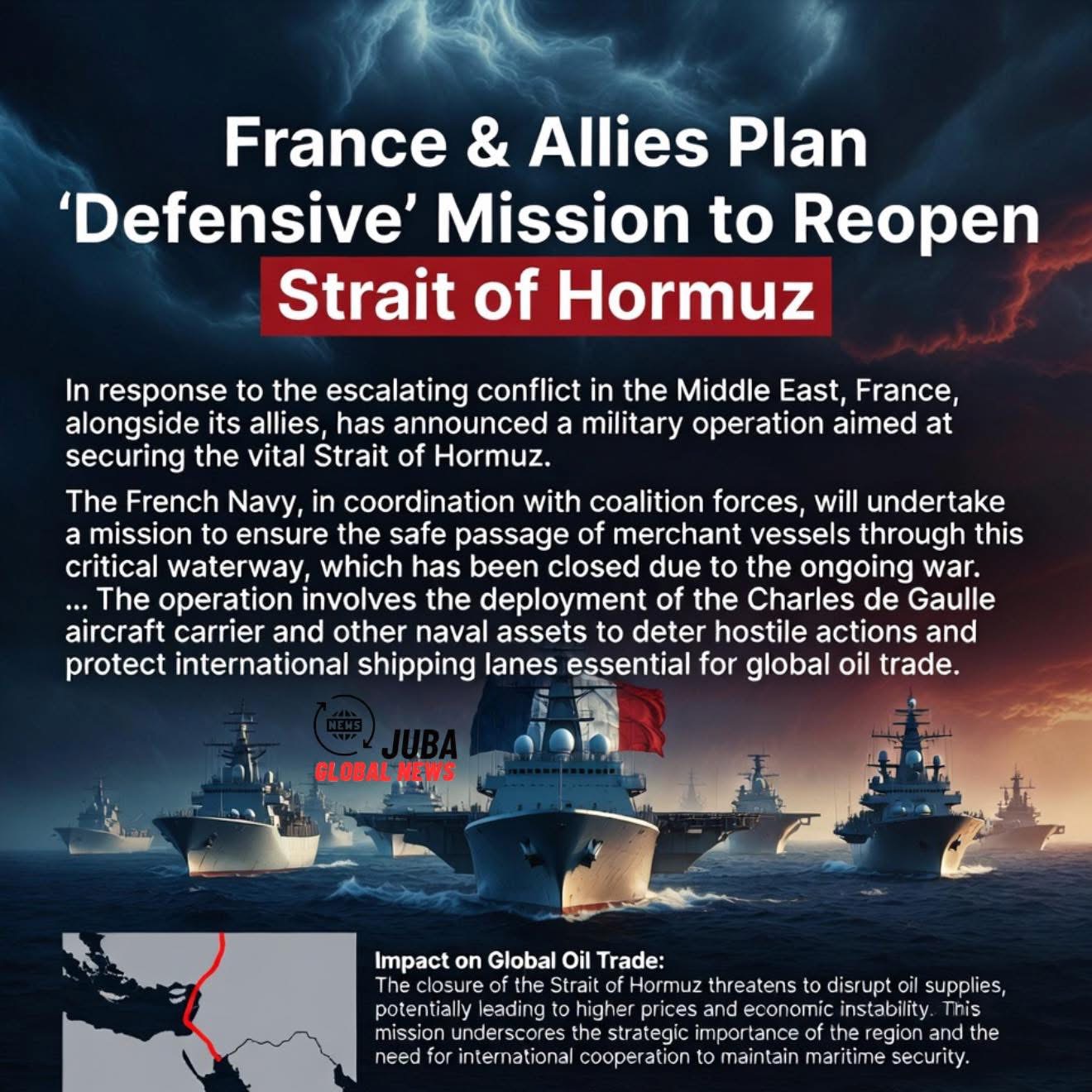
With the US-Israel war against Iran now in its second week and the Strait of Hormuz effectively closed to commercial traffic, French President Emmanuel Macron has announced that France and a coalition of European and non-European allies are preparing a “purely defensive” naval mission to escort vessels and gradually reopen the vital chokepoint. The initiative, described as a supportive effort to restore freedom of navigation, comes amid skyrocketing oil prices, halted tanker transits, and growing fears of a prolonged global energy crisis triggered by the conflict.
Macron’s Announcement: Defensive Escort Operations Ahead
Speaking from a military base in Paphos, Cyprus, on March 9, Macron outlined the mission’s scope during a joint appearance with Cypriot President Nikos Christodoulides and Greek Prime Minister Kyriakos Mitsotakis. He emphasized that the operation would be “purely defensive, purely support,” involving both EU and non-EU states.
“We are in the process of setting up a purely defensive, purely escort mission… whose purpose is to enable, as soon as possible after the most intense phase of the conflict has ended, the escort of container ships and tankers to gradually reopen the Strait of Hormuz,” Macron stated. He stressed the mission’s focus on protecting international trade, ensuring the flow of oil and gas from the Gulf region, and safeguarding allies threatened by spillover from the war.
France is committing significant assets: two frigates specifically for the Hormuz effort, alongside a broader deployment of nearly a dozen warships—including the Charles de Gaulle aircraft carrier strike group, helicopter carriers, and additional frigates—to the eastern Mediterranean, Red Sea, and potentially the Strait itself. The Netherlands has already pledged a frigate at France’s request, signaling early coalition momentum.
The timing is deliberate: escorts would begin only “after the end of the hottest phase of the conflict,” avoiding direct engagement during peak hostilities while preparing for post-escalation stabilization.
Why the Strait Matters: A Global Lifeline at Risk
The Strait of Hormuz, the narrow waterway between Iran and Oman, handles roughly 20-30% of the world’s seaborne crude oil and a substantial share of liquefied natural gas (LNG). Since Iran’s retaliatory actions following initial US-Israeli strikes on February 28—including threats to attack passing vessels and declarations of closure to “hostile” traffic—daily transits have collapsed from over 150 to near zero, according to ship-tracking data from Vortexa and other sources.
This shutdown has triggered the most severe energy supply shock in modern history, with Brent crude briefly surging past $120 per barrel before volatile trading. Global economies face acute risks: soaring import costs for oil-dependent nations, inflation pressures, disrupted supply chains, and potential shortages in fuel and petrochemicals.
Macron framed the mission as essential for continental security, warning that attacks on allies (such as recent Iranian drone strikes on Cyprus, an EU member) constitute threats to all of Europe. He reiterated calls for Iran to cease regional strikes and restore navigation freedom.
Coalition Building Amid Complex Geopolitics
The proposed mission builds on existing European naval efforts, such as the EU’s Aspides operation in the Red Sea, but extends them to the Gulf. France is leading coordination, drawing on its naval presence and diplomatic outreach to Gulf states, including recent calls with leaders from Kuwait, Qatar, Egypt, and Azerbaijan to express solidarity and stress energy security.
Non-EU partners are expected to join, broadening the coalition’s scope and legitimacy. This approach echoes past multinational efforts like the 2019 International Maritime Security Construct (IMSC), but operates in a far more volatile environment with active hostilities.
European leaders remain cautious: the mission is explicitly non-offensive, avoiding entanglement in the core US-Israel campaign. Macron has urged restraint, including warnings against escalation that could draw Europe deeper into the fray.
Challenges and Risks Ahead
Reopening the strait faces formidable hurdles. Iran’s IRGC maintains de facto control over parts of the waterway and has vowed to target any perceived threats. Coalition vessels could face drone swarms, missiles, or mines—risks that demand robust air defense, electronic warfare, and coordination.
Diplomatic channels remain strained: Macron’s recent call with Iranian President Masoud Pezeshkian demanded an end to strikes and Hormuz closure, but Tehran shows no signs of compliance under its new Supreme Leader Mojtaba Khamenei.
If successful, the mission could stabilize energy markets and avert deeper economic fallout. Failure—or escalation—risks turning a regional war into a broader maritime crisis affecting global trade.
As coalition preparations advance and the conflict rages, the world watches whether European-led diplomacy and naval power can restore a critical artery before the energy shock becomes irreversible.
Juba Global News Network will continue monitoring this high-stakes development. For updates on the Iran war, energy markets, and international responses, visit JubaGlobal.com.
Sources: Aggregated from Reuters, France 24, Al Jazeera, Le Monde, EUobserver, The National, and official statements as of March 10, 2026.