European Leaders Prepare ‘Unflinching’ Response to Trump’s Greenland Gambit: A United Front Emerges at Davos
By: Juba Global News Network | JubaGlobal.com January 21, 2026 In the crisp, snow-laden air of Davos, Switzerland, the World Economic Forum has transformed
By: Juba Global News Network | JubaGlobal.com
January 21, 2026
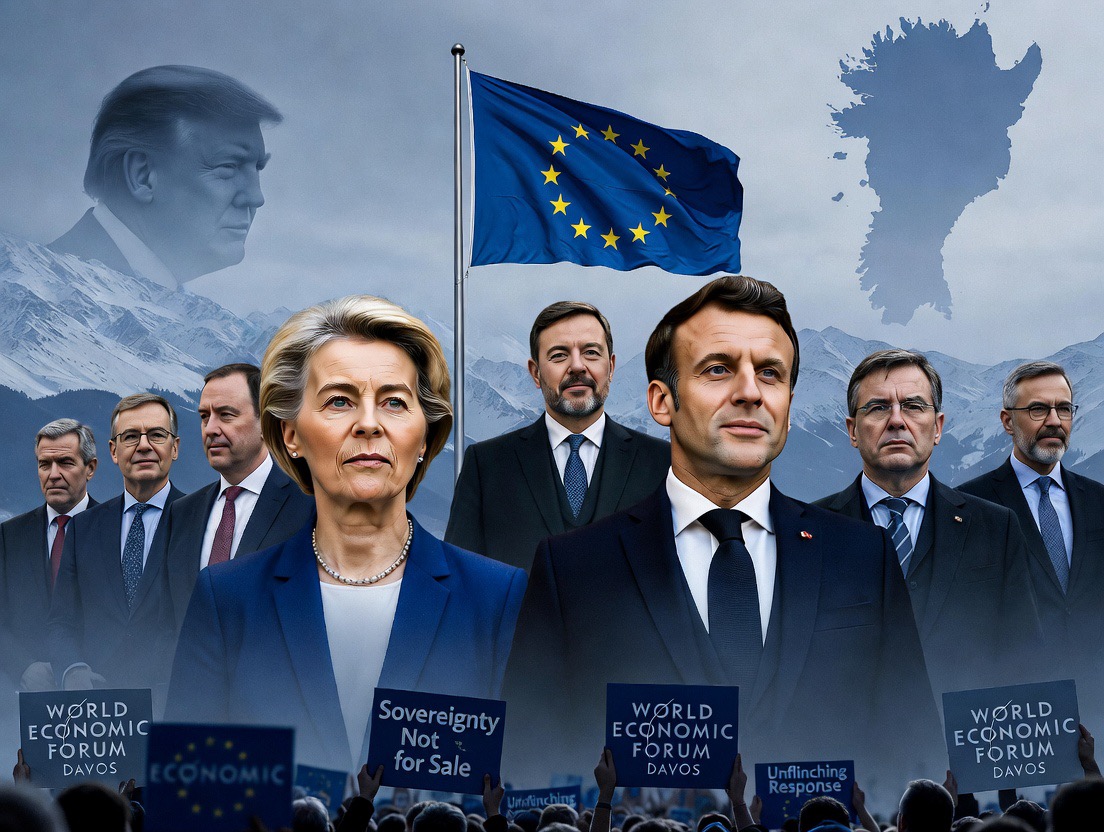
In the crisp, snow-laden air of Davos, Switzerland, the World Economic Forum has transformed from a routine gathering of global elites into a high-stakes diplomatic arena. At the center of the storm is U.S. President Donald Trump’s aggressive campaign to secure American control over Greenland, the vast Arctic territory under Danish sovereignty. What began as renewed interest in acquiring the island for strategic and resource reasons has escalated into explicit threats of tariffs against European allies, prompting a rare display of unity among EU leaders and their partners.
European Commission President Ursula von der Leyen delivered one of the most direct rebukes yet during her keynote address at the forum. Describing Trump’s proposed tariffs—set to begin at 10% on February 1 and potentially rise to 25% by June—as “a mistake, especially between long-standing allies,” von der Leyen emphasized that “a deal is a deal.” She referenced the U.S.-EU trade agreement finalized last July, insisting it must hold meaning in practice. “We consider the people of the United States not just our allies, but our friends,” she stated. “Plunging us into a downward spiral would only aid the very adversaries we are both so committed to keeping out of the strategic landscape.”
Von der Leyen went further, vowing that the EU’s response would be “unflinching, united, and proportional.” She declared full solidarity with Greenland and the Kingdom of Denmark, affirming that their sovereignty and territorial integrity are “non-negotiable.” In a clear signal of escalation preparedness, she announced plans for a “massive” increase in European investments in Greenland to bolster its economic resilience and Arctic security cooperation—implicitly countering U.S. pressure by strengthening ties without conceding ground.
French President Emmanuel Macron echoed this resolve with characteristic bluntness. Speaking at the forum, Macron warned of a dangerous shift toward “a world without rules,” criticizing what he called a “new colonial approach” and “useless aggressivity” in Trump’s tactics. He highlighted the risks of an “endless accumulation of new tariffs” used as leverage against territorial sovereignty, adding that such measures undermine decades of trans-Atlantic collaboration. Macron did not shy away from mentioning the EU’s powerful “anti-coercion instrument”—often dubbed the trade “bazooka”—suggesting Europe should not hesitate to deploy it if necessary to defend against economic bullying from its closest partner.
The backlash extends beyond Brussels and Paris. Leaders from the eight nations targeted by Trump’s tariff threats—Denmark, Norway, Sweden, France, Germany, the United Kingdom, the Netherlands, and Finland—issued a joint statement of solidarity with Denmark and Greenland. They reaffirmed their commitment to principles of sovereignty and territorial integrity, expressing readiness for dialogue but firm opposition to coercion. Danish officials, including Prime Minister Mette Frederiksen, have labeled the episode a “dark chapter,” while Greenland’s own leaders and residents have repeatedly rejected any notion of U.S. annexation, viewing it as a threat to their self-determination.
Behind the scenes, NATO Secretary General Mark Rutte has engaged directly with Trump, seeking to compartmentalize the dispute and preserve alliance unity amid ongoing challenges like the war in Ukraine. European foreign policy chief Kaja Kallas stressed that the bloc is “not interested in picking a fight” but will “hold our ground.” UK Foreign Secretary Yvette Cooper called the threats “no way to treat allies,” underscoring the broader concern that economic pressure on partners could fracture NATO at a vulnerable moment.
The Greenland controversy revives Trump’s 2019 proposal to purchase the island, once dismissed as whimsical but now pursued with far greater intensity. Administration officials frame it as essential for U.S. national security—pointing to Greenland’s strategic location, rare earth minerals, and role in countering Russian and Chinese Arctic ambitions. Yet European counterparts argue that coercive tactics risk alienating allies precisely when collective strength is needed most.
As sideline meetings unfold in Davos, the atmosphere remains charged. U.S. Treasury Secretary Scott Bessent has urged calm, telling counterparts to “take a deep breath” and avoid “hysteria,” while suggesting the tariffs are leverage for negotiation rather than inevitability. Trump himself has agreed to discussions on Greenland but insists there is “no going back,” posting provocative social media content—including an image of himself planting an American flag on the island and sharing private messages from leaders like Macron and Rutte.
For Europe, the stakes are existential: defending sovereignty against a powerful ally while avoiding a full-blown trade war that could harm economies already grappling with inflation, energy transitions, and geopolitical instability. Von der Leyen’s call for a “new form of European independence” reflects a growing sentiment that the continent must reduce vulnerability to unilateral actions from Washington.
Whether Davos yields de-escalation or further entrenchment remains uncertain. What is clear is that Trump’s Greenland gambit has forced Europe’s leaders into rare, coordinated defiance—signaling that even the closest alliances have red lines. As the forum continues, the world watches to see if diplomacy can prevail over brinkmanship, or if this surreal crisis marks the beginning of a deeper rift in the trans-Atlantic order.
Juba Global News Network will provide ongoing coverage from Davos. For real-time developments, visit JubaGlobal.com.