

Coordinated Suicide Bombings Devastate Maiduguri: At Least 23 Dead, Over 100 Injured in Renewed Jihadist Assault on Nigeria’s Northeast
On the evening of March 16, 2026, the northeastern Nigerian city of Maiduguri—long the epicenter of one of Africa’s most enduring insurgencies—was rocked b
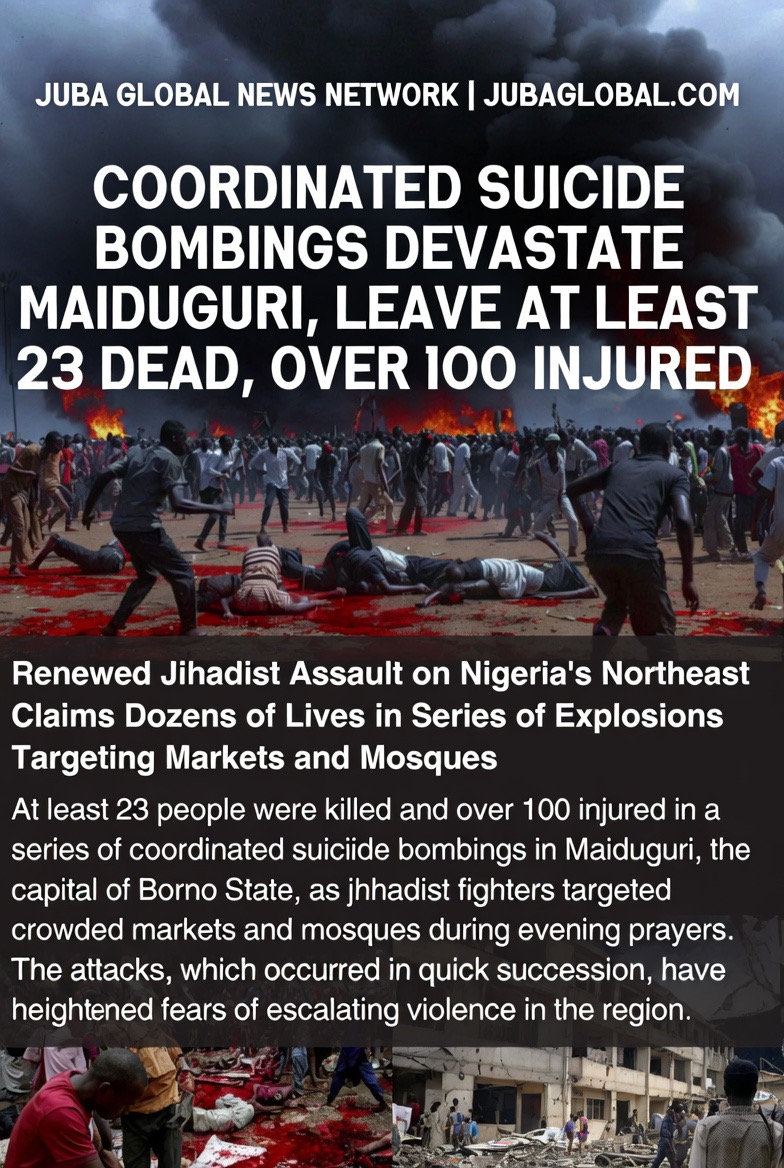
On the evening of March 16, 2026, the northeastern Nigerian city of Maiduguri—long the epicenter of one of Africa’s most enduring insurgencies—was rocked by a series of coordinated suicide bombings that claimed at least 23 lives and wounded more than 100 others. The attacks, which unfolded in quick succession around 7:30 p.m. local time during the breaking of the Ramadan fast (iftar), targeted crowded civilian sites: the entrance to the University of Maiduguri Teaching Hospital (UMTH), the bustling Monday Market, and the Post Office area in the city center. The blasts marked one of the deadliest incidents in Maiduguri in recent years, shattering the fragile sense of relative security the city had regained after years of relentless violence.
Eyewitnesses and security officials described a terrifying sequence. The first explosion detonated near the hospital entrance, where patients, visitors, and staff were present amid evening routines. Minutes later, blasts ripped through the Monday Market—Maiduguri’s largest trading hub—and the nearby Post Office hub, both packed with people shopping, trading, and heading home after iftar. Some reports mentioned a possible fourth site in the eastern Kaleri neighborhood, though official tallies focused on the three primary locations.
Borno State Police spokesperson Nahum Kenneth Daso confirmed the toll: 23 confirmed dead and 108 injured with varying degrees of severity. Victims were rushed to UMTH (ironically one of the targeted sites), Umaru Shehu Specialist Hospital, and Maiduguri Specialist Hospital. Emergency responders from Nigeria’s National Emergency Management Agency (NEMA) and security forces cordoned off the areas, conducting sweeps for secondary devices while ambulances ferried the wounded through chaotic streets.
Preliminary investigations pointed unequivocally to suicide bombings. Police stated the incidents were “carried out by suspected suicide bombers,” with attackers using explosive devices concealed on their bodies or in containers. One security guard at the hospital recounted how three suspicious individuals on a motorbike approached; after being turned away, they returned and hurled two food containers that exploded, injuring him severely. The coordinated nature—multiple sites hit almost simultaneously—suggested a planned operation aimed at maximizing casualties and terror in densely populated civilian zones.
While no group has officially claimed responsibility, suspicion immediately fell on jihadist factions operating in the Lake Chad Basin region. Nigerian military spokesman attributed the attacks to Boko Haram, the notorious Islamist insurgency founded in Maiduguri in 2002. Analysts noted the tactics align with patterns used by Boko Haram’s core faction (Jama’atu Ahl al-Sunnah lid-Da’wati wal-Jihad, or JAS) under leaders like Aliyu Ngulde, as well as possible involvement from splinter groups like the Islamic State West Africa Province (ISWAP). The attacks follow a resurgence of urban violence, including a December 2025 suicide bombing that signaled insurgents’ renewed ability to strike deep in Maiduguri despite military pressure pushing them toward rural areas.
The bombings represent a stark setback for Nigeria’s counter-insurgency efforts. Since the insurgency’s peak in the mid-2010s—when Boko Haram controlled swathes of territory, abducted schoolgirls in Chibok, and carried out frequent suicide attacks in Maiduguri—the city had seen improved security. Multi-national joint task forces, Nigerian military operations, and international support (including U.S. assistance) had displaced fighters to remote Sambisa Forest and Lake Chad islands, reducing large-scale urban assaults. Yet persistent low-level attacks, abductions, and ambushes continued, and this latest wave indicates jihadists retain sleeper cells and the capacity for spectacular operations.
The human cost was immediate and profound. Families mourned loved ones lost in ordinary evening activities—shopping for groceries, seeking medical care, or simply commuting home. One survivor recounted losing four children in the market blast. The attacks during Ramadan amplified the outrage, as they targeted a time of communal reflection and family gatherings in a predominantly Muslim region.
Politically, the incident prompted swift responses. President Bola Tinubu condemned the “barbaric” acts and ordered the deployment of additional security forces to Maiduguri, including top defense chiefs who visited the city days later. Borno Governor Babagana Umara Zulum expressed deep condemnation and pledged support for victims. Yet the attacks underscore ongoing challenges: porous borders with Chad, Cameroon, and Niger facilitate arms flows; intelligence gaps allow infiltrations; and humanitarian crises in displacement camps fuel recruitment.
For Maiduguri’s resilient residents—many of whom have endured over a decade of fear, displacement, and loss—the bombings revived nightmares of the insurgency’s darkest days. Markets that had begun to thrive again fell silent, hospitals strained under the influx of casualties, and security checkpoints multiplied overnight. As investigations continue and funerals proceed, the question looms: can Nigeria’s security apparatus prevent further escalation, or is this the harbinger of a renewed urban jihadist campaign?
In a conflict that has killed tens of thousands and displaced millions since 2009, these 23 lives lost serve as a grim reminder that peace in Nigeria’s northeast remains fragile—and jihadist resilience far from broken.
