

Cocaine Trafficking Routes Increasingly Pass Through West Africa to Europe: Report Warns of Growing Role as a Transit Hub Amid Sahel Instability
West Africa has quietly but rapidly emerged as one of the world’s most important cocaine transit corridors to Europe. A major new report released in early
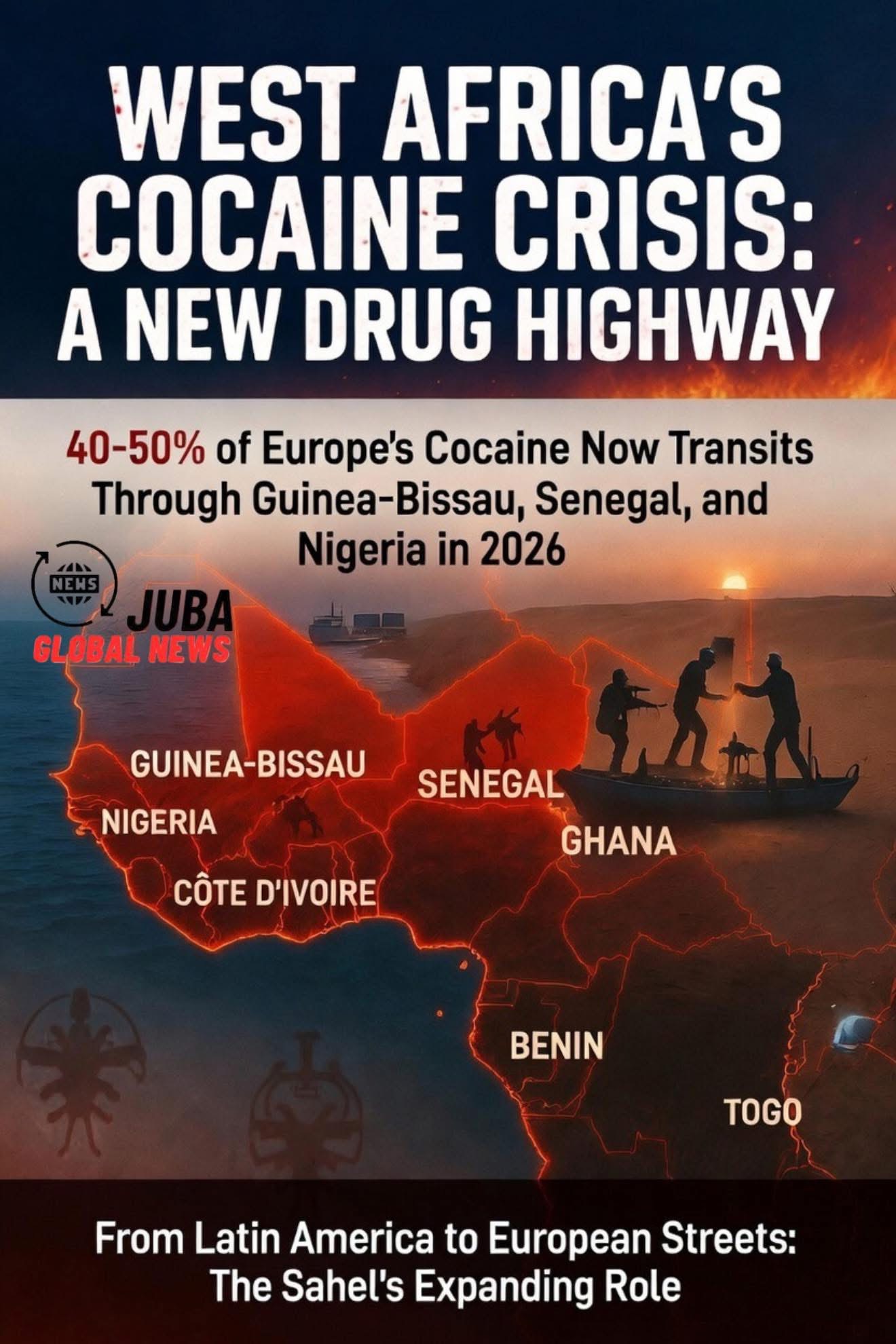
West Africa has quietly but rapidly emerged as one of the world’s most important cocaine transit corridors to Europe. A major new report released in early 2026 by the United Nations Office on Drugs and Crime (UNODC) and corroborated by Europol, the U.S. Drug Enforcement Administration (DEA), and regional intelligence agencies paints a stark picture: cocaine flows through the region have surged dramatically in recent years, turning fragile coastal and Sahelian states into critical nodes in the global drug trade.
The 2025–2026 UNODC World Drug Report and follow-up assessments estimate that up to 40–50% of the cocaine reaching Europe now transits through West Africa — a sharp increase from less than 10% a decade ago. Guinea-Bissau, Senegal, Côte d’Ivoire, Ghana, Nigeria, Benin, and Togo have become primary entry and staging points, with maritime, air, and overland routes feeding the lucrative European market.
How the Route Works: From Latin America to European Streets
The journey typically begins in Colombia, Peru, or Ecuador — the world’s top cocaine producers. Large maritime shipments (often hidden in legal cargo containers, fishing vessels, or “mother ships” that transfer loads to smaller boats mid-ocean) head across the Atlantic toward the Gulf of Guinea. Smaller, faster go-fast boats or fishing trawlers then ferry multi-ton loads to poorly monitored beaches, fishing ports, or river estuaries.
Once ashore, cocaine is broken into smaller consignments and moved north by land (through Burkina Faso, Mali, or Niger toward North African coasts) or hidden again in legitimate exports — cocoa beans, timber, cashew nuts, seafood, or even scrap metal — bound for European ports like Rotterdam, Antwerp, Le Havre, or Algeciras.
Air couriers remain active, especially Nigerians and Ghanaians swallowing pellets or concealing packages in luggage, but maritime routes now dominate due to sheer volume. Europol’s 2025 Cocaine Insights report noted record seizures: over 300 tonnes of cocaine intercepted in Europe in 2024–2025, with West African links in the majority of large maritime cases.
Why West Africa? Geography, Corruption, and Instability
Several factors make the region ideal:
- Geography: Long, largely unpatrolled coastlines (Guinea-Bissau alone has over 350 islands and creeks), porous land borders, and proximity to major shipping lanes.
- Weak Governance & Corruption: Multiple military juntas (Mali, Burkina Faso, Niger) and political instability have eroded law enforcement and border control. Bribes are cheap and officials often complicit.
- Sahel Jihadist Overlap: Armed groups like JNIM and ISSP increasingly tax or protect drug convoys for revenue, creating symbiotic relationships. Some reports indicate fighters provide “security” for traffickers in exchange for weapons or cash.
- Economic Desperation: High youth unemployment and poverty make recruitment of low-level couriers, drivers, and stash-house operators easy.
- Proximity to Europe: Shorter sea routes compared to the Caribbean reduce transit time and risk.
Guinea-Bissau remains the epicenter — often called Africa’s first “narco-state.” Despite political turmoil, the country saw massive maritime offloads in 2025, with several multi-ton seizures linked to local elites and security forces. Senegal and Côte d’Ivoire have seen sharp increases in port and beach landings, while Nigeria’s Lagos port remains a major exit point for containerized shipments.
The Human and Security Toll
The consequences are devastating:
- Violence & Intimidation: Cartels and local gangs assassinate journalists, judges, and honest police officers. In 2025, several high-profile murders in Guinea-Bissau and Senegal were linked to drug disputes.
- Corruption Cascade: Drug money infiltrates politics, judiciary, and security forces, undermining already fragile institutions.
- Local Drug Use Surge: Crack cocaine and “kush” (a synthetic drug cocktail) epidemics are exploding in urban areas, overwhelming health systems.
- Funding Insurgency: UN and DEA assessments warn that cocaine profits now help finance jihadist groups in the Sahel, creating a dangerous nexus between narco-trafficking and terrorism.
- Displacement & Exploitation: Fishing communities are coerced into smuggling; migrants are used as drug mules.
International Response: Too Little, Too Late?
Efforts to counter the flow remain fragmented. The U.S. DEA, Europol, and INTERPOL have increased joint operations (e.g., Operation Lionfish), leading to several high-profile arrests and seizures. The EU’s Cocaine Route Programme and UNODC’s Container Control Programme train port officials and improve scanning technology.
Yet challenges persist: limited regional cooperation, underfunded law enforcement, and the sheer scale of maritime traffic make interdiction difficult. Experts call for a multi-pronged approach — stronger port security, anti-corruption measures, alternative livelihoods for coastal communities, and tackling demand in Europe.
A Tipping Point for West Africa
As cocaine routes solidify through West Africa, the region stands at a dangerous crossroads. What began as a transit corridor risks becoming a deeply entrenched criminal economy with profound implications for governance, security, and public health.
Without decisive, coordinated action — from producer countries in Latin America to consumer markets in Europe — West Africa could slide further into the grip of transnational organized crime, with ordinary citizens bearing the heaviest burden.
The red dirt roads and turquoise coasts that once symbolized hope now carry a darker cargo — one that threatens to destabilize an already fragile sub-region for generations to come.
Juba Global News Network | March 2026
