Catastrophe in the Mud: Over 200 Dead in Rubaya Coltan Mine Collapse Highlights Deadly Risks in Eastern DRC’s Conflict-Ridden Mining Sector
By: Juba Global News Network | JubaGlobal.com February 1, 2026 – Forest Hills, Michigan (via wire reports from Goma, DRC) In one of the deadliest mining di
By: Juba Global News Network | JubaGlobal.com
February 1, 2026 – Forest Hills, Michigan (via wire reports from Goma, DRC)
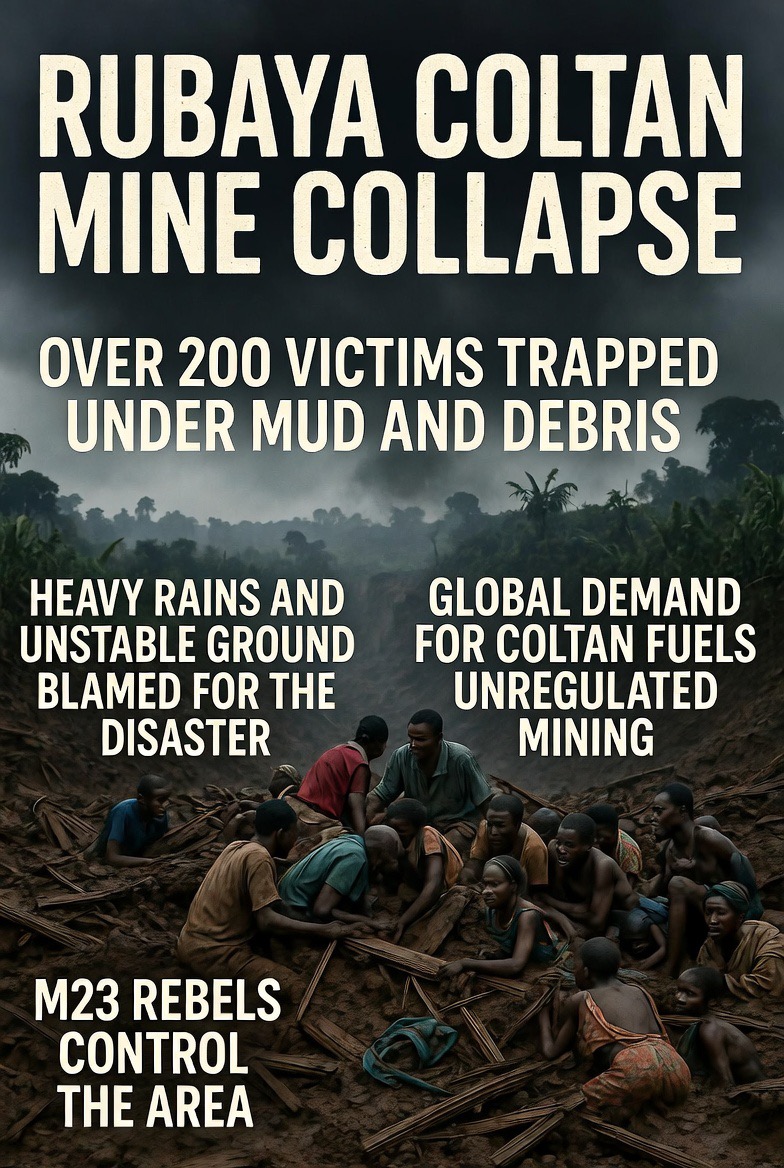
In one of the deadliest mining disasters in recent memory, more than 200 people—miners, children, market women, and others—lost their lives this week when heavy rains triggered a massive landslide that collapsed multiple artisanal mining pits at the Rubaya coltan site in North Kivu province, eastern Democratic Republic of the Congo (DRC).
The tragedy unfolded on Wednesday, January 28, 2026, when days of torrential seasonal rains saturated the slopes surrounding the Rubaya mining area, located about 60 kilometers (37 miles) northwest of Goma, the provincial capital. The landslide buried several hand-dug pits and tunnels, trapping victims under tons of mud and debris. Rescue efforts have been hampered by unstable ground, ongoing rain, and the remote, conflict-affected location.
Lumumba Kambere Muyisa, spokesperson for the rebel-appointed governor of North Kivu, confirmed the scale of the loss on Friday, January 30. “More than 200 people were victims of this landslide, including miners, children and market women,” he told Reuters. “Some people were rescued just in time and have serious injuries.” He added that approximately 20 injured survivors were receiving treatment in local health facilities, with plans to transfer the more seriously wounded to hospitals in Goma. An adviser to the governor, speaking anonymously, put the confirmed death toll at least at 227, with some bodies still unrecovered beneath the mud as of late Friday.
The Rubaya mines are a critical node in the global supply chain for coltan (columbite-tantalite), a mineral essential for manufacturing capacitors in smartphones, laptops, gaming consoles, and other electronics. The site is estimated to produce around 15% of the world’s coltan supply and roughly half of the DRC’s total deposits. Yet, like much of eastern Congo’s artisanal mining sector, operations at Rubaya are largely unregulated, informal, and extremely hazardous.
Artisanal miners—often working without safety equipment, proper supports, or engineering oversight—dig narrow tunnels and pits by hand. A single collapse can cascade across multiple sites, as was the case here. Former miners and local observers have long warned that poor maintenance, over-exploitation, and lack of oversight make such incidents almost inevitable during the rainy season.
Compounding the human tragedy is the political reality on the ground. The Rubaya mining area has been under the control of the M23 rebel group (March 23 Movement), backed by Rwanda according to multiple UN reports and Western governments (allegations Kigali denies), since 2024. The M23-affiliated authorities appointed the provincial governor whose office issued the statements on the disaster. The United Nations and human rights groups have repeatedly documented how mineral revenues from sites like Rubaya help finance armed groups, perpetuating cycles of violence and instability in North Kivu and neighboring provinces.
In response to the collapse, the rebel-appointed administration has suspended artisanal mining activities in the immediate area and ordered residents living near the site to relocate for safety. However, critics question whether these measures will be enforced or if mining will resume quickly once the ground stabilizes—driven by economic desperation and the high value of coltan on international markets.
This disaster is far from isolated. Eastern DRC has seen numerous deadly mining incidents in recent years, often linked to the same combination of weak regulation, conflict, poverty, and environmental pressures. In 2025 alone, several smaller collapses and tunnel floods claimed dozens of lives across North and South Kivu. The Rubaya event stands out for its scale, underscoring how the global demand for “conflict minerals” intersects with local suffering.
International organizations, including the UN’s Group of Experts on the DRC, have called for stricter supply-chain due diligence, traceability programs, and investment in safer, formalized mining practices. Yet progress remains slow. Many electronics companies and consumers continue to rely on coltan whose origins are difficult to verify, even as reports like this one highlight the human cost.
Survivors, families of the deceased, and local communities now face not only grief but also the loss of livelihoods in an area where mining is often the only viable income source. Aid groups are mobilizing to provide emergency support, but access remains challenging due to ongoing insecurity.
As search and recovery operations continue amid unstable conditions, the Rubaya collapse serves as a grim reminder of the intertwined crises in eastern Congo: conflict, environmental vulnerability, exploitative labor, and the global appetite for the minerals that power modern life.
Juba Global News Network will continue to monitor developments and provide updates as more details emerge.
Sources: Reuters, BBC, The Guardian, Al Jazeera, DW, Associated Press, and local statements from North Kivu authorities.