

BREAKING: Eight NATO Countries Targeted by Trump over Their Stance on Greenland Have Issued a Joint Statement
By Juba Global News Network | January 18, 2026 | JubaGlobal.com In a rapidly escalating diplomatic crisis that has shaken the foundations of the transatlan
By Juba Global News Network | January 18, 2026 | JubaGlobal.com
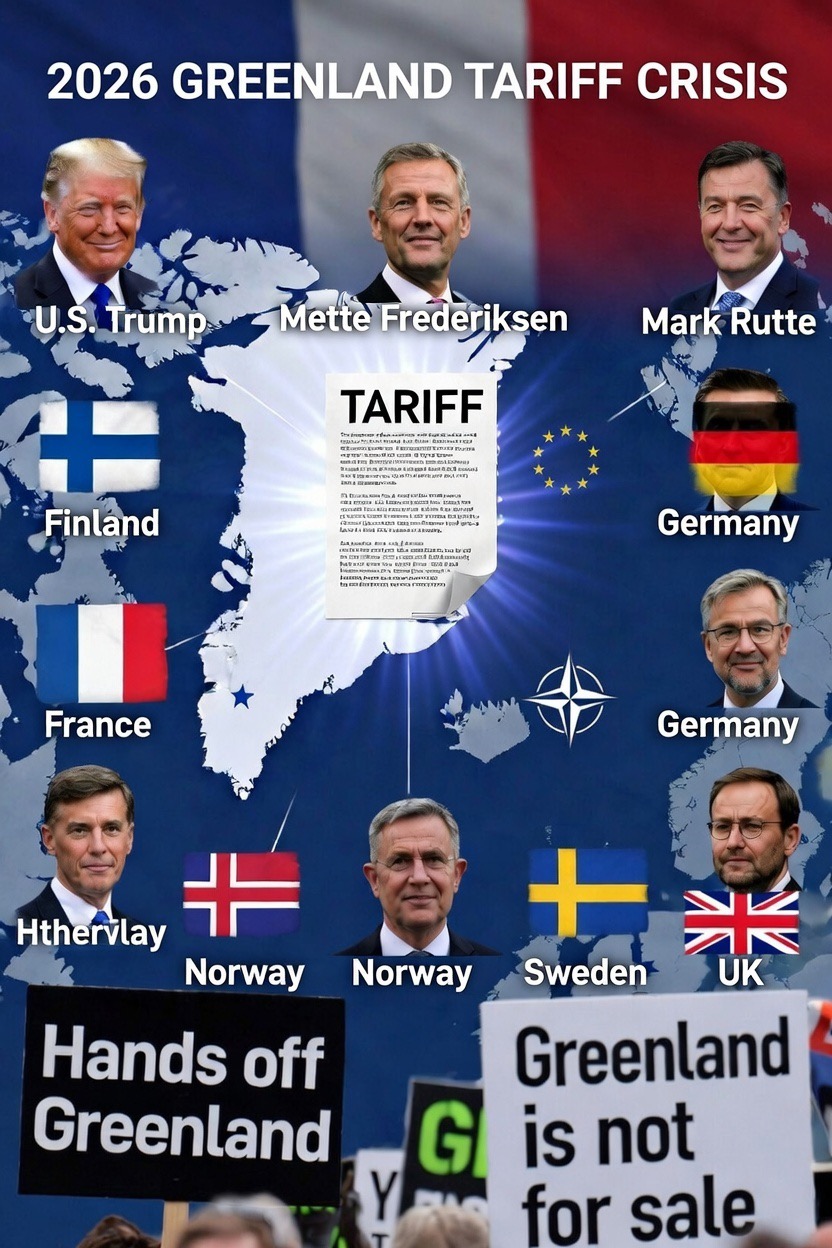
In a rapidly escalating diplomatic crisis that has shaken the foundations of the transatlantic alliance, eight NATO member nations—Denmark, Finland, France, Germany, the Netherlands, Norway, Sweden, and the United Kingdom—released a strongly worded joint statement on Sunday, January 18, 2026, directly rebuking U.S. President Donald Trump’s threats to impose punitive tariffs unless Denmark agrees to sell Greenland to the United States.
The statement, coordinated among the foreign ministries of the involved countries and published via official channels including the German government’s website, comes less than 24 hours after Trump announced via Truth Social that a 10% tariff on all goods exported from these nations to the U.S. would begin on February 1, 2026, escalating to 25% on June 1 if no deal is reached for the “Complete and Total purchase of Greenland.”
The Joint Statement in Full Context
The eight nations declared:
“We stand in full solidarity with the Kingdom of Denmark and the people of Greenland. As members of NATO, we are committed to strengthening Arctic security as a shared transatlantic interest. The pre-coordinated Danish exercise ‘Arctic Endurance,’ conducted with Allies, responds to this necessity. It poses no threat to anyone.
Tariff threats undermine transatlantic relations and risk a dangerous downward spiral. We will continue to stand united and coordinated in our response. We are committed to upholding our sovereignty.”
The declaration explicitly references the recent “Arctic Endurance” reconnaissance mission in Greenland, which involved small contingents from these countries at Denmark’s invitation. Officials described the deployment as routine and transparent, aimed at assessing conditions for potential future NATO exercises in the High North amid rising Russian and Chinese activities in the Arctic.
Leaders from the group reinforced the message individually:
- Danish Prime Minister Mette Frederiksen reiterated that “Europe won’t be blackmailed.”
- UK Prime Minister Keir Starmer called the tariffs “completely wrong” when applied to allies pursuing collective NATO security.
- French officials, including President Emmanuel Macron’s circle, emphasized no intimidation would sway their position on sovereignty issues in Ukraine, Greenland, or elsewhere.
The European Union leadership echoed this unity. European Commission President Ursula von der Leyen and European Council President António Costa issued a joint note expressing “full solidarity with Denmark and the people of Greenland,” while EU foreign policy chief Kaja Kallas warned that such divisions play into the hands of adversaries like Russia and China.
Trump’s Escalation and Rationale
Trump’s announcement framed the tariffs as a direct response to what he called the countries’ “very dangerous game” of sending military personnel to Greenland “for purposes unknown.” He has repeatedly argued that U.S. control of Greenland is essential for national security, citing rare earth minerals, strategic positioning against Russian expansion, and countering Chinese influence in the Arctic.
Under the existing 1951 U.S.-Denmark defense agreement, the United States already operates Pituffik Space Base in Greenland, providing significant military access without full ownership. Trump has dismissed this as insufficient, reviving his 2019 proposal to purchase the island and intensifying rhetoric since returning to office.
The tariffs, if implemented, would mark a historic use of economic coercion against core NATO allies, potentially overriding existing trade frameworks like the U.S.-EU agreement capping certain tariffs and the U.S.-UK bilateral deal.
Reactions and Broader Fallout
Protests erupted across Denmark and Greenland over the weekend, with thousands in Nuuk and Copenhagen chanting slogans like “Hands off Greenland” and “Greenland is not for sale.” Polls show near-universal opposition in Greenland to any U.S. takeover.
In the U.S., bipartisan criticism has emerged. Senators Jeanne Shaheen (D-NH) and Thom Tillis (R-NC), co-chairs of the Senate NATO Observer Group, condemned the move as harmful to American interests, businesses, and alliances. Sen. Lisa Murkowski (R-AK) called it “shameful,” highlighting risks to U.S. families from higher costs.
The EU has called an emergency ambassadors’ meeting to discuss countermeasures, which could include reciprocal restrictions on U.S. market access. Some European Parliament figures, like Manfred Weber, suggested pausing progress on any U.S.-EU trade deals.
Analysts warn this standoff could fracture NATO at a critical moment, as the alliance grapples with supporting Ukraine against Russia’s invasion. Divisions among allies, they argue, benefit Moscow and Beijing.
As tariffs loom and diplomatic backchannels remain active, the Greenland crisis has evolved from a quirky real-estate proposal into a major test of transatlantic unity. Whether dialogue or escalation prevails will shape U.S.-Europe relations for years to come.
Juba Global News Network is monitoring developments closely. Stay tuned for updates at JubaGlobal.com.
