Benin’s Foiled Coup: A Dawn of Instability in West Africa’s Democratic Bastion
Introduction: A Nation on the Brink On the morning of December 7, 2025, the West African nation of Benin awoke to the ominous echoes of gunfire and the cra
Introduction: A Nation on the Brink
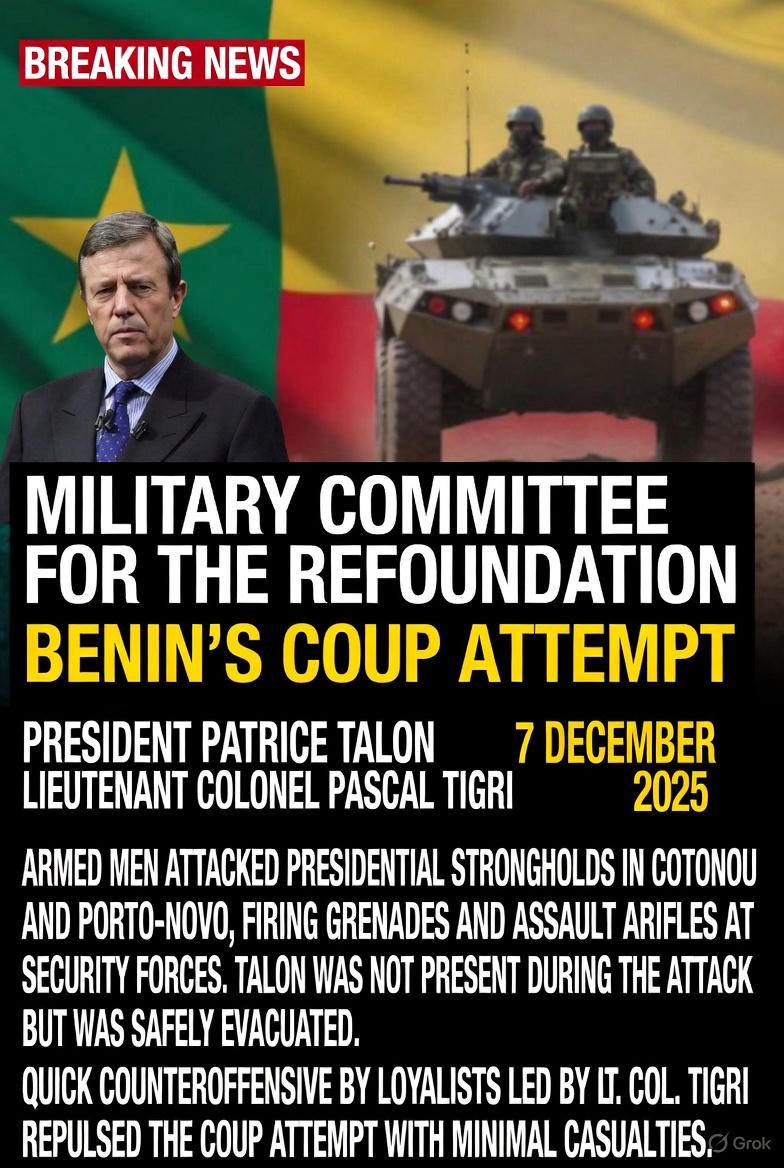
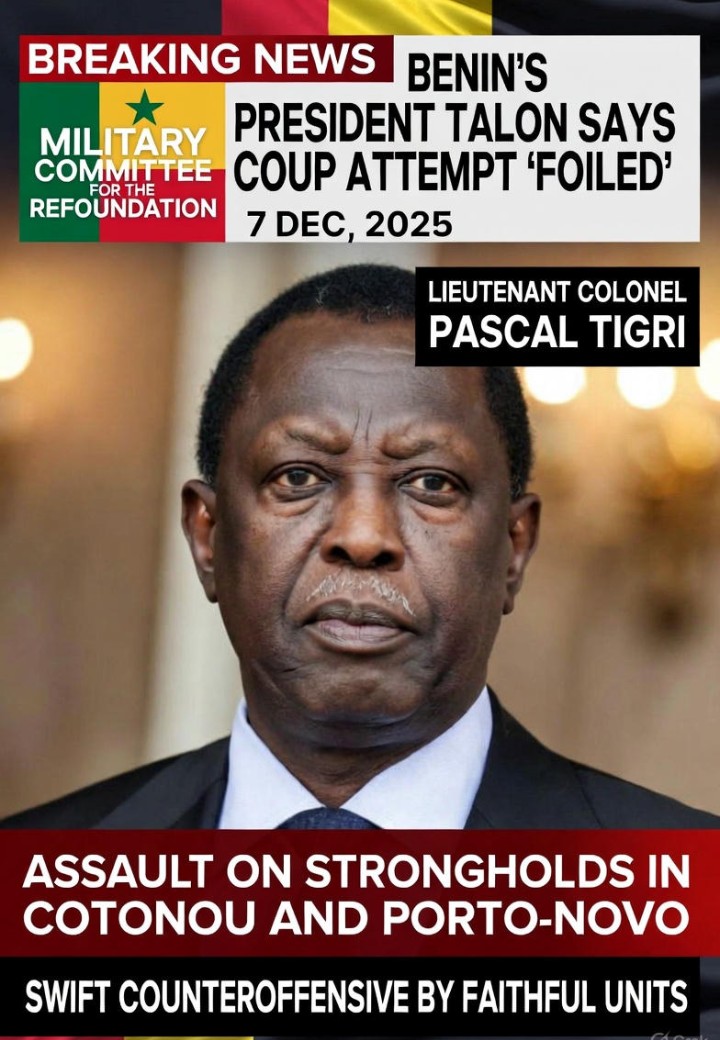
On the morning of December 7, 2025, the West African nation of Benin awoke to the ominous echoes of gunfire and the crackle of state television broadcasting an unprecedented declaration. A cadre of uniformed soldiers, identifying themselves as the “Military Committee for Refoundation,” stormed the national broadcaster in Cotonou, Benin’s economic hub, and proclaimed the dissolution of the government, the suspension of the constitution, and the ouster of President Patrice Talon. Led by Lieutenant Colonel Pascal Tigri, the mutineers vowed to usher in an era of “fraternity, justice, and work,” closing borders and halting political activities in a bid to “restore order.” For a fleeting moment, Benin—a country long hailed as a beacon of democratic stability in a region plagued by coups—teetered on the edge of chaos.
Yet, within hours, the plot unraveled. Loyalist forces, backed by the Beninese Armed Forces and the National Guard, swiftly regained control, foiling what Interior Minister Alassane Seidou described as a “mutiny by a small group of soldiers” aimed at destabilizing the state. President Talon, whose safety was briefly in question, emerged unscathed, his office affirming that the “large part of the army remained loyalist.” Gunfire subsided in the streets of Cotonou and Porto-Novo, the political capital, as roadblocks were dismantled and normalcy tentatively restored. The Economic Community of West African States (ECOWAS) swiftly condemned the attempt as a “subversion of Beninese sovereignty,” pledging unwavering support for constitutional order.
This thwarted coup, occurring mere months before the April 2026 presidential election, underscores the fragility of Benin’s democratic edifice amid mounting political pressures. As the dust settles, questions abound: What precipitated this audacious bid for power? How did Benin’s institutions hold firm? And what does this incident portend for a subregion that has witnessed eight successful coups since 2020? This article delves deeply into the events of December 7, contextualizing them within Benin’s political evolution, regional dynamics, and the broader specter of military intervention in West Africa.
The Anatomy of the Coup Attempt: A Timeline of Turmoil
The sequence of events unfolded with military precision, betraying months—if not years—of clandestine planning. Eyewitness accounts and official statements paint a picture of a meticulously orchestrated assault that faltered under the weight of institutional resilience.
Dawn Assault on Presidential Strongholds
The incursion began in the pre-dawn hours around 4:00 a.m. local time in Porto-Novo’s Le Guézo neighborhood, where President Talon’s residence came under fire from a detachment of approximately 20-30 soldiers loyal to Lt. Col. Tigri. Reports from Beninese media outlet TchadOne indicate that the attackers, armed with assault rifles and possibly anti-tank weapons, breached outer perimeters but were repelled by presidential guards. Concurrently, similar strikes targeted the home of Major General Abou Issa, a key Talon ally and military chief, and the national television headquarters in Cotonou.
By 5:30 a.m., the mutineers had seized the broadcaster, ORTB (Office de Radiodiffusion et de Télévision du Bénin). In a broadcast that stunned the nation, Tigri—clad in fatigues and flanked by fellow officers—read a communiqué declaring Talon’s “removal from office” and the formation of the Military Committee for Refoundation. “The army solemnly commits to giving the Beninese people the hope of a truly new era,” the statement intoned, echoing rhetoric from recent Sahelian coups. Borders were ordered closed, political parties suspended, and a curfew imposed, with promises of “national consultations” to chart a transitional path.
Social media erupted as videos of the broadcast circulated, amplifying panic in Cotonou’s bustling markets and Porto-Novo’s administrative corridors. Gunshots echoed near the port and Saint-Michel junction, where roadblocks sprang up, halting traffic and stranding commuters. Helicopters buzzed overhead, their origins unclear—loyalist reinforcements or mutineer scouts?
JubaGlobal.com
The Swift Counteroffensive
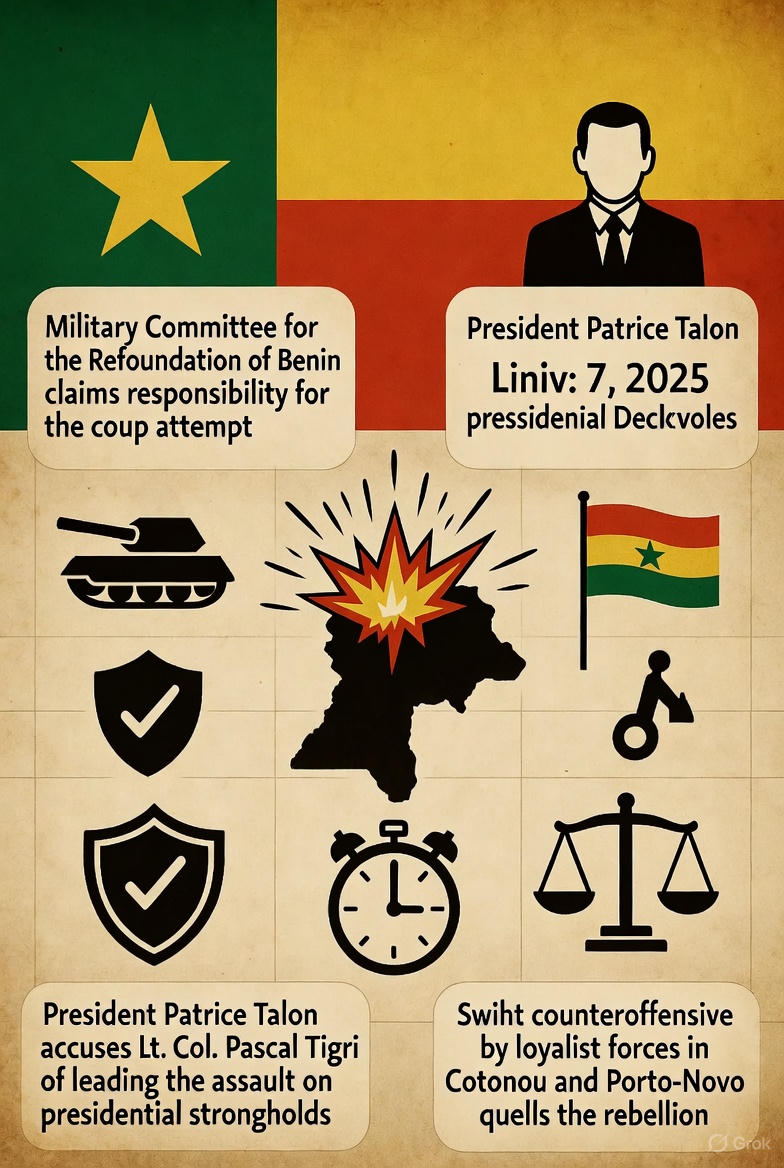
The government’s response was equally rapid. By 6:45 a.m., Foreign Minister Shegun Adjadi Bakari addressed Reuters, assuring that “the situation is under control” and that “a large part of the army and the National Guard are still loyal to the president.” Finance Minister Romuald Wadagni, Talon’s anointed successor for the 2026 polls, echoed this on social media: “The mutineers are holed up; we are clearing them out, but it’s not over yet.” Loyalist troops, numbering in the hundreds, converged on key sites, engaging in brief but fierce skirmishes that left at least three mutineers dead and several captured, per preliminary Interior Ministry reports.
By 8:00 a.m., ORTB was recaptured, its signal restored to air government assurances. President Talon’s office issued a statement confirming his safety and crediting “the unwavering loyalty of our armed forces” for the rapid resolution. No casualties among civilians were reported, though local hospitals treated minor injuries from stray bullets. Tigri and his core lieutenants evaded initial sweeps but were later apprehended near the Togolese border, according to unconfirmed ECOWAS sources.
The operation’s brevity—lasting less than four hours—highlights Benin’s robust command-and-control structures, honed through years of counter-terrorism drills and ECOWAS-backed reforms. Yet, the ease of the initial breach raises alarms about internal fissures within the military, where Tigri—a decorated officer with service in northern counter-insurgency ops—had cultivated a network of disaffected mid-level ranks.
Roots of Discontent: Benin’s Political Tectonics
To understand the coup’s genesis, one must excavate Benin’s recent political fault lines. Once Africa’s “coup-proof” democracy, Benin has, under Talon, veered toward authoritarian consolidation, eroding the pluralism that defined its post-1990 transition.
Talon’s Tenure: From Reformer to Autocrat?
Patrice Talon, a cotton magnate turned president, ascended in 2016 on promises of economic revitalization and anti-corruption. His early years delivered: GDP growth averaged 6.5% annually pre-COVID, fueled by port expansions in Cotonou and agricultural subsidies. Benin, a voodoo heartland with a population of 13 million, positioned itself as a stable conduit for regional trade, contrasting the jihadist insurgencies ravaging the Sahel.
Yet, Talon’s grip tightened. The 2019 elections, marred by opposition disqualifications, saw him win 86% amid boycotts and protests that claimed dozens of lives. Critics decried a “de facto one-party state,” with Talon leveraging judicial maneuvers to sideline rivals like former presidents Thomas Boni Yayi and Lionel Zinsou. The November 2025 constitutional referendum—extending presidential terms from five to seven years—ignited fury. Passed amid low turnout and allegations of fraud, it was lambasted as a “power grab” to entrench Talon’s Union Progressiste (UP) coalition. Wadagni’s nomination as UP candidate further fueled perceptions of dynastic maneuvering, alienating military veterans and youth who viewed Talon as out of touch with Benin’s 70% under-30 demographic.
Economic woes compounded grievances. Inflation hit 4.2% in 2025, driven by global commodity shocks and Niger’s border closure amid its own 2023 coup fallout. Unemployment among urban youth in Cotonou hovers at 15%, per World Bank data, breeding resentment in a nation where French colonial legacies and ethnic divides (Fon, Adja, Bariba) simmer beneath the surface. Tigri’s communiqué cited “endemic corruption and electoral manipulation” as casus belli, resonating with opposition voices like Reckya Madougou, Talon’s 2021 vanquished foe.
Military Malaise: From Guardians to Grumblers
Benin’s armed forces, numbering 7,000 active personnel, have historically been apolitical, a legacy of the 1990 National Conference that birthed multiparty democracy. Reforms under Talon bolstered pay and equipment, but promotions stagnated, and northern deployments against spillover from Mali’s jihadists strained morale. Tigri, a northerner from the Borgou region, reportedly chafed at perceived favoritism toward southern officers. Whispers of external meddling—possibly from Wagner-linked actors in neighboring Burkina Faso—circulate, though unproven.
Regional Ripples: West Africa’s Coup Contagion
Benin’s near-miss injects fresh peril into ECOWAS’s faltering anti-coup architecture. Since 2020, Mali, Guinea, Burkina Faso, Niger, and Gabon have fallen to putschists, fracturing the bloc and emboldening juntas. ECOWAS’s sanctions on Niger expired in 2025 without restoration, eroding credibility. Benin’s stability buffered trade routes; its destabilization could spike piracy in the Gulf of Guinea and refugee flows into Togo and Nigeria.
France, Benin’s ex-colonial power, evacuated non-essential staff from its Cotonou embassy, while the U.S. urged “all parties to respect democratic norms.” China, with stakes in Benin’s phosphate mines, remained mum, prioritizing continuity. Domestically, opposition leaders hailed the foiling as a “victory for the people,” but warned of reprisals against perceived plot sympathizers.
Aftermath and Analysis: Stability’s Fragile Thread
By midday December 7, Cotonou’s markets reopened, though tension lingers. Talon addressed the nation, vowing “justice for traitors” and electoral reforms, but analysts doubt sincerity. The coup’s failure reaffirms Benin’s institutional depth—its judiciary, media, and civil society remain vibrant—but exposes vulnerabilities. Tigri’s trial, expected soon, may purge disloyal elements but risks deepening military rifts.
Economically, markets dipped 2% on the Benin Stock Exchange, with cotton futures volatile. Tourism, a $200 million sector, braces for fallout, as does the Voodoo Festival slated for January 2026. Long-term, Benin’s 2026 vote tests ECOWAS mediation; a flawed poll could reignite unrest.
Conclusion: Reclaiming the Democratic Flame
The 2025 Beninese coup attempt, though aborted, is a stark reminder that democracy in West Africa is no inheritance but a perpetual vigil. Benin’s swift rebound honors its “coup-proof” moniker, yet the embers of discontent glow. As Talon navigates his final months, the onus falls on inclusive reforms to quarantine military adventurism. For ECOWAS and the AU, bolstering early-warning systems is imperative to stem the coup cascade. In a subregion where juntas cloak tyranny in populism, Benin’s resilience offers hope—but only if nurtured. The dawn of December 7 broke with shadows; may the days ahead illuminate a path to enduring peace.