South Sudan’s Jonglei Crisis Deepens: Over 280,000 Displaced Amid Escalating SSPDF–SPLA-IO Clashes and Cholera Outbreak
By Juba Global News Network Staff
JubaGlobal.com
February 15, 2026 – Juba, South Sudan
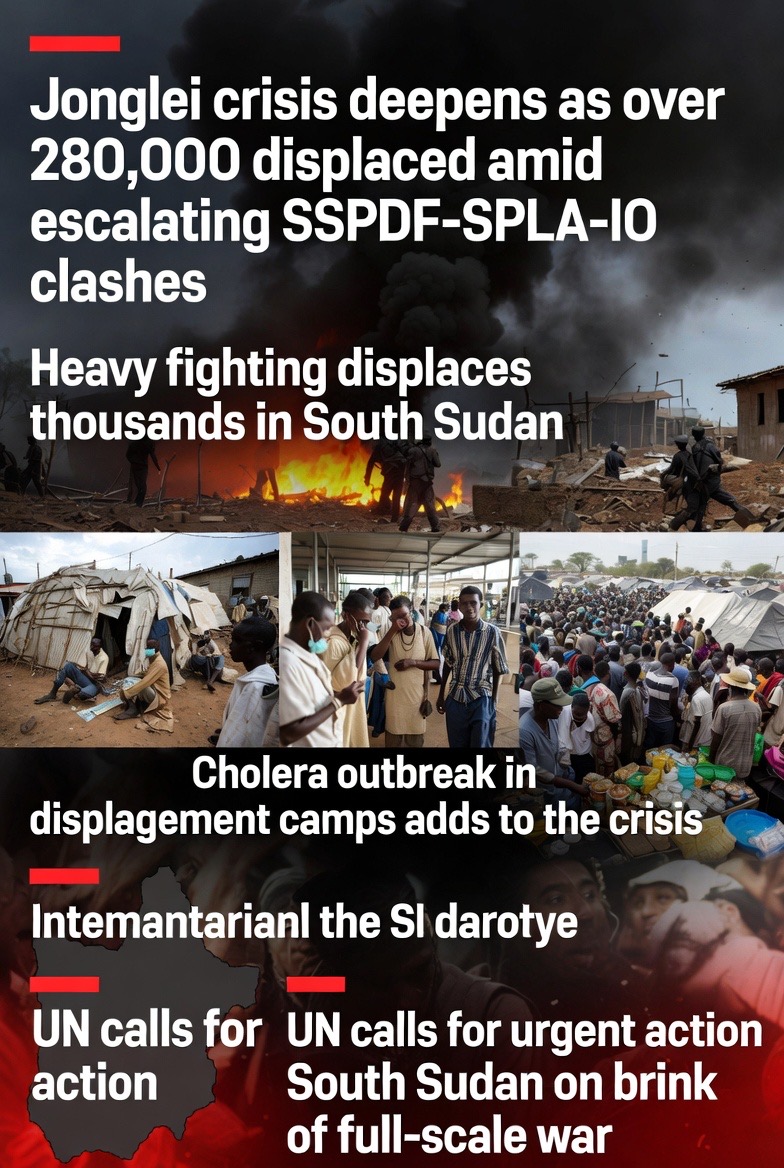
The humanitarian and security situation in Jonglei State has reached a new level of alarm, with the United Nations Office for the Coordination of Humanitarian Affairs (OCHA) reporting more than 280,000 people displaced by violence since late December 2025. Heavy fighting between South Sudan People’s Defence Forces (SSPDF) and SPLA-IO forces — the largest scale of clashes in the region since 2017 — has triggered mass displacement, widespread destruction of civilian infrastructure, and a sharp spike in cholera cases, pushing one of Africa’s most vulnerable regions closer to catastrophe.
OCHA’s latest Flash Update No. 7 (covering February 7–13, 2026) paints a grim picture:
- Displacement: More than 280,000 people displaced within Jonglei alone since the current wave of violence intensified in late December 2025. An additional 100,000–150,000 people are estimated to have fled to neighboring states (Upper Nile, Unity) or across the border into Ethiopia and Sudan.
- Casualties and wounded: Dozens of wounded civilians and combatants arrive daily at Akobo Hospital and other limited medical facilities. Exact fatality figures remain difficult to verify due to access constraints, but community leaders report scores of civilian deaths.
- Cholera outbreak: Nationwide cumulative cases reached 98,195 with 1,619 deaths as of early February (WHO/Health Ministry data). Jonglei accounts for a significant share of new cases, exacerbated by overcrowding in displacement sites, lack of clean water, and collapsed sanitation systems.
- Access constraints: Aid organizations face severe restrictions — roadblocks, active fighting, and bureaucratic hurdles limit deliveries of food, medicine, shelter materials, and water/sanitation supplies. Several NGOs have suspended operations in parts of Akobo, Uror, and Nyirol counties.
Roots of the Current Escalation
The violence stems from a toxic combination of unresolved issues from the 2018 Revitalized Agreement on the Resolution of the Conflict in South Sudan (R-ARCSS) and local resource/power struggles:
- Delayed unification and security arrangements — Integration of SPLA-IO forces into the SSPDF remains incomplete; cantonment sites are underfunded and poorly supplied, leading to defections and splintering.
- Local power struggles — Competition for grazing land, water points, and political control among Dinka, Nuer, and Murle communities has been weaponized by national-level actors.
- Cattle raiding and revenge cycles — Inter-communal raids have escalated into large-scale military engagements, with SSPDF accused of siding with certain groups while SPLA-IO backs others.
- Political deadlock in Juba — The ongoing treason trial of First Vice President (suspended) Dr. Riek Machar and failure to implement key R-ARCSS benchmarks (unified army, state boundaries, elections timeline) have eroded trust and emboldened hardliners.
The recent formal integration of the pro-government Red Belt militia into the SSPDF (announced February 13–14) has been viewed by some SPLA-IO commanders as a further provocation, further complicating ceasefire efforts.
Humanitarian Catastrophe Unfolding
The scale of displacement and destruction is overwhelming limited humanitarian capacity:
- Food insecurity — IPC Phase 4 (Emergency) conditions are widespread; many families have lost livestock, crops, and access to markets.
- Health crisis — Beyond cholera, malaria, measles, and acute watery diarrhea are surging in crowded displacement sites. UNICEF warns that 450,000 children across the country are at immediate risk of acute malnutrition.
- Protection risks — Reports of gender-based violence, child recruitment, and arbitrary detention are rising. Women and girls in displacement sites face heightened vulnerability.
- Education — Hundreds of schools remain closed; thousands of children have missed months of learning.
UN Humanitarian Coordinator Anita Gbeho reiterated on February 7: “Attacks on humanitarian personnel, facilities, and supplies are unacceptable and may constitute war crimes. We call on all parties to ensure safe and unhindered access.”
National and International Response
President Salva Kiir Mayardit, attending the AU Summit in Addis Ababa (February 14–15), reiterated the government’s commitment to peace but blamed “spoilers” for the violence. The government has deployed additional SSPDF reinforcements to Jonglei and promised to investigate civilian casualties.
The African Union, IGAD, and Troika partners (U.S., UK, Norway) have issued statements calling for immediate cessation of hostilities and full implementation of R-ARCSS security arrangements. The UN Security Council expressed “grave concern” over the nationwide surge in violence on February 13 and warned that perpetrators of war crimes could face international accountability.
Humanitarian agencies continue to scale up where access permits:
- WFP and partners have prepositioned food for 150,000 people in Jonglei.
- WHO/UNICEF are supporting cholera treatment centers and oral cholera vaccine campaigns.
- UNHCR and IOM are providing emergency shelter and non-food items to new arrivals.
Outlook: A Tipping Point?
Many analysts warn that the current trajectory in Jonglei — and the broader failure to implement the peace agreement — risks unraveling South Sudan’s fragile stability and reigniting wider conflict ahead of delayed elections. Without rapid de-escalation, increased humanitarian access, and credible progress on army unification and political dialogue, the coming months could see displacement exceed 500,000 in Jonglei alone and cholera cases surpass 100,000 nationwide.
For the people of Jonglei — already among the most vulnerable in Africa — every day of continued fighting means more lives lost, more families separated, and more hope extinguished. The international community’s response in the coming weeks will be critical to averting a full-scale humanitarian catastrophe in the heart of the continent.
Juba Global News Network will continue to provide on-the-ground updates, analysis, and voices from affected communities as the Jonglei crisis unfolds. We call for immediate protection of civilians, safe humanitarian access, and renewed commitment to the peace process.