

Iran Offers Partial Dilution of 60% Enriched Uranium Stockpile in Exchange for Limited Sanctions Relief: A High-Stakes Nuclear Gambit Amid Escalating Regional Tensions
By Juba Global News Network Staff JubaGlobal.com February 14, 2026 – Juba, South Sudan In a carefully calibrated diplomatic move delivered through Omani in
By Juba Global News Network Staff
JubaGlobal.com
February 14, 2026 – Juba, South Sudan
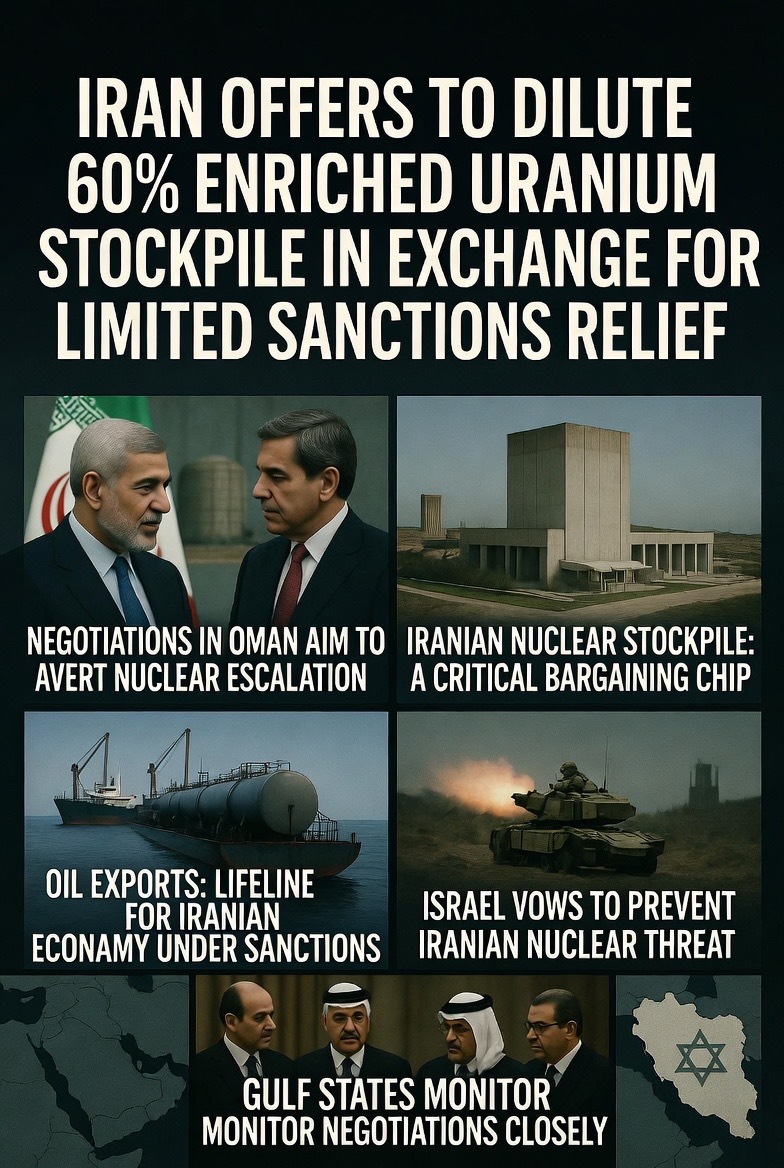
In a carefully calibrated diplomatic move delivered through Omani intermediaries on February 12, 2026, Iran has formally proposed diluting a significant portion of its stockpile of uranium enriched to 60% U-235 in return for partial and reversible sanctions relief from the United States and the E3 (United Kingdom, France, Germany). The offer — the most concrete confidence-building gesture from Tehran in more than three years — arrives at a moment of extreme fragility in the JCPOA landscape, with Israeli Prime Minister Benjamin Netanyahu in Washington pressing President Trump for military options, and Iranian-backed militias in Iraq, Syria, Yemen and Lebanon raising their alert status.
The Proposal: What Iran Is Offering — and Demanding
According to diplomats briefed on the Omani channel and confirmed by two separate Western intelligence sources, the Iranian proposal contains the following core elements:
- Dilution of ~40–45% of current 60% stockpile (estimated at 142–148 kg as of IAEA February 2026 report) down to 20% or lower within 90–120 days under IAEA continuous monitoring.
- Capping new 60% production at zero for at least 12 months after dilution begins.
- Resumption of enhanced IAEA access to centrifuge workshops, uranium-conversion facilities, and previously restricted sites (Fordow, Natanz, Turquzabad).
- Temporary suspension of installation of new advanced centrifuges (IR-6, IR-8 models) beyond current numbers.
In exchange, Iran is requesting:
- Immediate suspension (not permanent lifting) of U.S. secondary sanctions on oil exports, petrochemicals, shipping insurance, and banking access for humanitarian trade.
- Release of ~$6–8 billion in frozen Iranian funds held in South Korea, Iraq, Oman and other jurisdictions (funds already partially accessible for humanitarian purchases but heavily restricted).
- Removal of the IRGC from the U.S. Foreign Terrorist Organization list for a renewable 12-month period.
- Written commitment from the U.S. and E3 not to pursue “snapback” sanctions under UNSCR 2231 before the end of 2027.
Notably absent from the proposal is any commitment to dismantle advanced centrifuges already installed, export existing highly enriched uranium, or negotiate limits on ballistic-missile development — three red lines repeatedly demanded by the U.S., Israel, and several Gulf states.
Strategic Context: Why Now?
Iranian officials have privately told European diplomats that the timing is driven by three converging pressures:
- Credible threat of Israeli or joint U.S.-Israeli military action — Netanyahu’s White House visit and public statements by Israeli Defense Minister Yoav Gallant (“all options remain on the table”) have convinced Tehran that a strike on nuclear facilities could occur before summer 2026 if no diplomatic offramp appears.
- Severe economic deterioration — oil exports have fallen to ~1.1–1.2 million barrels per day (down from 2.5 million pre-2018), foreign-exchange reserves are critically low, and the rial has lost ~85% of its value against the dollar since 2021.
- Domestic political calculus — President Masoud Pezeshkian and Foreign Minister Abbas Araghchi face mounting criticism from hardliners for failing to deliver economic relief while the IRGC and Supreme Leader’s office remain deeply skeptical of any deal with the “Great Satan.”
Regional and International Reactions
Israel — Prime Minister Netanyahu, speaking alongside President Trump on February 13, dismissed the Iranian offer as “a transparent delaying tactic” and reiterated that Israel “will not allow Iran to cross the nuclear threshold under any circumstances.” Israeli officials privately indicate they view any dilution below 90% as insufficient.
United States — The Trump administration has not yet issued an official response. However, senior officials have told Reuters and the Financial Times that the proposal is “inadequate on scope and verification” and that relief would only be considered after verifiable, permanent steps toward 3.67% enrichment and export of all uranium above that level.
E3 (UK, France, Germany) — European diplomats describe the offer as “a serious starting point” but insist that any relief package must include binding, long-term limits on enrichment capacity and missile programs — conditions Iran has consistently rejected.
Gulf States — Saudi Arabia, UAE and Bahrain issued a joint statement calling the proposal “insufficient and insincere” and urged the U.S. to maintain “maximum pressure” until Iran agrees to a “comprehensive regional security framework.”
China and Russia — Both have welcomed the Iranian gesture as “a constructive step” and urged the U.S. to reciprocate. Beijing has reportedly offered to purchase additional Iranian oil if partial sanctions relief is granted.
Outlook: Narrow Path to Diplomacy — or Escalation?
The Iranian proposal arrives at a moment when multiple clocks are ticking:
- IAEA Board of Governors meeting in early March 2026 could censure Iran for lack of cooperation on undeclared nuclear material.
- UN Security Council “snapback” sanctions clock expires in October 2026 under JCPOA sunset clauses.
- Israel’s window for unilateral military action narrows as Iran disperses and hardens nuclear assets.
- U.S. domestic political calendar — mid-term congressional elections in November 2026 — limits how much flexibility Trump can show without appearing weak on Iran.
Most nonproliferation experts assess the odds of a near-term breakthrough as low (15–25%). More likely scenarios include:
- Protracted indirect talks through Oman and possibly Qatar, producing a limited “freeze-for-freeze” arrangement lasting 6–12 months.
- Israeli or U.S. strike on one or more nuclear facilities if Iran crosses a new red line (e.g., enriching to 90% or expelling IAEA inspectors).
- Continued attrition — Iran slowly expands its nuclear program while evading major new sanctions, betting on U.S. domestic political divisions and European reluctance to re-impose snapback.
For now, the Iranian offer keeps a narrow diplomatic channel open — but the distance between Tehran’s proposal and Washington’s bottom line remains vast, and the margin for miscalculation dangerously thin.
Juba Global News Network will continue monitoring the nuclear file, regional proxy dynamics, and diplomatic maneuvering, providing balanced analysis as the 2026 nuclear crisis enters what many observers fear could be its most dangerous phase yet.
