

Russia Launches Massive Overnight Drone & Missile Barrage: Ukraine’s Energy Grid Suffers Severe New Damage as Winter Blackouts Intensify
By Juba Global News Network Staff JubaGlobal.com February 14, 2026 – Juba, South Sudan In one of the largest combined aerial assaults of the war so far, Ru
By Juba Global News Network Staff
JubaGlobal.com
February 14, 2026 – Juba, South Sudan
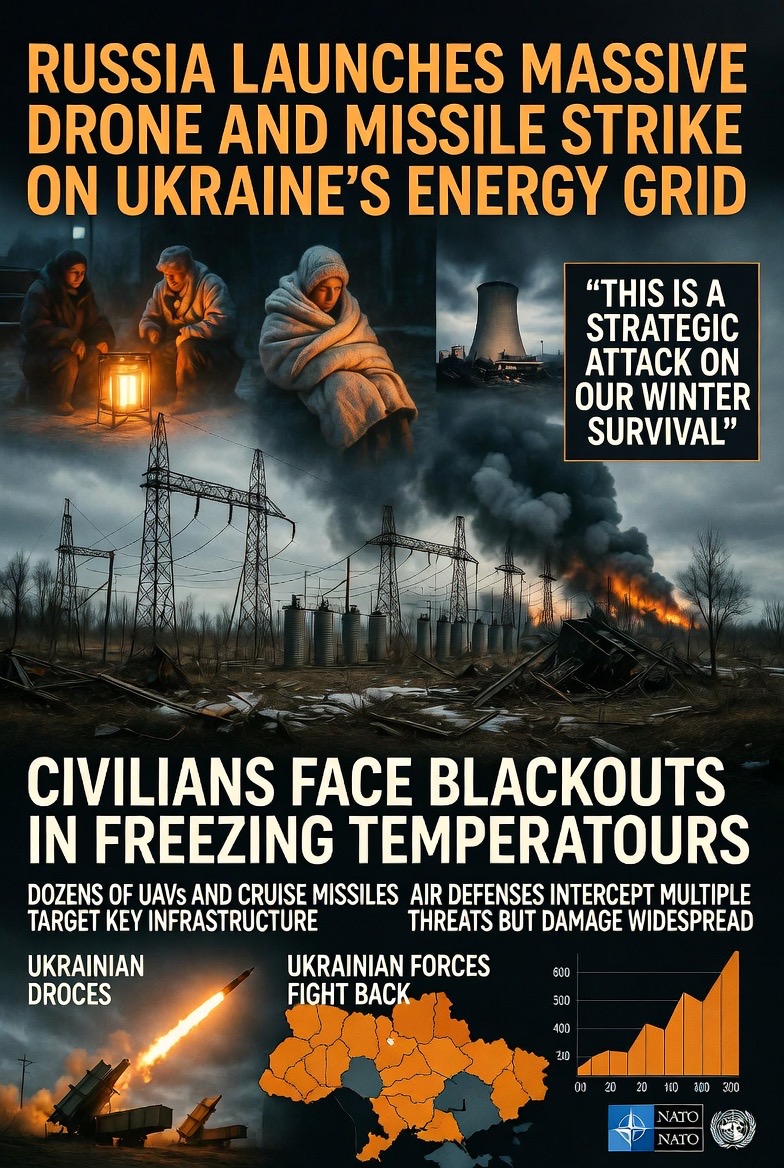
In one of the largest combined aerial assaults of the war so far, Russian forces launched more than 130 Shahed-type kamikaze drones and 45 cruise and ballistic missiles against Ukrainian energy infrastructure overnight on February 13–14, 2026. The wave of strikes — which Ukrainian air defenses describe as “one of the most intense since the start of the full-scale invasion” — killed at least three civilians, injured more than 40 people, and caused widespread, long-duration blackouts across 13 of Ukraine’s 24 oblasts plus the city of Kyiv.
Ukrenergo, the national grid operator, declared a nationwide emergency load-shedding regime within hours of the first impacts. As of midday February 14, roughly 60–65% of Ukrainian households and businesses were subject to scheduled or emergency power cuts lasting 8–18 hours per day. Several thermal power plants already heavily damaged in previous attacks were knocked offline again, while high-voltage substations in Kyiv, Kharkiv, Dnipro, Zaporizhzhia, Poltava and Sumy oblasts suffered direct hits.
Scope and Targets of the Assault
According to preliminary assessments by Ukraine’s Energy Ministry and military intelligence:
- Drones — 132 Shahed-136/131 Geran-2 drones launched in multiple waves from Russia’s Krasnodar, Kursk and occupied Crimea regions. Air Force reported downing 78 (≈59%).
- Missiles — at least 45 launched, including Kh-101/555 cruise missiles from Tu-95MS and Tu-160 strategic bombers, Kalibr sea-launched cruise missiles from Black Sea ships, and a smaller number of Iskander and Kinzhal ballistic missiles. Air Force claimed 28 intercepts (≈62%).
- Primary targets — 14 high-voltage substations (330–750 kV), 7 gas compressor stations/pipeline nodes, 3 thermal power plants (including units at Burshtyn, Ladyzhyn and Sloviansk), and several critical repair depots storing Western-supplied autotransformers and mobile generators.
Ukrainian officials emphasized that the attack deliberately targeted already-damaged but partially repaired facilities, destroying months of expensive reconstruction work. A senior Ukrenergo executive told Reuters on condition of anonymity: “They are not just hitting the grid — they are hitting our ability to ever recover it.”
Human and Humanitarian Toll
Beyond the immediate fatalities and injuries, the humanitarian consequences are severe:
- Hospitals in Kharkiv, Sumy and Zaporizhzhia oblasts are running on diesel generators with only 4–6 hours of fuel reserve left. Several have begun triage protocols, postponing non-emergency surgeries.
- Water supply systems failed in multiple districts of Kyiv, Dnipro and Poltava due to loss of pumping power; bottled water distribution points are being set up but face long queues.
- Residential heating largely relies on electric boilers in urban apartment blocks — many families are now without heat in temperatures averaging –12 °C to –18 °C.
- UN OCHA updated its winter humanitarian appeal figure to 11.8 million people (≈30% of the population) requiring urgent assistance with heating, power, water and shelter repair.
President Volodymyr Zelenskyy, in an early-morning video address, accused Russia of “genocide by freezing” and repeated his plea for more air-defense systems:
“Every Patriot battery, every NASAMS launcher, every IRIS-T module that our partners delay is measured in destroyed homes, dead children, and weeks of darkness. We are not asking for charity — we are asking for the tools to stop this terror.”
Russian Framing and Strategic Calculus
Moscow has not officially acknowledged targeting civilian energy infrastructure. The Russian Defense Ministry described the strikes as “precision attacks on military-logistics facilities, energy nodes supporting the AFU, and decision-making centers.” Pro-Kremlin Telegram channels and state media, however, openly celebrated the operation as a legitimate way to impose “unbearable costs” on Ukraine’s war effort and civilian population.
Independent defense analysts identify several interlocking Russian objectives:
- Degrade Ukraine’s rear-area sustainment — power shortages disrupt drone charging, radar operation, field-hospital refrigeration, railway signaling and repair workshops.
- Force air-defense dilution — each large-scale attack compels Ukraine to expend expensive interceptors protecting static grid nodes instead of mobile frontline units.
- Psychological & economic pressure — prolonged blackouts in mid-winter increase civilian suffering, potentially fueling domestic discontent or refugee outflows.
- Destroy Western-supplied repair capacity — high-voltage autotransformers and mobile substations cost tens of millions of dollars each and have lead times of 12–24 months.
Despite heavy losses to its own long-range aviation fleet and cruise-missile stockpiles, Russia continues to receive fresh Shahed airframes from Iran and has reportedly scaled up domestic assembly lines. Current production estimates suggest Moscow can sustain 90–140 large-scale energy strikes per winter season.
Ukraine’s Winter Survival Measures
Ukrainian authorities have activated their multi-layered winter resilience plan:
- Maximum electricity imports from Poland, Slovakia, Romania, Moldova and Hungary (currently capped at ≈1.9 GW due to interconnection limits).
- Massive deployment of small-scale gas turbines, solar panels and diesel generators at critical infrastructure (hospitals, water pumping stations, mobile command posts).
- Strict industrial demand quotas and public conservation campaigns (“one kettle at a time”).
- Underground and highly mobile repair teams working mostly at night.
- Expanded Starlink/Starshield usage to maintain emergency communications and grid control when terrestrial networks fail.
Even so, officials privately admit that blackouts exceeding 18–20 hours per day in major cities would push urban areas toward systemic collapse: sewage freezes, water pipes burst, coal/gas boilers go offline, and food storage fails.
International Response
- NATO — Secretary General Jens Stoltenberg promised “accelerated delivery” of additional Patriot, NASAMS and IRIS-T systems, though no new firm commitments were announced.
- European Union — Emergency €350 million package approved for grid repair equipment, generators and fuel.
- United States — Fast-tracked delivery of 18 additional high-voltage autotransformers and mobile substations under the Ukraine Security Assistance Initiative.
- UN — OCHA raised its winter appeal to $3.1 billion, warning that continued energy attacks could push an additional 2 million people into acute humanitarian need.
As Ukraine enters the second half of its third war winter, the battle over electricity has become as strategically important as the fight over territory. Russia appears determined to keep the country dark and cold; Ukraine — with Western support — is fighting to keep the lights on just long enough for spring to arrive and potential diplomatic or military turning points to emerge.
Juba Global News Network will continue to report on the energy war, humanitarian conditions and diplomatic efforts, providing balanced coverage as millions of Ukrainians endure another brutal season of blackouts and bombardment.
