Argentina’s Inflation Surge Continues: Milei’s Shock Therapy Faces Growing Backlash as Prices Rise for Fifth Straight Month
By Juba Global News Network Staff
JubaGlobal.com
February 13, 2026 – Juba, South Sudan
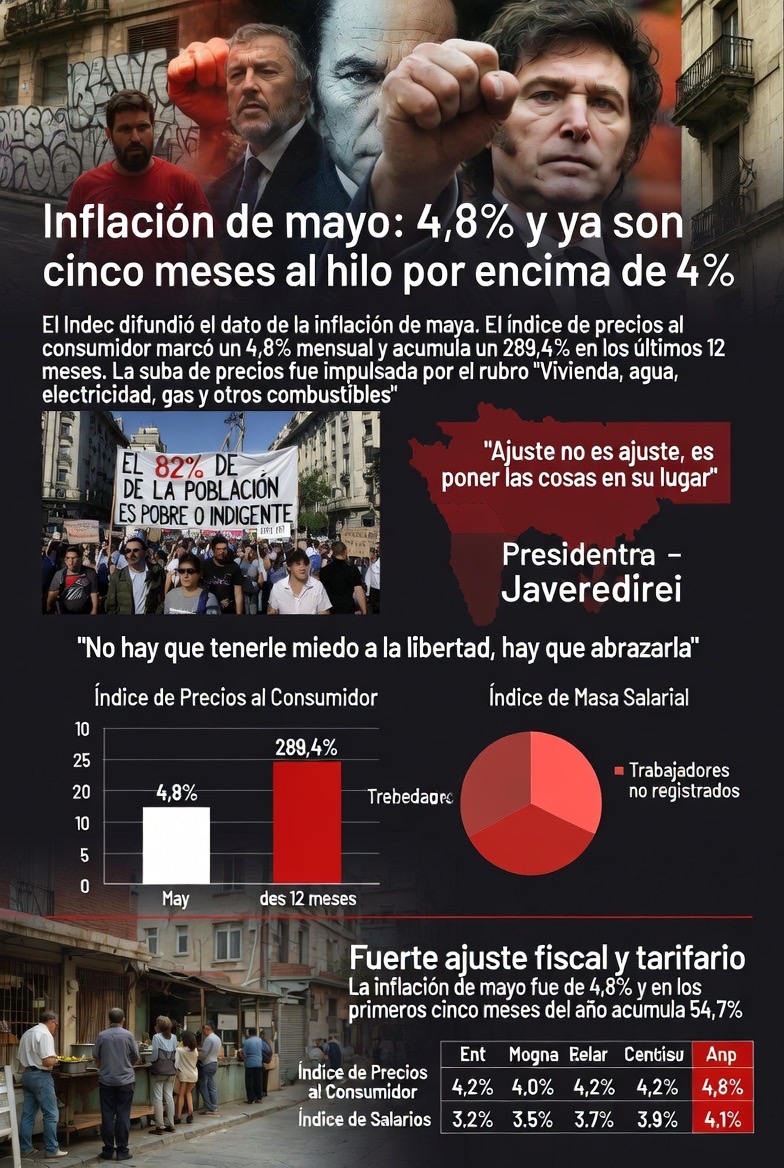
Argentina recorded a monthly inflation rate of 4.8% in January 2026, the fifth consecutive monthly increase since President Javier Milei took office in December 2023, according to official data released by the National Institute of Statistics and Census (INDEC) on February 12. While the figure represents a dramatic slowdown from the hyperinflationary peaks of 2023–2024 (when monthly rates routinely exceeded 20–25%), the persistent upward trend has fueled widespread frustration among ordinary Argentines and intensified political pressure on Milei’s libertarian economic experiment.
The annual inflation rate now stands at approximately 142% — still among the highest in the world — but the key concern for most households is not the year-on-year number; it is the relentless month-after-month increase in the cost of food, rent, utilities, public transport, and medicines. A basic basket of goods and services considered essential by INDEC rose 5.1% in January, outpacing overall inflation and hitting the poorest households hardest.
The Human Cost: A Nation of “Two Argentinas”
In Buenos Aires’ working-class neighborhoods of La Boca, Villa Soldati, and Constitución, the mood is increasingly grim. María Gómez, a 42-year-old single mother and supermarket cashier, described her reality to local media:
“I earn 380,000 pesos a month. A kilo of beef now costs 9,800 pesos, a liter of milk 1,400 pesos, a kilo of tomatoes 3,200 pesos. I used to buy meat three times a week; now maybe once. My children eat pasta with oil and onion more days than I want to count. We are not starving, but we are hungry all the time.”
Similar stories are repeated across the country. The poverty rate — which peaked at 57.4% in early 2024 — has fallen to around 41–43% according to private estimates (official figures lag), but extreme poverty (indigence) has remained stubbornly high at 9–11%. Soup kitchens report lines growing longer, while pediatricians in public hospitals note rising cases of childhood malnutrition for the first time in more than a decade.
Milei’s Diagnosis and Treatment Plan
President Milei and Economy Minister Luis Caputo have consistently framed the persistent inflation as the painful but unavoidable consequence of dismantling an economy addicted to monetary financing of fiscal deficits. Their core argument remains unchanged:
- The previous Peronist governments printed money at extraordinary speed to finance spending → chronic inflation became embedded → expectations became unanchored.
- The only way to break this cycle is to eliminate the fiscal deficit (“zero deficit” became Milei’s signature campaign slogan), end monetary emission for Treasury purposes, and restore credibility through painful but necessary austerity.
- Once inflation expectations are re-anchored, real wages and purchasing power will recover — but this process is unavoidably protracted and socially costly.
Key elements of the program implemented since late 2023:
- Fiscal shock therapy — primary fiscal surplus achieved in Q1 2024 and maintained (though largely through cuts to pensions, public wages, subsidies, and capital spending rather than revenue growth).
- Deregulation blitz — elimination of most price controls, rent controls, import restrictions, export taxes on many products, and hundreds of regulations via DNU 70/2023 and subsequent decrees.
- Exchange-rate unification — official peso devalued 54% on day one, followed by a managed crawl of 2% per month (far below inflation), creating a large real appreciation of the currency.
- Monetary tightening — negative real interest rates for much of 2024–2025, reduction of monetary base, and aggressive sterilization of liquidity.
- Labor-market flexibility — controversial reforms reducing severance costs and allowing easier hiring/firing (partially blocked by courts but partially implemented via decree).
Why Inflation Has Not Fallen Faster
Despite the aggressive fiscal adjustment and monetary squeeze, several factors explain why disinflation has been slower than Milei’s team initially projected:
- Regressive expenditure cuts — reductions in energy, transport, and food subsidies directly raised household costs, feeding through into CPI.
- Real exchange-rate appreciation — the slow devaluation crawl combined with high domestic inflation has made tradable goods increasingly expensive relative to non-tradables, creating cost-push pressures.
- Wage–price spiral remnants — collective bargaining rounds in 2024–2025 often resulted in wage increases that exceeded current inflation but lagged behind past inflation, perpetuating inertia.
- Indexation lag — many contracts, pensions, and regulated prices are adjusted with a lag, so past high inflation continues to feed through.
- Supply-side bottlenecks — deregulation has been uneven; key sectors (meat, dairy, construction materials) still face informal barriers or concentrated market power.
- Seasonal and administered-price effects — January usually sees higher inflation due to school-year start, tourism, and regulated-price resets.
Political and Social Fallout
Milei’s approval rating has fallen from a peak of 58–60% in mid-2024 to 44–48% in recent polls (with disapproval now in the low-to-mid 50s). The president retains strong support among younger voters and the middle-to-upper-middle class in Greater Buenos Aires, but has lost significant ground among the working class, retirees, and public-sector employees.
Mass protests have returned to Plaza de Mayo and major avenues in Buenos Aires, Córdoba, Rosario, and Mendoza. The powerful CGT labor confederation called a 36-hour general strike in mid-January — the first since Milei took office — which paralyzed much of the country. University students, retirees, and feminist organizations have also mobilized against spending cuts to public education, pensions, and gender-violence programs.
In Congress, Milei’s La Libertad Avanza party remains a small minority. Most legislation has passed either through decree (later partially struck down by courts) or through uneasy alliances with PRO (Macri’s party) and segments of the Radical Civic Union. The opposition Peronist/Union por la Patria bloc is fractured but increasingly vocal in denouncing “adjustment with recession.”
Government Response and Outlook
President Milei has doubled down on his messaging: “There is no alternative to fiscal discipline. The quicker we kill inflation, the sooner real wages recover.” Economy Minister Caputo insists the country is “past the worst” and predicts monthly inflation below 3% by mid-2026 if fiscal discipline is maintained and the harvest remains strong.
Private economists are more cautious. Consensus forecasts for 2026 annual inflation range from 55% (optimistic) to 90% (pessimistic), with most clustering around 70–80%. The IMF, which approved a new Extended Fund Facility in late 2025, has urged gradual subsidy unwinding and stronger social safety nets to cushion the most vulnerable.
For millions of Argentines, 2026 will likely remain a year of acute hardship. Whether Milei’s high-risk gamble ultimately produces a virtuous cycle of disinflation, investment, and growth — or instead leads to social explosion and political reversal — may not be clear until late 2027 or 2028. For now, the country remains trapped in the painful middle phase of shock therapy: inflation is lower than before, but most people feel poorer every month.
Juba Global News Network will continue to track Argentina’s economic and social evolution, providing balanced coverage as the nation navigates one of the most ambitious — and controversial — stabilization programs in its modern history.