

Zelenskyy Slams Europe at Davos: “Where Is the Real Support?” – A Stark Warning Amid Fragile Peace Talks
By: Juba Global News Network | JubaGlobal.com In a speech that cut through the polished optimism of the 2026 World Economic Forum in Davos, Ukrainian Presi
By: Juba Global News Network | JubaGlobal.com
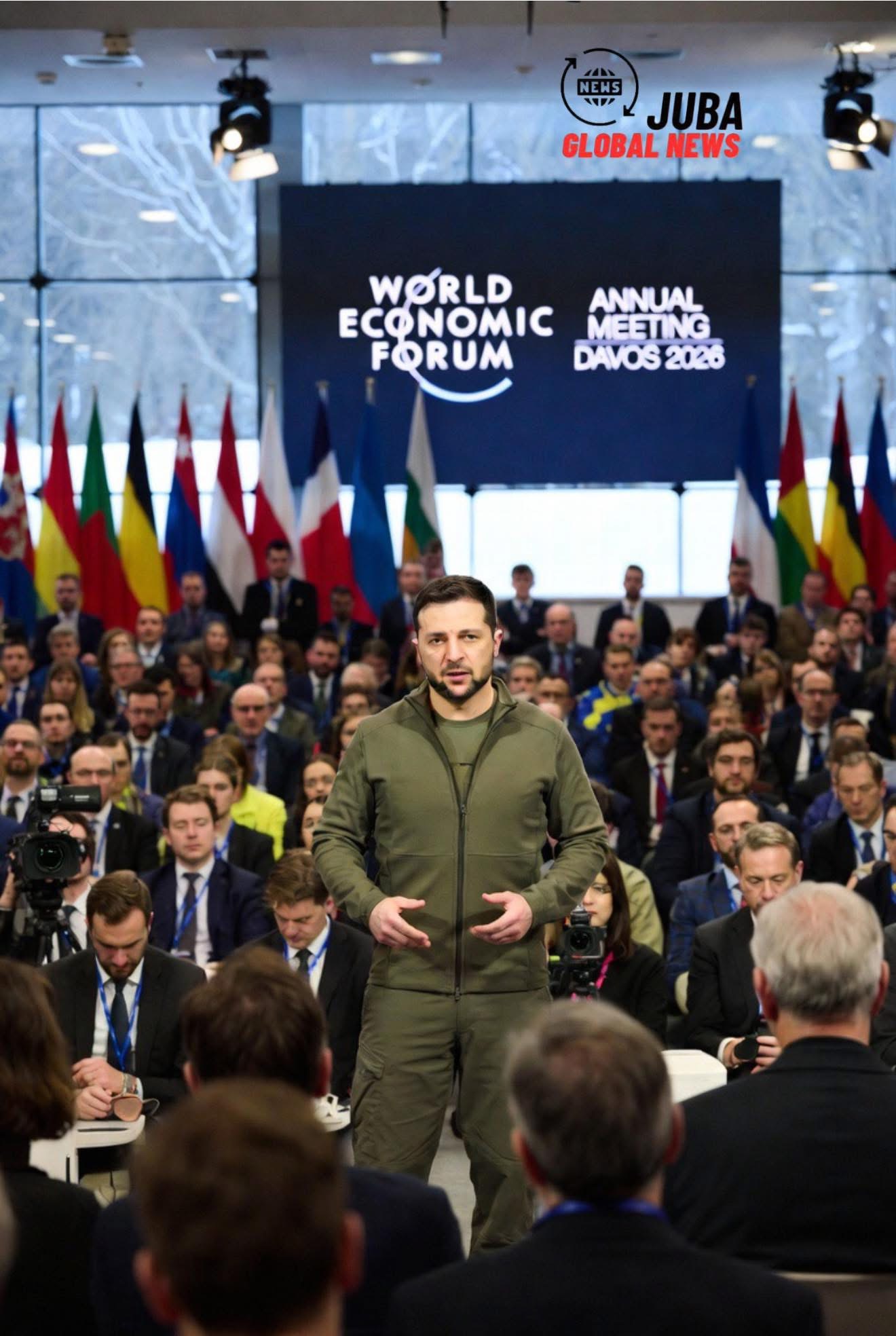
In a speech that cut through the polished optimism of the 2026 World Economic Forum in Davos, Ukrainian President Volodymyr Zelenskyy delivered a pointed and emotional critique of Europe’s waning commitment to Ukraine. Speaking on January 22, 2026, Zelenskyy asked the assembled global leaders a question that hung heavily over the alpine resort: “Where is the real support?” His words came at a critical juncture—just hours after Russia launched one of its largest air assaults of the year on Ukrainian cities, and as trilateral peace talks involving the U.S., Russia, and Ukraine continued in Abu Dhabi.
Zelenskyy’s appearance at Davos marked his first in-person address to the forum since the full-scale invasion began in 2022. The Ukrainian leader, dressed in his signature olive-green military-style attire, spoke to a packed hall of business executives, heads of state, and international policymakers. His message was clear: while diplomatic efforts to end the war were underway, Ukraine could not afford complacency or reduced support from its European partners.
“We are not asking for charity,” Zelenskyy said, his voice steady but edged with frustration. “We are asking for the tools to defend our people and our future. Europe has the capacity—economic, military, and moral—to stand firmly with us. But the question remains: where is that real support when it matters most?” He pointed to delays in promised weapon deliveries, hesitancy over long-range missiles, and what he described as “political fatigue” in several European capitals as contributing to a dangerous slowdown in aid.
The timing of Zelenskyy’s remarks amplified their impact. Just overnight, Russian forces had launched a massive barrage of drones and missiles on Kyiv, Kharkiv, Odesa, and other cities, killing civilians and damaging critical infrastructure. The strikes left parts of Ukraine without power in sub-zero temperatures, underscoring the urgency of continued military assistance. Zelenskyy tied the attack directly to the peace talks, accusing Russia of using violence to pressure Ukraine into unfavorable concessions.
“While we sit at the table in Abu Dhabi, bombs fall on our homes,” he said. “This is not diplomacy. This is terror. And it will not force Ukraine to surrender our sovereignty or our people.”
Zelenskyy’s speech highlighted specific grievances with European nations. He noted that while the U.S. has continued to provide substantial military aid, some European countries have fallen short of their commitments. Germany, once a major donor, has faced criticism for slow delivery of Leopard tanks and air defense systems. France and the UK have pledged support but have been cautious about supplying long-range weapons capable of striking deep into Russian territory. Zelenskyy called on Europe to “match words with action” and warned that any retreat in solidarity would embolden Russia.
The address also touched on the broader implications for European security. “If Ukraine falls, the next target will be closer to your borders,” Zelenskyy cautioned. “This is not just our war—it is Europe’s war. The price of hesitation today will be paid in blood tomorrow.”
The speech drew mixed reactions in the hall. Some European leaders appeared visibly uncomfortable, while others applauded the Ukrainian president’s candor. Behind closed doors, however, tensions were evident. German Chancellor Olaf Scholz, in a separate session, emphasized Europe’s ongoing support but stressed the need for “sustainable” aid packages. French President Emmanuel Macron reiterated his country’s commitment to Ukraine but reiterated the importance of avoiding escalation that could lead to direct NATO-Russia confrontation.
Zelenskyy’s appearance at Davos came amid cautious optimism about the Abu Dhabi talks, the first formal discussions involving high-level representatives from Russia, Ukraine, and the United States. While no major breakthroughs were announced, sources described the atmosphere as “productive” with progress on humanitarian issues and prisoner exchanges. However, the Russian air strikes immediately after the talks raised doubts about Moscow’s sincerity.
In his speech, Zelenskyy urged the international community not to “reward aggression with concessions.” He reiterated Ukraine’s position that any peace agreement must include the full withdrawal of Russian forces, the restoration of territorial integrity, and security guarantees to prevent future invasions.
The speech also highlighted Ukraine’s domestic resilience. Zelenskyy spoke of the courage of ordinary Ukrainians, from frontline soldiers to civilians rebuilding shattered communities. He paid tribute to the thousands who have lost their lives and called for continued global solidarity.
As the war enters its fifth year, Zelenskyy’s words served as both a plea and a warning. With winter deepening and Russian forces regrouping, Ukraine faces mounting challenges. The question he posed—“Where is the real support?”—echoes across Europe and beyond, challenging leaders to reaffirm their commitment or risk the unraveling of the rules-based international order.
Juba Global News Network will continue to cover developments from Davos, the Abu Dhabi talks, and the ongoing conflict in Ukraine. As President Zelenskyy made clear, the path to peace is narrow, and the cost of hesitation is high.
