

US Strikes Devastate Iran’s Kharg Island Military Targets in Major Blow to Regime’s Oil Export Defenses
By Juba Global News Network | JubaGlobal.comMarch 15, 2026 In a daring and highly coordinated overnight operation that has sent shockwaves through the Midd
By Juba Global News Network | JubaGlobal.comMarch 15, 2026
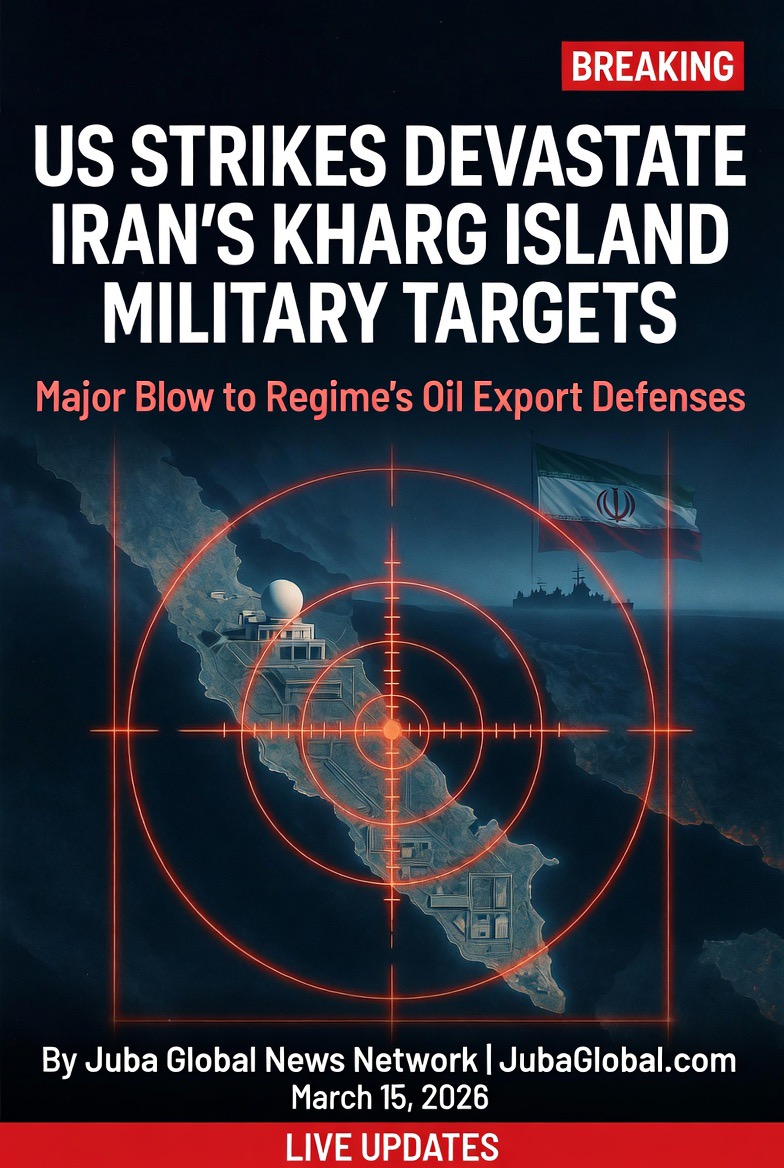
In a daring and highly coordinated overnight operation that has sent shockwaves through the Middle East and global energy markets, United States Central Command (CENTCOM) forces delivered a devastating series of precision strikes against more than 90 military installations on Iran’s strategically vital Kharg Island. The assault, which unfolded between March 13 and 14, 2026, marks one of the most significant direct US military actions against Iranian territory since the onset of the current US-Israel coalition campaign against the Islamic Republic.
President Donald J. Trump, speaking from the White House late on March 14, described the mission as an unqualified success. “We obliterated every military target on Kharg Island. Totally demolished. The radar systems, the missile batteries, the naval mine storage facilities — gone. We could have hit the oil terminals too, but we chose not to… for now,” the President told NBC News in an exclusive interview. He added a pointed warning to Tehran: “If they keep playing games with the Strait of Hormuz, we’ll come back and finish the job. And it might just be for fun next time.”
The strikes were executed using a combination of advanced stealth aircraft, long-range cruise missiles, and unmanned aerial systems. According to CENTCOM’s official briefing, F-35 Lightning II fighters operating from carriers in the Arabian Sea, supplemented by B-2 Spirit bombers flying from Diego Garcia, delivered the primary ordnance. Tomahawk cruise missiles launched from US Navy destroyers and submarines provided the opening salvos, while Reaper and Global Hawk drones supplied real-time targeting intelligence. The operation was completed in under six hours with zero reported US or coalition casualties.
High-resolution footage released by CENTCOM shows massive secondary explosions ripping through the Kharg Air Defense Complex, the Matla ul Fajr long-range radar installation (capable of tracking targets up to 500 kilometers away), underground missile silos, and naval mine-laying facilities at the island’s northern port. Kharg Airport’s runways and hangars were also rendered unusable. Independent satellite imagery analyzed by defense experts confirms at least 85 percent destruction of identified military infrastructure.
Crucially, the United States deliberately spared the island’s massive oil export terminals and storage tanks. Kharg Island handles approximately 80 percent of Iran’s total crude oil exports — roughly 2.5 million barrels per day under normal conditions. By leaving these facilities intact, Washington signaled a calibrated strategy: maximum pressure on Iran’s military capabilities without immediately triggering a full-scale global energy crisis. Nevertheless, oil markets reacted with volatility. Brent crude surged to $98.70 per barrel in early Asian trading on March 15 before settling near $96, while WTI hovered around $92. Analysts at Goldman Sachs warned that any future strikes on the oil infrastructure could push prices above $130 and tip the world economy into recession.
Iran’s response was swift and defiant. Mojtaba Khamenei, who assumed the role of Supreme Leader following the reported death of his father Ayatollah Ali Khamenei in late February, issued a televised address vowing continued closure of the Strait of Hormuz. “The Great Satan has attacked our soil, but we will not yield. The Strait remains closed until the aggressors withdraw. This is our leverage, and we will use it,” he declared. Iranian state media claimed the strikes killed 37 military personnel and wounded over 120, though independent verification remains impossible due to Tehran’s information blackout.
Iranian Foreign Ministry spokesman Nasser Kanaani accused Gulf Arab states — particularly the United Arab Emirates — of providing logistical support for the raid. “We have evidence that American aircraft used bases in the Emirates. Three major UAE ports have now been placed on high alert for possible Iranian retaliation,” he stated. Tehran also threatened to target US military installations across the region, including Al Udeid Air Base in Qatar and the Fifth Fleet headquarters in Bahrain.
The Kharg operation is part of a broader escalation that began on February 28, 2026, when Israeli forces launched preemptive strikes against Iranian nuclear and missile sites. Since then, the US-Israel coalition has conducted over 7,600 airstrikes inside Iran and 1,100 in Lebanon, according to Pentagon tallies. Iranian casualties now exceed 1,400 dead and 18,000 injured, with fresh strikes reported in the past 48 hours against facilities in Isfahan (killing at least 15 civilians and scientists), Tehran’s Space Research Centre, and multiple Islamic Revolutionary Guard Corps (IRGC) command posts.
On the ground in Lebanon, Hezbollah continues to launch short-range rockets into northern Israel, while Israeli Defense Forces have begun preparations for a possible large-scale ground incursion into southern Lebanon. In Israel itself, small but growing anti-war protests have emerged in Tel Aviv, with demonstrators criticizing the mounting financial cost of the campaign and the risk of wider regional conflict. “We support defending ourselves, but at what price?” one protester told local media.
The economic ripple effects are already being felt worldwide. Global shipping insurance rates for vessels transiting the Strait of Hormuz have quadrupled in the past two weeks. More than 30 tankers have been rerouted around the Cape of Good Hope, adding 14 days and millions of dollars to each voyage. Asian economies, particularly China, Japan, South Korea, and India — which together import over 70 percent of their oil from the Gulf — are bracing for supply shortages. China’s state-run Xinhua news agency accused Washington of “economic terrorism” and called for an emergency UN Security Council meeting.
Russia and China have both voiced strong support for Iran, with Moscow promising advanced air-defense systems and Beijing increasing its purchases of discounted Iranian crude through alternative routes. However, neither power has shown willingness to intervene militarily.
Back in Washington, President Trump urged oil-importing nations to contribute naval assets to secure the Strait. “Many countries that are very big users of oil from the Gulf will be sending War Ships, in conjunction with the United States,” he posted on Truth Social. Pentagon sources confirm that over 2,000 additional US Marines are deploying to the region aboard amphibious assault ships, and a carrier strike group centered on the USS Gerald R. Ford has been repositioned closer to the Strait.
Defense analysts describe the Kharg strikes as a potential turning point. “This is classic gunboat diplomacy with 21st-century precision,” said retired US Navy Admiral James Stavridis. “By destroying the military umbrella protecting the oil facilities without hitting the oil itself, the US has given Iran a very clear choice: keep disrupting global energy flows and lose your entire export capability, or negotiate.”
Iranian analysts, however, insist the regime remains resilient. “Kharg is symbolic, but Iran has other ports and can survive on domestic production and Asian black-market sales,” said Tehran-based political commentator Hossein Abasi. “The closure of the Strait hurts the West more than it hurts us in the long run.”
As the conflict enters its third week, the world watches with bated breath. Will Iran reopen the Strait in exchange for sanctions relief? Will the US escalate to full oil-facility strikes? Or will back-channel diplomacy — rumored to be underway through Oman and Qatar — produce a breakthrough?
Juba Global News Network will continue to provide round-the-clock, on-the-ground coverage of this rapidly evolving crisis. For live updates, exclusive footage, and expert analysis, visit JubaGlobal.com and follow us across all platforms.
Related Coverage:
- Fresh US-Israeli strikes hit Isfahan nuclear-adjacent sites
- Global oil prices and supply chain disruptions explained
- Mojtaba Khamenei’s first major address as Supreme Leader
- Hezbollah rocket barrage wounds civilians in Eilat
- Trump calls on allies to deploy warships to Hormuz
Stay informed. Stay ahead. Juba Global News Network — reporting the truth from the front lines.
