

US Precision Strikes ‘Obliterate’ Military Targets on Iran’s Kharg Island Oil Hub as Trump Warns of Further Action if Hormuz Remains Blocked
By Juba Global News Network | JubaGlobal.com March 16, 2026 In a major escalation of the ongoing US-Israel war against Iran, United States forces carried o
By Juba Global News Network | JubaGlobal.com
March 16, 2026
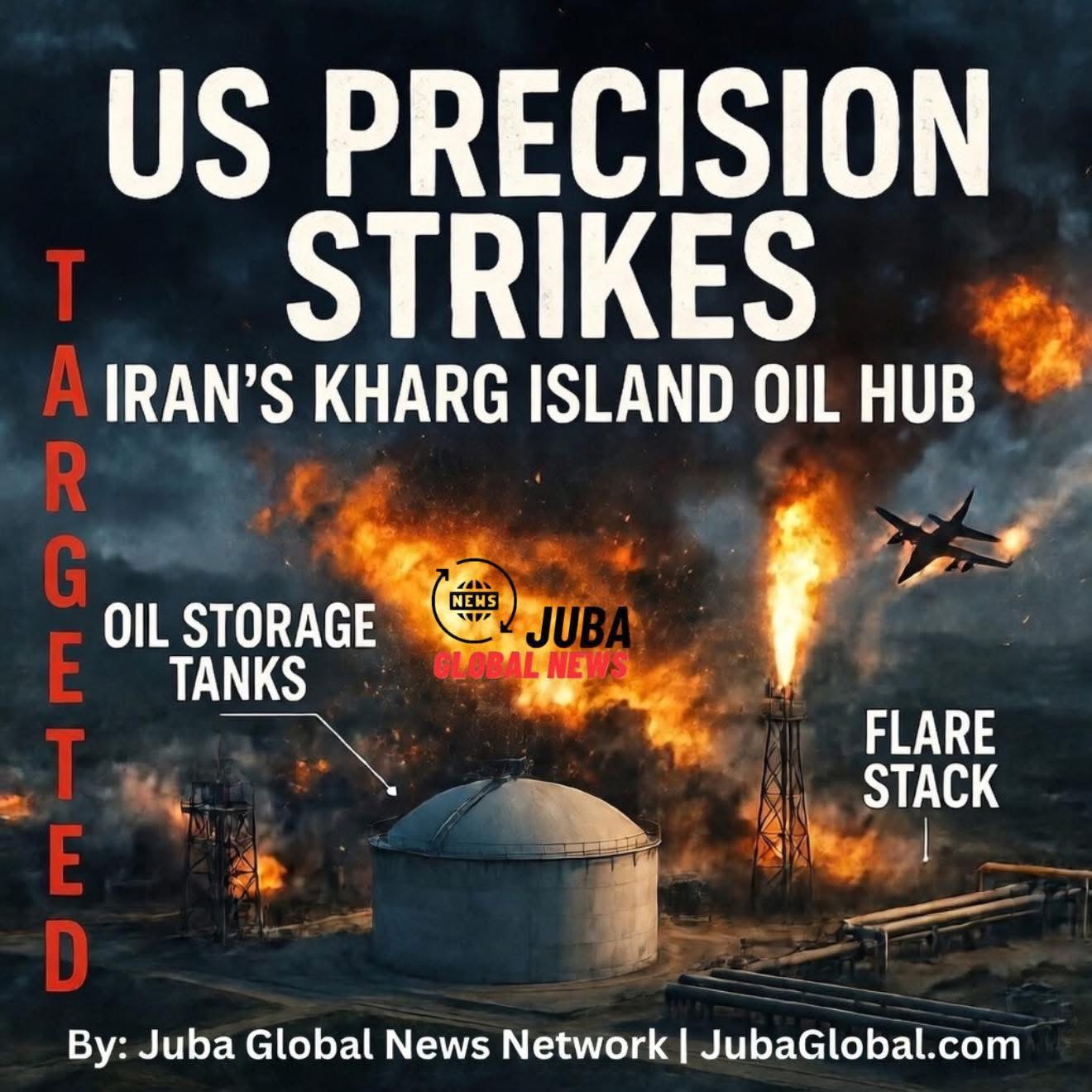
In a major escalation of the ongoing US-Israel war against Iran, United States forces carried out large-scale precision airstrikes on March 13 targeting over 90 military installations on Kharg Island — Iran’s primary oil export terminal responsible for handling approximately 90% of the country’s crude shipments. President Donald Trump described the operation as having “totally obliterated every military target” on the strategic island, while emphasizing that civilian oil infrastructure, including loading terminals, storage tanks, and processing facilities, was deliberately spared.
The strikes, part of Operation Epic Fury, focused on naval mine storage depots, missile bunkers, radar installations (including the long-range Matla ul Fajr early-warning system), air defense complexes, and the island’s airport used for military logistics. CENTCOM released declassified footage showing guided munitions striking hardened targets with pinpoint accuracy, producing massive secondary explosions consistent with destroyed munitions stockpiles.
Trump, speaking from the White House on March 14-15, issued a direct warning: if Iran continues to interfere with commercial shipping through the Strait of Hormuz — effectively halting most tanker traffic since early March — the US would “reconsider” its restraint and target the oil export facilities themselves. “We could do it just for fun if they keep playing games,” he added in characteristic blunt style, while calling on NATO allies and other partners to deploy warships to help secure the vital chokepoint.
Iran’s Response and Escalating Retaliation
Tehran condemned the attacks as “economic terrorism” and vowed severe consequences. Iranian officials claimed the strikes damaged a desalination plant supporting island residents, though US sources denied hitting civilian utilities. In retaliation, Iran launched its 54th wave of ballistic missiles since the war began, including the first confirmed combat use of the advanced solid-fuel Sejjil missile — a 1.5-ton warhead weapon capable of reaching Tel Aviv in roughly seven minutes with reduced detectability and interception challenges.
Missiles struck residential and military sites in central Israel, including Tel Aviv, causing property damage, minor injuries, and triggering widespread shelter alerts. Hezbollah intensified rocket barrages from Lebanon, while Iranian drones targeted Gulf states again, sparking fires near Dubai International Airport and forcing emergency responses in the UAE.
Oil Markets React with Volatility
Brent crude futures rose sharply following confirmation of the Kharg strikes and Trump’s threats, climbing toward $105 per barrel amid fears of a full export shutdown. Kharg Island’s military neutralization removes Iran’s ability to easily stage mine-laying or fast-boat swarm attacks from the island itself, but analysts warn that remaining mainland capabilities and proxy forces could still disrupt flows.
Global shipping remains paralyzed: over 150 vessels are anchored or rerouted, insurance rates have quadrupled, and major traders report near-total avoidance of the Gulf. The US has begun forming a multinational naval coalition to escort tankers and clear any mines already deployed (estimated at fewer than 10 so far, despite Iran’s arsenal of thousands).
Broader War Context: Day 17 of Intense Conflict
The Kharg operation comes on day 17 of the war that started February 28 with joint US-Israeli surprise attacks. Israel continued heavy strikes on Iranian cities including Hamadan, where massive smoke plumes rose from targeted sites, while US-Israeli forces claim to have degraded roughly 80-85% of Iran’s ballistic missile production and air defense network.
Civilian casualties mount: Iranian authorities report over 42,000 damaged civilian structures (homes, schools, hospitals) and hundreds dead. In Israel, repeated missile and rocket barrages have killed dozens and injured thousands. Gulf allies face ongoing drone threats, with black smoke reported near key infrastructure.
President Trump reiterated that the campaign aims for “total and decisive” victory, including dismantling Iran’s nuclear and missile threats. Diplomatic channels remain frozen, with Tehran rejecting talks unless attacks cease and reparations are paid.
As the war enters its third full week, the focus shifts to whether Iran’s remaining arsenal — including Sejjil missiles and proxy militias — can impose enough pain to force negotiations, or if US-led pressure on the Strait of Hormuz will compel Tehran to stand down.
Juba Global News Network continues round-the-clock coverage of this rapidly evolving crisis.
