

US Marine Expeditionary Units Deploy to Persian Gulf as Trump Administration Bolsters Naval Presence Amid Iran War Escalation
By Juba Global News Network | JubaGlobal.com March 16, 2026 In a significant show of force and deterrence, the United States has surged additional Marine E
By Juba Global News Network | JubaGlobal.com
March 16, 2026
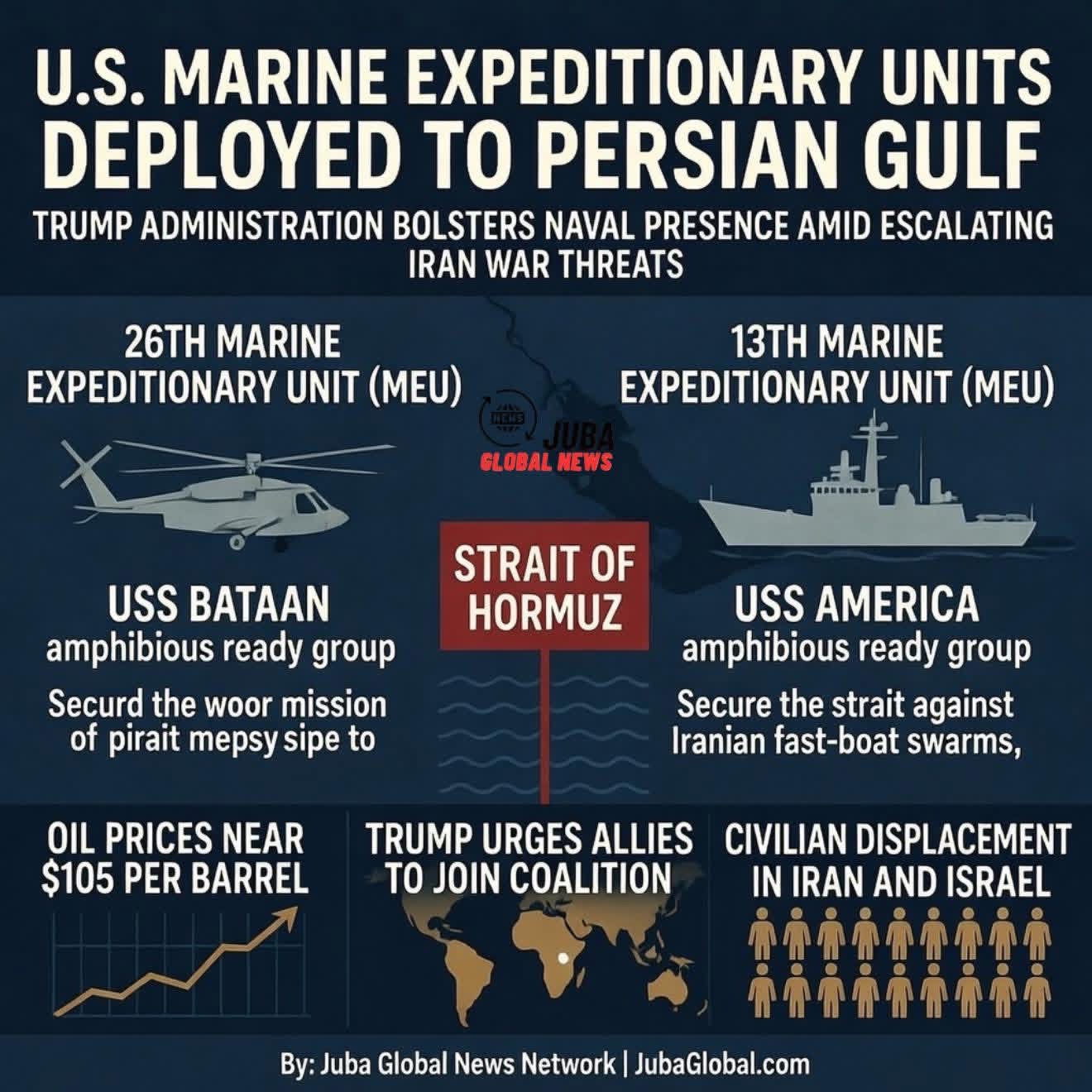
In a significant show of force and deterrence, the United States has surged additional Marine Expeditionary Units (MEUs) into the Persian Gulf and surrounding waters as the US-Israel war against Iran enters its 17th day. Pentagon officials confirmed today that elements of the 26th Marine Expeditionary Unit (embarked aboard the USS Bataan amphibious ready group) and reinforcements from the 13th MEU (forward-deployed with the USS America ARG) have been repositioned from the Mediterranean and Indian Ocean to join the existing carrier strike groups already operating in the region.
The deployment—described by Defense Department spokespersons as “prudent force posture adjustments to ensure freedom of navigation and deter further Iranian aggression”—comes amid Tehran’s continued threats to close the Strait of Hormuz and the near-total paralysis of commercial tanker traffic through the critical chokepoint.
Marine Mission: Secure Littorals, Counter Asymmetric Threats
Marine Expeditionary Units are versatile, self-sustaining air-ground task forces typically built around 2,200 Marines, reinforced with aviation combat elements (including MV-22 Ospreys, AH-1Z Vipers, UH-1Y Venoms, and F-35Bs), logistics support, and amphibious assault capabilities. Their rapid deployment to the Gulf is widely interpreted as preparation for several potential missions:
• Maritime interdiction and escort operations — Protecting commercial shipping if the multinational coalition (currently being assembled at President Trump’s urging) begins convoy escorts through the Strait.
• Mine countermeasures support — Using Marine reconnaissance and explosive ordnance disposal teams, alongside Navy MH-53E Sea Dragon helicopters, to clear any Iranian-laid mines (estimated fewer than 10 deployed so far, but thousands in inventory).
• Rapid crisis response — Providing quick-reaction forces for noncombatant evacuation operations (NEO), embassy reinforcement, or limited raids against Iranian fast-boat swarms and shore-based anti-ship missile batteries.
• Amphibious deterrence — Positioning amphibious ready groups near Iranian coastlines to signal readiness for larger-scale operations if the conflict escalates dramatically.
Pentagon briefers emphasized that no amphibious assault on Iranian soil is currently planned or authorized. Instead, the MEUs are positioned to “deter and, if necessary, respond to Iranian attempts to interfere with freedom of navigation in international waters.”
Trump’s Direct Pressure on Allies
President Donald Trump has repeatedly linked the Marine surge to his push for greater allied participation in securing the Strait. In remarks yesterday, he stated:
“We’ve got the best Marines in the world heading to the Gulf right now. We’re not asking anyone to do our fighting—we’re asking our so-called allies to show up. If you want cheap oil and safe shipping lanes, put your ships where your mouth is. NATO countries, Gulf partners—step up or be remembered.”
The president has reportedly spoken directly with leaders in the UK, France, Saudi Arabia, UAE, Bahrain, and others, pressing for additional warships and patrol aircraft. While the UK has quietly increased its Gulf presence and France has signaled willingness to join escort missions, no formal coalition task force has yet been announced.
Current Naval Posture in Theater
As of March 16:
• Carrier Strike Groups: USS Abraham Lincoln CSG and USS Dwight D. Eisenhower CSG remain on station, conducting continuous air operations over Iraq, Syria, and the Persian Gulf.
• Amphibious Ready Groups: USS Bataan ARG (26th MEU) and USS America ARG (13th MEU elements) now converging in the northern Arabian Sea / Strait of Hormuz approaches.
• Surface combatants: Multiple Arleigh Burke-class destroyers and Ticonderoga-class cruisers equipped for ballistic missile defense and mine countermeasures.
• Submarines: At least two Ohio-class guided-missile submarines (SSGNs) and Virginia-class attack submarines believed to be in the region, providing covert strike and intelligence capabilities.
CENTCOM has also repositioned additional KC-135 and KC-46 tankers to Diego Garcia and Al Udeid Air Base in Qatar to support extended fighter sorties.
Iranian Reaction and Escalation Risks
Iran’s Revolutionary Guard Corps Navy (IRGCN) has increased fast-boat patrols and missile boat deployments along its coastlines, conducting highly publicized “swarm exercises” in recent days. Senior commanders have threatened to target any coalition vessels attempting to force passage through the Strait if Tehran declares it closed to “enemy” shipping.
Tehran continues to reject negotiations unless US and Israeli strikes cease and reparations are paid for civilian damage. Iranian state media portrayed the Marine deployment as “proof of American desperation” and vowed that any amphibious landing attempt would meet “a fiery hell.”
Civilian and Economic Ripple Effects
With over 150 tankers idled or rerouted, insurance rates quadrupled, and Brent crude futures trading near $105 per barrel, the Marine surge underscores the high stakes for global energy markets. Analysts warn that even limited clashes in the Strait could send prices surging past $150, triggering recession fears worldwide.
Humanitarian groups continue to sound alarms over civilian casualties and displacement in Iran (over 3 million displaced), Israel (tens of thousands evacuated from northern communities), and Lebanon (1.1 million displaced by Israeli-Hezbollah clashes).
As additional Marine forces flow into theater, the Persian Gulf has become the most militarized waterway on Earth. Whether the deployment leads to de-escalation through strength or triggers a wider naval confrontation remains one of the defining questions of this rapidly evolving war.
Juba Global News Network will continue providing live updates on US military movements and regional reactions.
