

US and Venezuela Agree to Resume Diplomatic Ties Amid Broader Geopolitical Shifts in Middle East War
By: Juba Global News Network | JubaGlobal.comMarch 6, 2026 – 06:25 AM EST Update In a surprise diplomatic development on the seventh day of the US-Israel-I
By: Juba Global News Network | JubaGlobal.comMarch 6, 2026 – 06:25 AM EST Update
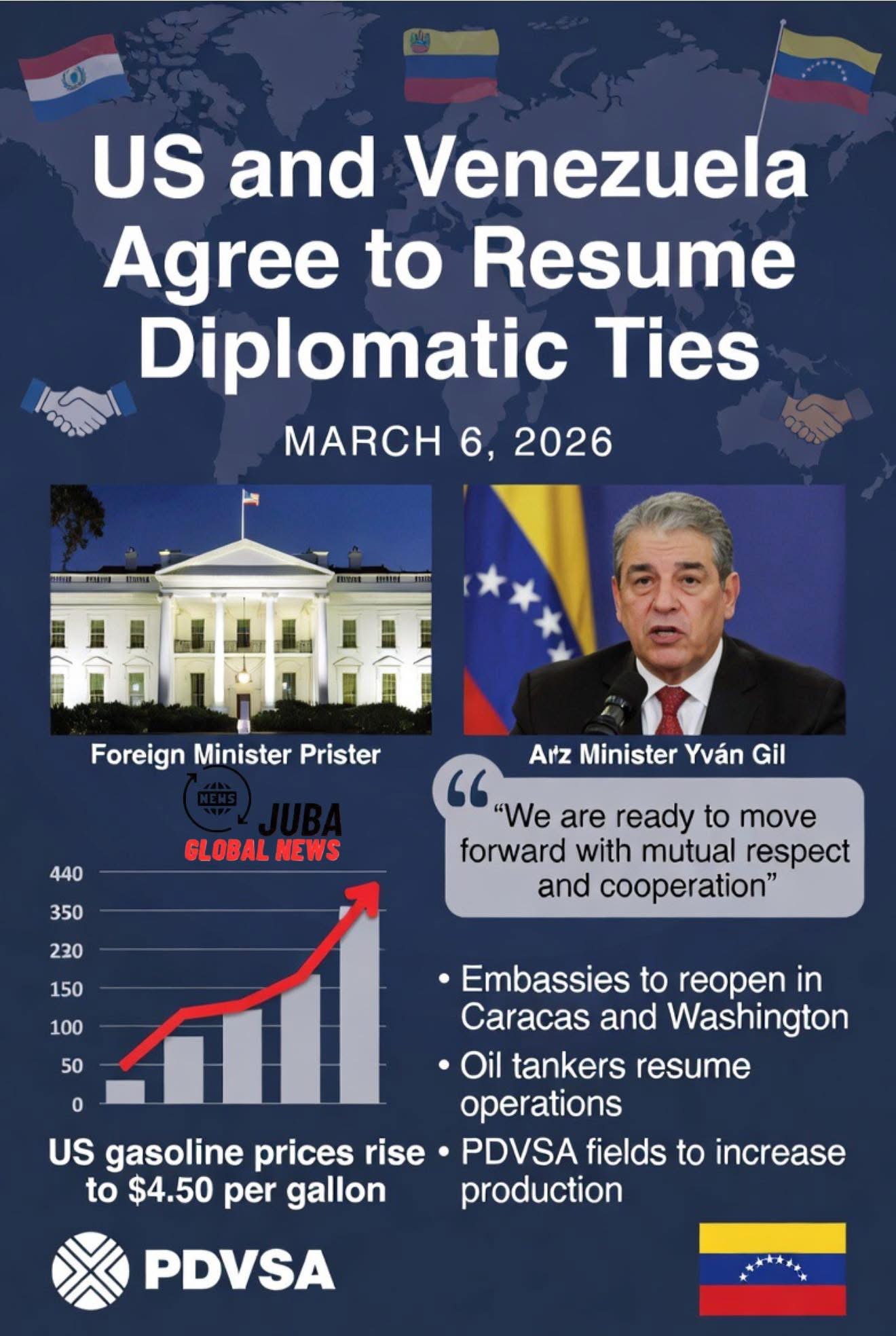
In a surprise diplomatic development on the seventh day of the US-Israel-Iran war, the United States and Venezuela announced an agreement to resume full diplomatic relations, reopen embassies, and exchange ambassadors for the first time since the rupture in 2019. The move, confirmed by the White House and Venezuelan Foreign Minister Yván Gil late March 5, comes amid dramatic geopolitical realignments triggered by the escalating conflict in the Middle East and appears designed to secure energy stability, reduce Russia’s influence in Latin America, and create breathing room for Washington on multiple fronts.
Background: From Rupture to Reconciliation
Diplomatic ties between Washington and Caracas were severed in January 2019 when the Trump administration recognized opposition leader Juan Guaidó as Venezuela’s interim president and withdrew recognition from Nicolás Maduro’s government. The US embassy in Caracas was downgraded to a “US Interests Section” under Swiss protection, and Venezuela’s embassy in Washington was shuttered. Sanctions, oil embargoes, and repeated attempts at regime pressure followed, driving Maduro closer to Russia, China, Iran, and Cuba.
The Biden administration maintained the hard line but quietly eased some oil sanctions in 2022–2023 to stabilize global markets after Russia’s invasion of Ukraine. Talks mediated by Qatar and Mexico in late 2023 produced limited prisoner swaps and temporary sanctions relief, but full normalization remained elusive—until now.
The Agreement: Key Terms
According to joint statements and sources briefed on the negotiations:
- Immediate resumption of embassy operations in Caracas and Washington, with ambassadors to be named within 60 days.
- Partial sanctions relief — The US will issue a six-month general license allowing US companies to resume limited crude purchases from PDVSA (Venezuela’s state oil company) and invest in maintenance of existing fields, provided revenues are used for humanitarian imports and debt servicing (not military purposes).
- Prisoner exchange — Release of several remaining US citizens detained in Venezuela (including some held since 2020–2022) in return for Venezuelan nationals held in the US on sanctions-violation or narcotics charges.
- Election roadmap reaffirmation — Maduro pledged to allow greater international observation of the 2025 presidential vote and release a number of political prisoners; the US reiterated its call for “free and fair” elections but stopped short of demanding Maduro’s exit.
- Energy security clause — Implicit understanding that increased Venezuelan crude exports (projected +300,000–500,000 bpd in coming months) will help offset losses from the Middle East crisis.
The deal does not include lifting secondary sanctions on Venezuelan gold or full normalization of financial relations.
Timing and Strategic Context
The announcement arrives at a moment of acute global energy stress:
- Iranian exports have collapsed to near zero.
- Saudi and Gulf loadings are disrupted by proxy attacks and transit fears.
- Asian refiners face acute shortages; US gasoline prices are climbing rapidly.
Venezuela holds the world’s largest proven oil reserves (~300 billion barrels) and could ramp up production from ~700,000 bpd to 1.2–1.5 million bpd within 12–18 months if investment returns. Even a modest increase helps cushion the market shock from the Persian Gulf.
Geopolitically, the move weakens Russia’s leverage in Latin America (Rosneft and other Russian firms have large stakes in Venezuelan fields) and reduces Maduro’s dependence on Tehran, which supplied drones, gasoline, and technical aid during sanctions. It also frees diplomatic bandwidth for the Trump administration as it manages the Iran war, Gulf escalations, and domestic political pressure over rising fuel costs.
Reactions
- US domestic — Republicans largely praised the pragmatic energy move; Democrats criticized it as “rewarding a dictator” and abandoning democratic principles. Consumer groups welcomed any relief at the pump.
- Venezuela — Maduro framed the deal as a “victory of resistance” and proof sanctions failed. Opposition figures (including María Corina Machado) denounced it as legitimizing the regime without real concessions.
- Russia & China — Moscow called it a “betrayal” of anti-imperialist solidarity; Beijing remained silent but is expected to push back quietly to protect its loans and oil stakes.
- Gulf states & Israel — Quiet approval; any diversification of global supply away from Iran is viewed positively.
- Oil markets — WTI and Brent futures pared some gains after the news, though volatility remains extreme.
Outlook
The agreement is fragile—implementation could stall over sanctions details, prisoner lists, or renewed crackdowns in Caracas. Yet it represents one of the first tangible diplomatic off-ramps in a war that has otherwise seen rapid escalation.
As Tehran burns, Tel Aviv faces barrages, Beirut suburbs smolder, and Gulf skies fill with interceptors, the US-Venezuela reset is a rare example of pragmatism cutting through the chaos. Whether it proves a stabilizing move or merely a footnote in a widening global crisis remains to be seen.
Juba Global News Network will track developments from the White House, Venezuelan Foreign Ministry, Reuters, Bloomberg, Argus Media, and regional sources. Energy and diplomatic landscapes shift quickly—stay tuned to verified outlets. Stay informed and safe.
