Ukraine’s Bold Christmas Day Strikes: Storm Shadow Missiles and Drones Target Russian Energy Infrastructure
Kyiv, December 25, 2025 – In a dramatic escalation on Christmas Day, Ukrainian forces launched a coordinated series of attacks deep inside Russian territor
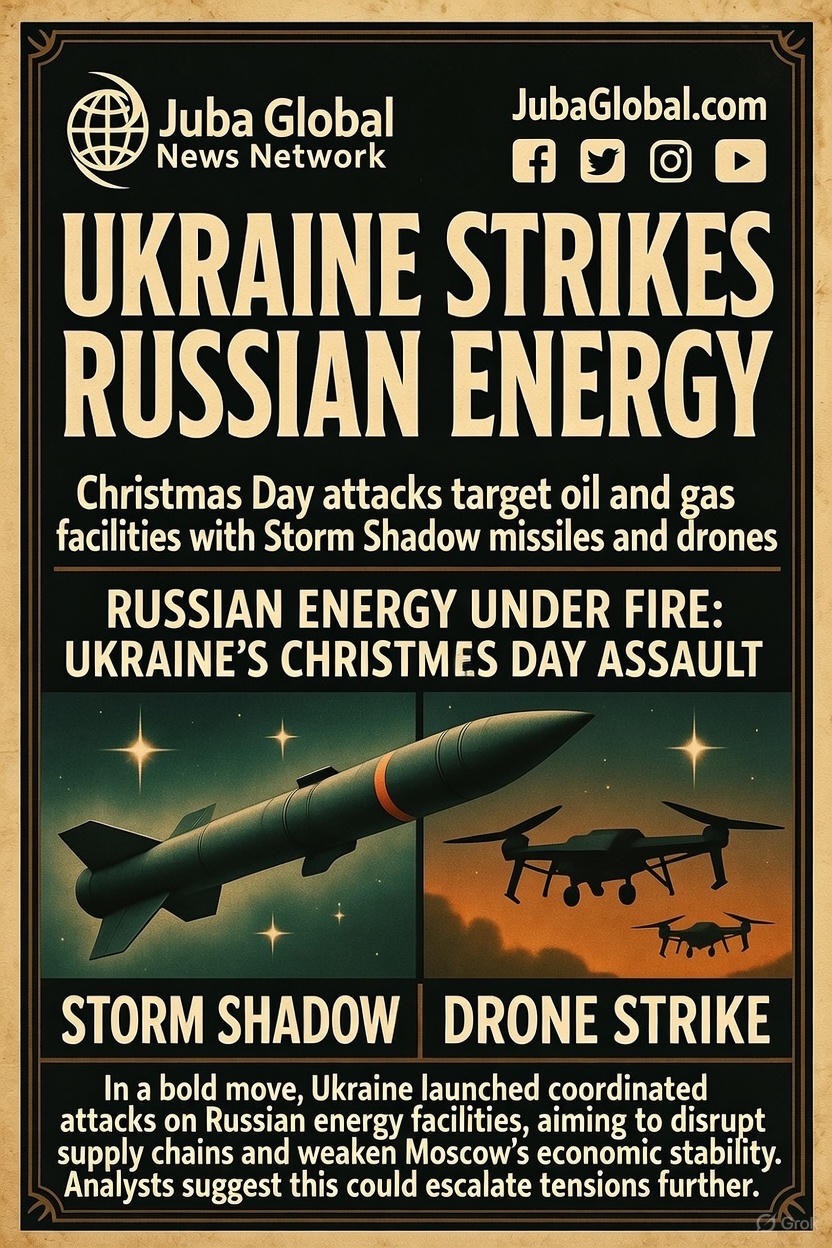
Kyiv, December 25, 2025 – In a dramatic escalation on Christmas Day, Ukrainian forces launched a coordinated series of attacks deep inside Russian territory, utilizing British-supplied Storm Shadow cruise missiles and domestically produced long-range drones to strike multiple oil and gas facilities. The operations, confirmed by Ukrainian military and security officials, underscore Kyiv’s ongoing campaign to disrupt Russia’s energy sector, a critical lifeline funding Moscow’s nearly four-year war effort.
The Ukrainian General Staff announced that the Air Force employed Storm Shadow missiles to target the Novoshakhtinsk oil refinery in Russia’s Rostov region, one of the largest suppliers of oil products in southern Russia and a key provider of fuel to Russian troops. Multiple explosions were reported at the site, with damage assessments ongoing. This marks a continued use of the advanced Western-supplied weaponry against strategic Russian industrial targets.
Simultaneously, Ukraine’s Security Service (SBU) revealed that its long-range drones successfully hit oil storage tanks at the Temryuk port in Krasnodar region and a major gas processing plant in Orenburg, southwestern Russia. Russian regional authorities confirmed fires at Temryuk, where flames engulfed two oil tanks over an area of approximately 2,000 square meters. The Orenburg facility, described as the world’s largest gas processing plant and located about 1,400 kilometers from the Ukrainian border, represents a significant blow to Russia’s natural gas infrastructure.
Additional reports indicate strikes on a military airfield in Maikop, Adygea republic, further demonstrating the breadth of the operation.
The Attacks in Detail: Targets and Impact
The Novoshakhtinsk refinery, located near the border with Ukraine, has long been a priority target for Kyiv due to its role in refining crude oil into fuels essential for Russian military logistics, including diesel and aviation kerosene. Ukrainian officials emphasized that the facility directly supports occupation forces. Video footage circulating on social media showed thick plumes of smoke rising from the site following the Storm Shadow impacts.
At Temryuk port on the Sea of Azov, drone strikes ignited massive fires in petroleum storage tanks. Regional emergency services mobilized to contain the blaze, with no immediate reports of casualties but significant disruption to port operations. Temryuk serves as a vital hub for oil exports and liquefied petroleum gas, making it a recurring target in Ukraine’s shadow campaign against Russia’s “shadow fleet” and energy export infrastructure.
The Orenburg gas processing plant strike highlights Ukraine’s expanding drone capabilities, reaching deep into Russian territory to hit economically vital assets. This facility processes vast quantities of natural gas, contributing substantially to Russia’s export revenues.
These attacks come amid mutual escalations in strikes on energy infrastructure. Russia has intensified drone and missile barrages on Ukrainian power grids and cities, while Ukraine has ramped up operations against Russian refineries and depots since August 2025, aiming to erode Moscow’s oil revenues—estimated to fund a significant portion of the war machine.
Storm Shadow: A Game-Changer in Ukraine’s Arsenal
The confirmed use of Storm Shadow missiles—air-launched, precision-guided cruise missiles with a range exceeding 250 kilometers—represents a potent escalation. Supplied by the United Kingdom (and jointly developed with France as SCALP), these weapons have been pivotal in previous strikes on Russian military-industrial complexes. Ukraine has employed them sparingly but effectively against high-value targets, often penetrating Russian air defenses.
The UK’s permission for Ukraine to use Storm Shadow inside Russian territory, granted in late 2024, has enabled such operations. This Christmas Day deployment signals Kyiv’s confidence in blending Western precision weaponry with its indigenous drone technology for multi-domain strikes.
Broader Context: A War Without Pause
As the conflict approaches its fourth anniversary in February 2026, both sides show no signs of de-escalation during the holiday season. Russian forces continued overnight drone attacks on Ukrainian cities, including Chernihiv and Odesa, causing casualties and infrastructure damage. Ukrainian President Volodymyr Zelenskyy condemned these as “brutal strikes” even on Christmas.
Diplomatic efforts, including recent U.S.-mediated proposals for ceasefires and peace plans, remain stalled. While Zelenskyy has signaled flexibility on certain issues, Russia’s advances on the ground and refusal to compromise on key demands prolong the stalemate.
Ukraine’s strategy of targeting energy assets aims not only to impose economic pain but also to force Russia into resource strain. Analysts note that repeated refinery hits have already reduced Russia’s refining capacity by notable percentages, impacting fuel availability for military operations.
Reactions and Implications
Russian officials downplayed the attacks, claiming most drones were intercepted, but confirmed fires and emergency responses. Pro-Kremlin commentators criticized the timing on “Catholic Christmas,” accusing Ukraine of deliberate provocation.
Internationally, the strikes highlight Western support for Ukraine’s defensive capabilities extending to offensive actions against war-sustaining infrastructure. The UK and allies have defended such uses as legitimate under international law.
For Ukraine, these operations boost morale and demonstrate resilience, proving Kyiv can project power far beyond the frontlines. However, risks of Russian retaliation—potentially intensified strikes on civilian infrastructure—loom large.
As winter deepens and energy becomes a battlefield weapon, Ukraine’s Christmas Day offensive serves as a stark reminder: in this protracted war, there are no holidays from hostilities.
This report is based on statements from Ukrainian military sources, Russian regional authorities, and international media monitoring.
By: Juba Global News Network | JubaGlobal.com