Ukraine War Marks Four-Year Anniversary
The four-year anniversary of Russia’s full-scale invasion of Ukraine, observed on February 24, 2026, stands as a grim reminder of Europe’s most devastating conflict since World War II. What Moscow initially billed as a swift “special military operation” to “de-Nazify” and “demilitarize” Ukraine has devolved into a prolonged war of attrition, claiming hundreds of thousands of lives, displacing millions, and reshaping global security dynamics. As the war enters its fifth year, frontlines remain largely static in many areas, diplomatic breakthroughs prove elusive, and both sides show no signs of yielding on core demands.
The Invasion’s Launch and Initial Miscalculations
Russia’s assault began in the early hours of February 24, 2022, with missile strikes across Ukraine, ground incursions from multiple directions—including from Belarus toward Kyiv—and airborne assaults aimed at capturing key infrastructure. President Vladimir Putin declared the goal was to protect Russian-speaking populations in Donbas, eliminate perceived threats from NATO expansion, and prevent Ukraine from becoming a Western-aligned state. Analysts widely expected a quick victory, with Russian forces reaching Kyiv within days.
Those expectations collapsed rapidly. Ukrainian defenses, bolstered by pre-invasion Western intelligence and rapid mobilization, repelled advances on the capital. Russian columns bogged down in northern Ukraine suffered heavy losses from ambushes, anti-tank weapons like Javelins, and drone strikes. By late March 2022, Moscow withdrew from the north, shifting focus to the east and south. The initial phase exposed logistical failures, poor morale, and underestimation of Ukrainian resolve—setting the tone for a conflict far longer and costlier than anticipated.
Battlefield Stalemate and Territorial Realities
Four years on, Russia controls approximately 19-20% of Ukraine’s territory, including Crimea (annexed in 2014) and significant portions of Donetsk, Luhansk, Zaporizhzhia, and Kherson oblasts. Gains in 2025 were marginal—around 0.8% of Ukrainian land per some assessments—often at staggering human cost. Russian advances remain slow and attritional, relying on mass artillery, glide bombs, and waves of infantry supported by North Korean-supplied munitions.
Ukraine has demonstrated resilience through innovative drone warfare, deep strikes into Russian territory, and occasional counteroffensives. Recent reports highlight Ukrainian gains in southern sectors (e.g., Dnipropetrovsk and Zaporizhzhia oblasts), recapturing settlements and stabilizing lines in the north near Kupyansk. However, the overall front remains “frozen” in many places, characterized by trench warfare reminiscent of World War I but augmented by modern technology like FPV drones and electronic warfare.
Casualty figures are horrific. The UN has verified at least 15,172 civilian deaths and over 41,000 injuries since 2022. Military losses are far higher: estimates suggest Russia suffered over 400,000 casualties in 2025 alone, with total figures (killed and wounded) approaching 1.2-1.3 million. Ukrainian military casualties are estimated in the hundreds of thousands, though official numbers remain closely guarded.
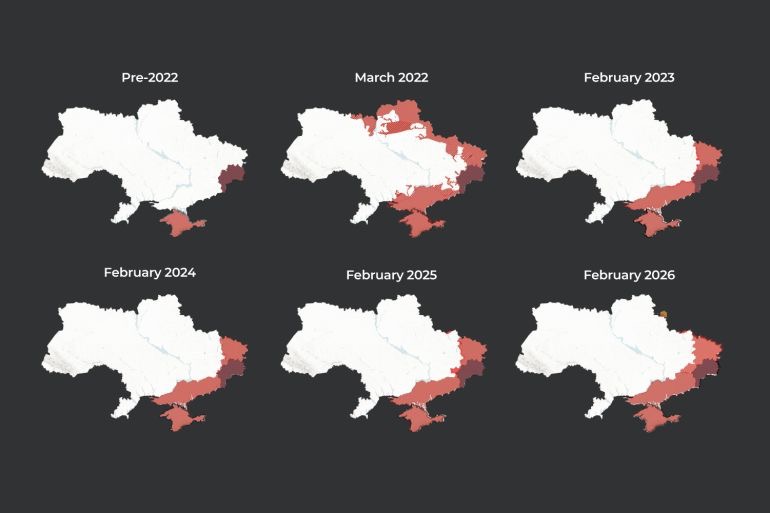
This map illustrates the progression of Russian-controlled territory from pre-2022 (including Crimea and parts of Donbas) through February 2026, showing limited net expansion despite years of fighting.
Commemorations, Leadership Messages, and International Solidarity
Ukrainian President Volodymyr Zelenskyy marked the day with a defiant address, declaring: “Putin has not achieved his goals. He has not broken Ukrainians. He has not won this war.” He emphasized Ukraine’s preservation of independence and statehood, vowing to pursue “peace and justice” while urging continued Western aid—particularly air defenses—and pushing for EU accession talks to target 2027. Zelenskyy hosted leaders from the “Coalition of the Willing,” including EU officials and Nordic-Baltic representatives, in Kyiv for solidarity events.
NATO Secretary General Mark Rutte praised Ukraine as a “nation of heroes,” noting Russia’s failure to meet battlefield objectives and reaffirming the alliance’s commitment to sustained military, financial, and humanitarian support. The UN General Assembly adopted a resolution calling for an immediate, full, and unconditional ceasefire, with strong backing from member states.
Pope Leo XIV renewed his longstanding calls for peace, stating ahead of the anniversary: “Let the weapons fall silent, let the bombings cease, let an immediate ceasefire be reached, and let dialogue be strengthened to pave the way toward peace.” He described the conflict as leaving “death, devastation, and a trail of pain that marks generations,” stressing that “peace cannot be postponed.”
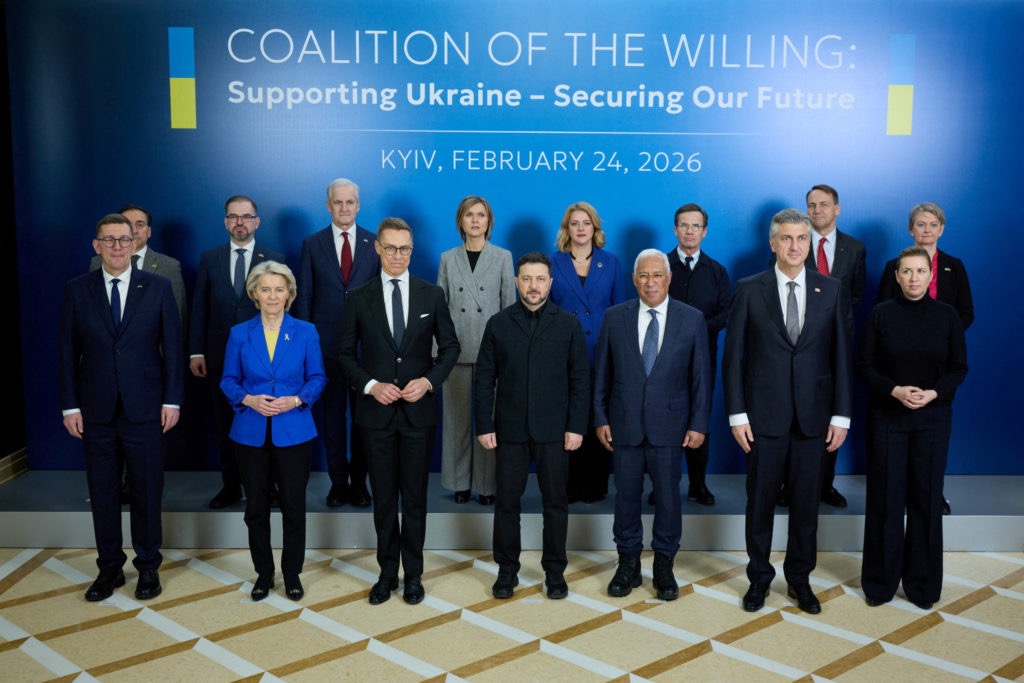
Ukrainian President Volodymyr Zelenskyy (center) stands with international leaders during a Coalition of the Willing event in Kyiv on February 24, 2026, symbolizing ongoing global support.
From Moscow, responses were muted. Kremlin officials avoided extensive commentary on the anniversary, reiterating that “goals” like demilitarization and denazification remain unfulfilled. Some Russian statements focused on diversionary claims, including unsubstantiated allegations about Western transfers of nuclear-related materials to Ukraine.
Hybrid Threats and Recent Escalations
The anniversary period saw heightened hybrid warfare. Just days prior, explosions in Lviv—a western city far from frontlines—killed a 23-year-old police officer and injured 25 others. Authorities described it as a terrorist act involving improvised explosive devices planted in waste bins near a retail area. A suspect was detained, allegedly recruited via Telegram by Russian special services. President Zelenskyy warned of ongoing efforts to incite such sabotage and destabilize rear areas.
Russia continued large-scale drone and missile barrages targeting energy infrastructure, exacerbating winter hardships for civilians.

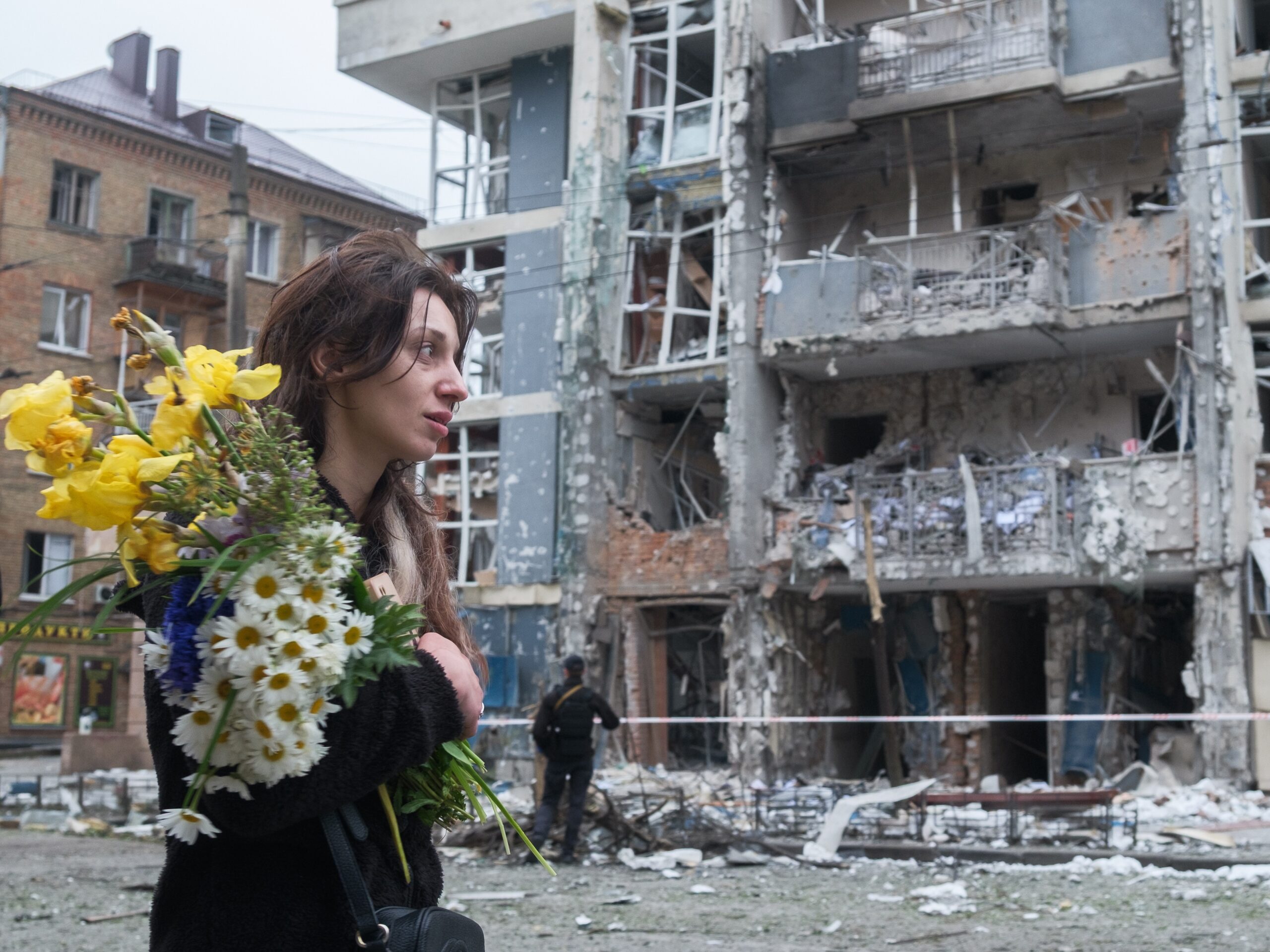
A Ukrainian woman walks past the ruins of a residential building destroyed in the ongoing conflict, highlighting the widespread devastation four years into the war.
Diplomatic Horizons and Global Impact
Peace efforts, including U.S.-mediated talks in Geneva, have seen procedural movement but little substantive progress. Russia maintains maximalist positions, while Ukraine insists on full territorial restoration, accountability for war crimes, and security guarantees. Under U.S. President Trump, there’s increased pressure for negotiations, though European allies emphasize no concessions without justice.
The war has transformed global security: NATO expanded with Finland and Sweden’s accession, Europe’s defense spending surged, and Ukraine’s military became one of Europe’s strongest through combat experience. Yet the human toll—displaced millions, ruined cities, generational trauma—underscores the urgency for resolution.
As Zelenskyy reflected, “We have preserved Ukraine.” Whether the fifth year brings breakthrough diplomacy or continued stalemate will define the conflict’s trajectory. For now, the anniversary serves as both a tribute to Ukrainian endurance and a stark warning of the costs of unresolved aggression.