

Trump’s 48-Hour Ultimatum to Iran: Will the U.S. “Obliterate” Power Plants to Force Open the Strait of Hormuz?
By Juba Global News Network | JubaGlobal.com March 22, 2026 – Updated as of 07:20 AM EDT Fort George G. Meade Junction, Maryland In a dramatic late-night e
By Juba Global News Network | JubaGlobal.com
March 22, 2026 – Updated as of 07:20 AM EDT
Fort George G. Meade Junction, Maryland
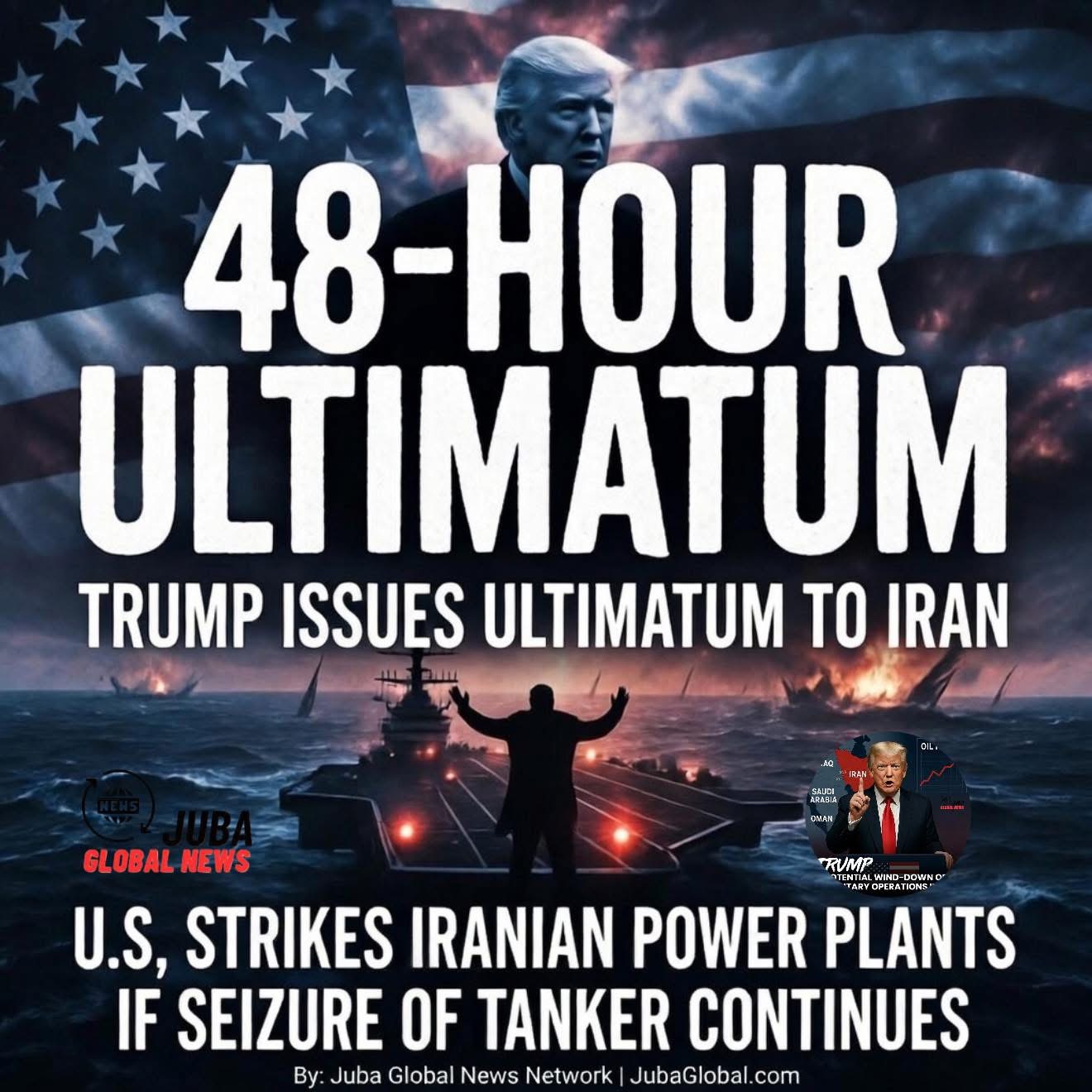
In a dramatic late-night escalation that has sent shockwaves through global markets and diplomatic channels, U.S. President Donald Trump issued a blunt 48-hour ultimatum to Iran on Saturday evening via his Truth Social platform. The demand: fully reopen the Strait of Hormuz “WITHOUT THREAT” or face immediate and devastating U.S. strikes on Iran’s power plants, beginning with the largest facility.
Trump’s post, timestamped around 7:44 PM ET (23:44 GMT) on March 21, 2026, read in full:
“If Iran doesn’t FULLY OPEN, WITHOUT THREAT, the Strait of Hormuz, within 48 HOURS from this exact point in time, the United States of America will hit and obliterate their various POWER PLANTS, STARTING WITH THE BIGGEST ONE FIRST! Thank you for your attention to this matter. President DONALD J. TRUMP.”
The deadline now ticks toward approximately 7:44 PM ET on Monday, March 23, 2026 (or early Tuesday in Tehran), placing the world on the brink of what analysts describe as a potential catastrophic new phase in the four-week-old U.S.-Israeli war against Iran.
The Spark: A Chokepoint in Crisis
The Strait of Hormuz—a narrow, 21-mile-wide waterway connecting the Persian Gulf to the Gulf of Oman—remains one of the most strategically vital arteries in global energy trade. Approximately 20-21% of the world’s seaborne crude oil and a substantial share of liquefied natural gas (LNG) pass through it daily, primarily from producers like Saudi Arabia, Iraq, the UAE, Kuwait, and Qatar.
Since the outbreak of full-scale conflict on February 28, 2026, following Operation Epic Fury—a massive joint U.S.-Israeli airstrike campaign that targeted Iranian military sites, nuclear facilities (including Natanz), and reportedly resulted in the death of Supreme Leader Ali Khamenei—Iran has effectively imposed a de facto blockade. Tehran has deployed naval mines, fast-attack boats, drones, and threats against commercial shipping, while allowing limited passage for vessels from “friendly” nations such as China, India, and Pakistan. Ships linked to the U.S., Israel, or their allies face severe risks, including attacks or forced rerouting.
The result has been chaos in energy markets:
- Oil prices have surged dramatically, with Brent crude reflecting extreme volatility.
- European natural gas prices jumped as much as 35% in recent sessions.
- Global shipping firms have largely halted transit, rerouting around Africa or avoiding the region entirely.
This disruption has fueled inflation fears, supply shortages in Asia, and intense domestic pressure on the Trump administration to resolve the crisis.
Trump’s Reversal: From “Winding Down” to Escalation
The ultimatum marks a sharp pivot. Just days earlier, on March 20, Trump had publicly floated the idea of “winding down” U.S. military involvement, suggesting that allies should police the strait themselves. He wrote that the U.S. “does not” need to guard it, urging nations like China, Japan, South Korea, France, and the UK to deploy warships.
Yet soaring gasoline prices at American pumps, stranded tankers, and criticism from allies appear to have shifted the calculus. Trump now demands full, unrestricted access—no mines, no threats, no selective enforcement—and threatens strikes on civilian-critical infrastructure: Iran’s power grid.
Targeting power plants would likely cause widespread blackouts, disrupt military communications, cripple industrial output, and trigger humanitarian fallout for millions of Iranian civilians already enduring strained services from prior strikes.
Iran’s Defiant Response
Tehran wasted no time rejecting the demand as “aggression” and “bluff.” Iranian state media and military spokespersons warned that any attack on power infrastructure would prompt massive retaliation against U.S. energy assets and military bases across the Middle East, potentially including Gulf oil fields, refineries, and naval installations.
An Iranian official at the UN’s International Maritime Organization, Ali Mousavi, insisted the strait remains “open” to all vessels except those of “enemy” countries—with passage possible via coordination for “security and safety.” This framing maintains the blockade while offering a diplomatic veneer.
Iran’s armed forces continue to assert de facto control, emphasizing that U.S.-Israeli “aggression” is the root cause of the closure.
Broader War Context and Risks
The ultimatum arrives amid relentless escalation:
- Iranian ballistic missiles struck southern Israeli cities Dimona and Arad on March 22, injuring over 100 (including children) near the Dimona nuclear research center.
- U.S. Central Command reports over 8,000 targets struck in Iran, with significant degradation of naval and missile capabilities.
- Proxy fronts rage: Hezbollah claims dozens of attacks from Lebanon, while disruptions ripple to the Red Sea via Houthis.
- Russia reaffirms support for Iran as a “loyal friend,” offering mediation while condemning U.S. actions.
- A coalition of 22 nations has urged Iran to reopen the strait, but no unified naval escort operation has fully materialized.
Analysts warn that U.S. strikes on power plants could:
- Trigger Iranian missile/drone swarms on U.S. carriers and bases.
- Expand attacks to Gulf energy infrastructure, echoing the 1980s Tanker War but on a larger scale.
- Risk a “Black Monday” market crash from prolonged energy shocks.
- Drag in additional powers, from NATO allies to China (heavily reliant on Gulf oil).
Some reports suggest the U.S. is weighing options like occupying or blockading Iran’s Kharg Island oil terminal to force compliance—a move that would represent another major escalation.
What Happens Next?
As the clock runs down, possibilities include:
- Backchannel diplomacy or partial concessions from Tehran.
- Limited Iranian gestures (e.g., clearing mines for select traffic).
- U.S. follow-through on strikes, potentially sparking wider regional war.
- Allied intervention to secure shipping lanes.
The world watches anxiously. With thousands already dead, economies reeling, and no clear off-ramp, Trump’s “obliterate” rhetoric underscores how a targeted military operation has morphed into a global energy and security emergency.
Juba Global News Network will continue monitoring developments in real time. For live updates, analysis, and the latest from the front lines, visit JubaGlobal.com. 🌍
All information based on public reports and statements as of March 22, 2026. Situation remains highly fluid.
