Trump Unveils “The Great Healthcare Plan”: Bold Promises to Slash Costs, Expand Access, and Overhaul U.S. Medical System
By: Juba Global News Network | JubaGlobal.com
Published: January 16, 2026
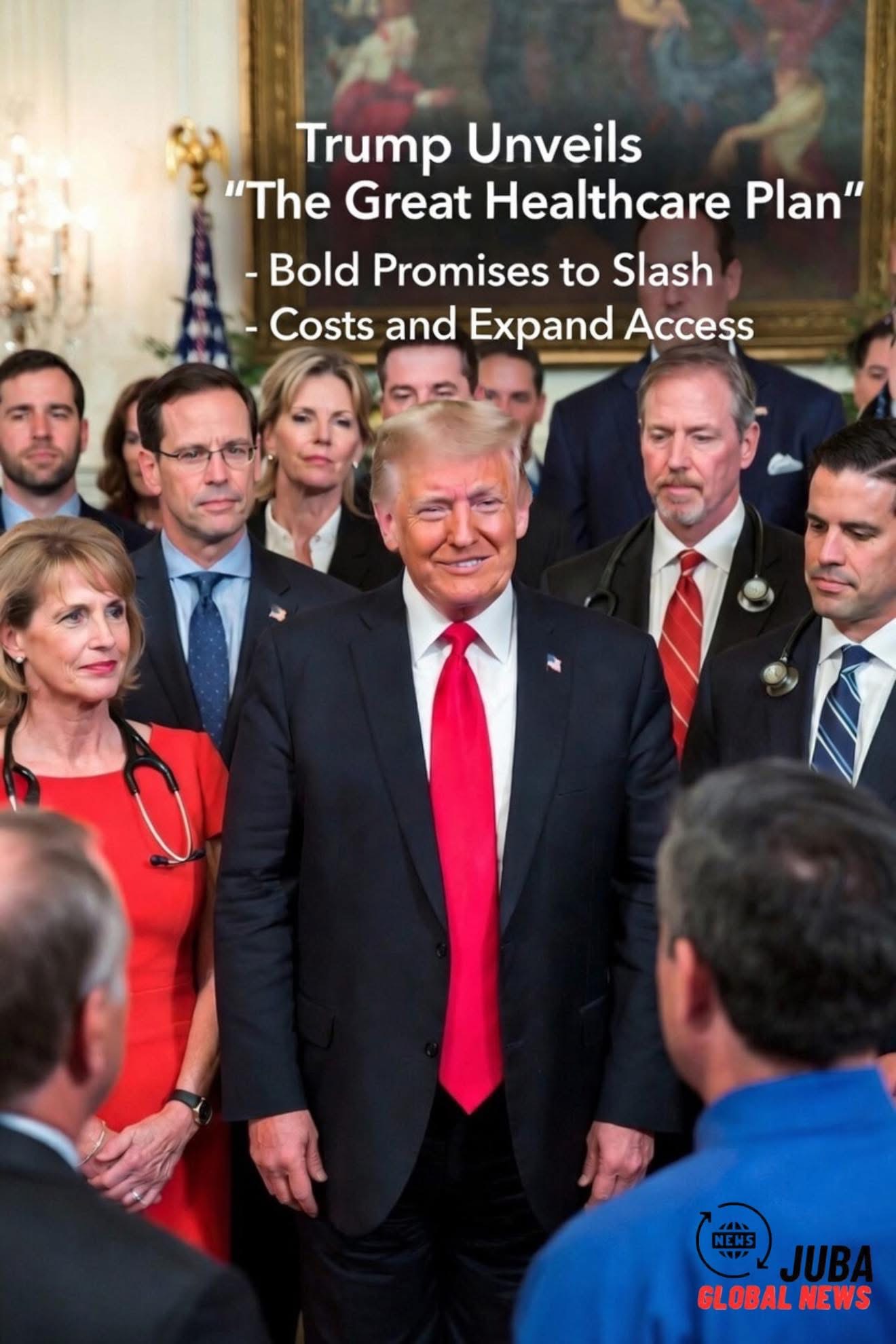
President Donald Trump formally introduced “The Great Healthcare Plan” during a high-profile White House event on January 15, 2026, describing it as the most sweeping, pro-patient, and cost-cutting healthcare reform in American history. The plan—outlined in a 28-page blueprint released by the administration—aims to dramatically lower prescription drug prices, expand choice and competition, reduce hospital and insurance bureaucracy, protect pre-existing conditions more aggressively than current law, and eliminate what Trump called “waste, fraud, and abuse” that he claims inflates costs for working families.
Speaking from the East Room flanked by physicians, small-business owners, and patients, Trump declared: “For too long, Americans have been crushed by sky-high bills, surprise charges, and a system rigged for Big Pharma and big insurance. The Great Healthcare Plan puts patients first, doctors second, and bureaucrats last. We are going to make healthcare great again—better, cheaper, and available to everyone who wants it.”
Key Pillars of “The Great Healthcare Plan”
- Prescription Drug Price Reduction – Most Favored Nation + Direct Negotiation
The plan revives and expands Trump’s first-term “Most Favored Nation” policy, requiring drug manufacturers to offer U.S. patients the lowest prices paid in any other developed country for the same medications. The administration claims this alone could cut prices on the 50 most expensive drugs by 30–60%.
In addition, the plan directs the Department of Health and Human Services (HHS) to immediately begin direct price negotiations with pharmaceutical companies for high-cost drugs under Medicare Part D and the new Medicare Advantage framework—bypassing the slower Inflation Reduction Act timeline. Trump promised executive action within 60 days if Congress does not pass supporting legislation. - Price Transparency 2.0 and Surprise Billing Crackdown
Building on the 2020 No Surprises Act, the plan mandates real-time, upfront price disclosure for every hospital procedure, test, and doctor visit—enforceable with steep fines for non-compliance. Patients would receive binding “good faith estimates” before treatment, with hospitals and insurers liable for any significant deviation.
The administration also proposes banning “facility fees” for routine outpatient care and requiring insurers to cover emergency services at in-network rates regardless of hospital network status. - Expanded Choice Through Association Health Plans and Short-Term Coverage
Trump plans to reissue rules allowing small businesses, trade associations, and self-employed individuals to band together in large-group Association Health Plans (AHPs) across state lines—bypassing costly state mandates and regulations.
Short-term, limited-duration insurance policies would be extended from 364 days to three years (with guaranteed renewability), offering lower premiums for healthy individuals while preserving protections for pre-existing conditions in the individual market. - Medicare & Medicaid Reforms – Block Grants and Premium Support
For Medicaid, the plan proposes converting the program to block grants with per-capita caps adjusted for inflation and population growth—giving states greater flexibility to design coverage while capping federal spending growth.
On Medicare, Trump reiterated support for premium-support models (similar to Medicare Advantage expansion) and vows to protect current beneficiaries over 55 from benefit cuts. The plan also accelerates Medicare drug-price negotiation timelines and seeks to rein in “overutilization” through value-based care incentives. - Tort Reform and Administrative Cost Reduction
The blueprint calls for federal limits on non-economic damages in medical malpractice lawsuits (capping pain-and-suffering awards at $250,000–$500,000 depending on state), streamlined medical-licensing reciprocity across states, and elimination of redundant paperwork requirements that force doctors to spend hours on billing rather than patients.
Administrative simplification targets aim to reduce the U.S. healthcare system’s estimated $500 billion+ in annual paperwork and billing costs. - Pre-Existing Conditions & Coverage Guarantees
Trump repeatedly emphasized that “no American with a pre-existing condition will ever be denied coverage or charged more” under his plan—strengthening existing protections in the Affordable Care Act while removing what he called its “onerous mandates and taxes.”
Political and Industry Reactions
Republican congressional leaders, including House Speaker Mike Johnson and Senate Majority Leader John Thune, expressed strong support, promising fast-track consideration of key elements in the 2026 session. Industry groups offered mixed responses: the Pharmaceutical Research and Manufacturers of America (PhRMA) warned that aggressive price controls could stifle innovation, while the American Hospital Association criticized potential cuts to Medicaid funding. The American Medical Association praised tort reform and administrative relief but urged caution on block grants that could reduce coverage for low-income patients.
Democratic leaders immediately labeled the plan “a giveaway to insurance companies and Big Pharma dressed up as reform.” Senate Minority Leader Chuck Schumer called it “a rehash of failed 2017 repeal efforts that would have left millions uninsured.” Progressive groups highlighted the absence of a public option or Medicare-for-All pathway, arguing the proposals prioritize deregulation over universal coverage.
Economic and Implementation Outlook
The White House estimates the plan could reduce average family healthcare premiums by 15–25% within five years through competition, transparency, and drug-price cuts. Independent analyses (from the Congressional Budget Office and think tanks) are pending, but early projections suggest modest federal savings from Medicaid caps offset by higher costs if short-term plans siphon healthier individuals from ACA exchanges.
Implementation will rely heavily on executive action in the early stages—particularly on Most Favored Nation pricing, transparency rules, and AHP expansion—while major structural changes (block grants, tort reform) require congressional approval. With narrow Republican majorities and a packed 2026 legislative calendar, passage is far from guaranteed.
As the administration begins stakeholder consultations and regulatory drafting, “The Great Healthcare Plan” stands as one of President Trump’s signature domestic initiatives of his second term—ambitious in scope, polarizing in politics, and certain to dominate healthcare debates throughout 2026.
Juba Global News Network will track regulatory proposals, congressional action, and expert analyses as the plan moves forward.
Sources: White House fact sheet and East Room remarks (January 15, 2026), HHS briefing documents, Reuters, The Wall Street Journal, Politico, Kaiser Family Foundation preliminary analysis, American Medical Association statements, PhRMA response, and congressional leadership offices.