

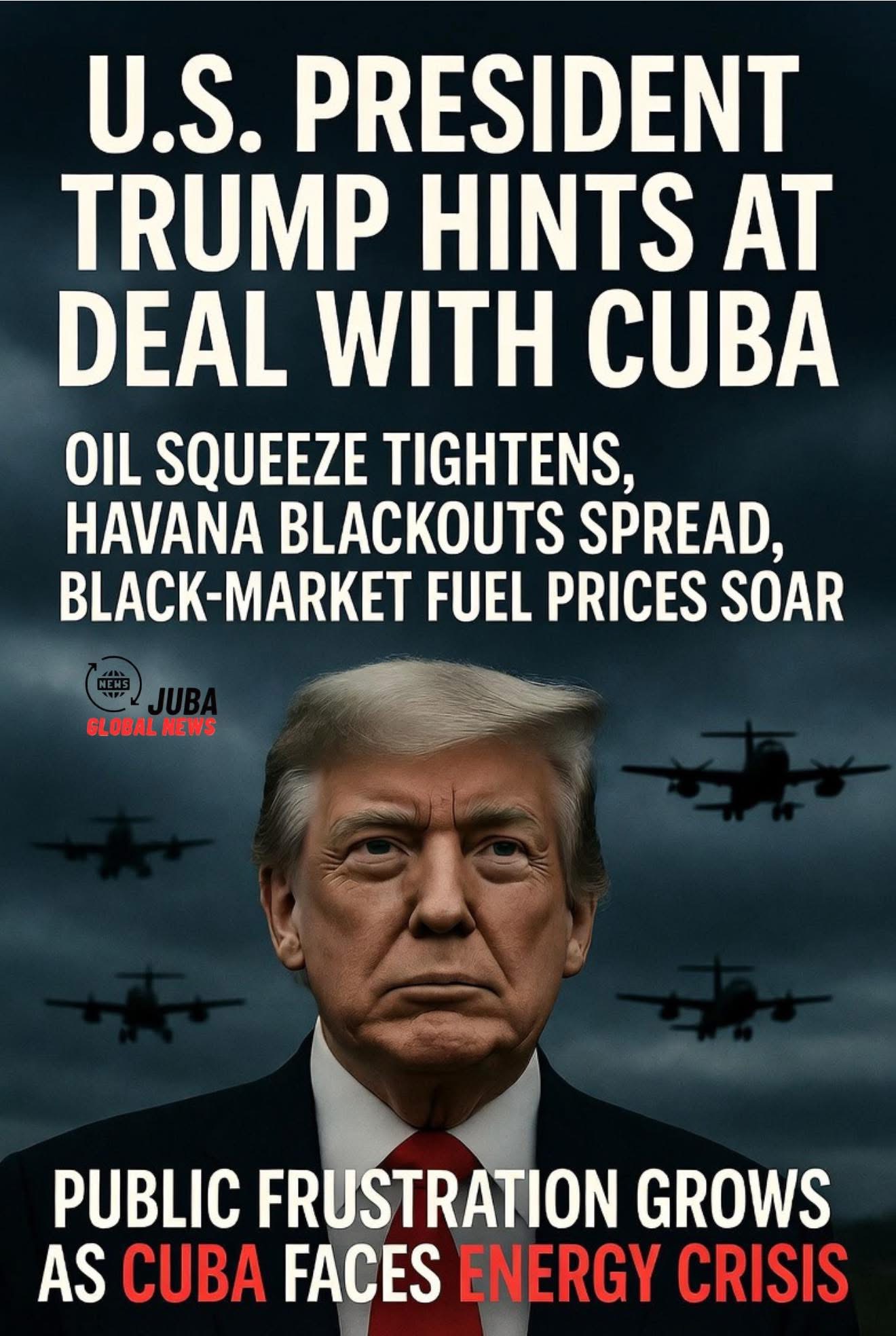
Trump Hints at Potential US Deal with Cuba as Oil Squeeze Tightens: Blackouts Worsen, Prices Soar, and Havana Faces a Dire Energy Crisis
By: Juba Global News Network | JubaGlobal.com February 1, 2026 – Forest Hills, Michigan (via wire reports from Washington, Havana, Caracas, and Mexico City
By: Juba Global News Network | JubaGlobal.com
February 1, 2026 – Forest Hills, Michigan (via wire reports from Washington, Havana, Caracas, and Mexico City)
In a striking mix of carrot-and-stick diplomacy, U.S. President Donald Trump indicated on January 31, 2026, that the United States is “starting to talk” to Cuban leaders and could “work a deal” with the communist-run island, even as his administration ramps up pressure by severing Havana’s critical oil lifeline. The comments, made aboard Air Force One, follow weeks of aggressive moves to block Venezuelan oil shipments to Cuba—once its primary energy supplier—and threaten tariffs on any nation continuing to provide fuel to the island.
Trump’s remarks came amid Cuba’s deepening humanitarian and economic crisis: widespread rolling blackouts lasting up to 20+ hours daily, skyrocketing black-market fuel prices, long lines for basic goods, and growing public frustration. The island’s energy grid, already fragile from decades of underinvestment and U.S. sanctions, has collapsed further since early January 2026, when U.S. military action captured Venezuelan President Nicolás Maduro, effectively halting PDVSA oil deliveries that previously met about one-third of Cuba’s needs.
The Oil Cutoff: From Venezuela to Broader Blockade Threats
The turning point arrived in early January 2026 with the U.S. operation in Caracas that ousted Maduro and his wife Cilia Flores. Trump swiftly declared “no more oil or money going to Cuba—ZERO!” on Truth Social, predicting the Cuban government “will be falling pretty soon” without Venezuelan support. Venezuela had long subsidized Cuba through discounted oil under a barter arrangement (doctors and other professionals in exchange for fuel), but shipments ceased almost immediately after the regime change.
Mexico briefly stepped in as a lifeline, supplying roughly 44% of Cuba’s foreign oil in 2025 and continuing limited exports in early 2026. However, Trump escalated on January 29 by signing an executive order declaring a “national emergency” over Cuba—citing its alleged ties to Russia, China, Hamas, Hezbollah, and “malign actors”—and authorizing tariffs on goods from any country providing oil to Havana. The order empowers the Secretaries of State, Commerce, Treasury, and Homeland Security to assess and impose penalties, putting direct pressure on Mexico and any other potential suppliers (e.g., Russia or Algeria).
White House statements framed the policy as protecting U.S. national security from Cuba’s “unusual and extraordinary threat,” while Trump suggested the measures would force Havana to negotiate rather than trigger a full humanitarian collapse. “It doesn’t have to be a humanitarian crisis. I think they probably would come to us and want to make a deal,” he told reporters.
Cuba’s response has been defiant. President Miguel Díaz-Canel denounced the moves as “fascist, criminal, and genocidal,” accusing Washington of attempting to “suffocate” the economy. Foreign Minister Bruno Rodríguez called the actions “unfair and dangerous,” while emphasizing Cuba’s sovereignty. Despite the rhetoric, analysts note Havana faces few viable alternatives: domestic production covers only a fraction of demand, and alternative suppliers risk U.S. retaliation.
Impact on Cuban Daily Life: Blackouts, Price Spikes, and Desperation
The oil cutoff has devastated Cuba’s energy sector. Rolling blackouts—already common—now dominate daily life, halting factories, closing schools and workplaces, spoiling food in refrigerators, and crippling public transport. In Havana and other cities, residents report 18–22 hour outages, with power restored only briefly. Fuel lines stretch for blocks, and black-market gasoline prices have surged to levels unaffordable for most.
Tourism, a key hard-currency earner, has collapsed amid unreliable electricity and fuel shortages. Agriculture and food distribution suffer, exacerbating shortages and inflation. The population decline accelerates as more Cubans emigrate, fleeing economic despair. Independent reports estimate the island has only weeks of reserves left without new inflows, with some analysts warning of a potential “catastrophic” breakdown if no relief arrives.
Trump has downplayed humanitarian fallout, insisting pressure will lead to regime change or concessions. He has floated Marco Rubio (Secretary of State and a Cuban-American) as a potential future leader, joking “Sounds good to me!” on social media.
The “Deal” on the Horizon: What Might It Entail?
Trump provided few details on the emerging talks, describing them as preliminary and indirect (possibly via intermediaries like Qatar or regional actors). Goals remain vague but appear maximalist: permanent curbs on Cuba’s alliances with adversaries, economic reforms, or even regime transition away from communism. Trump has hinted at “kind” terms if Havana engages seriously, contrasting with his threats of escalation—including speculation about a naval blockade (the first since the 1962 Missile Crisis).
Cuba insists any dialogue must respect sovereignty and lift the decades-old embargo first. Hardliners in Havana view concessions as capitulation, but economic desperation could force pragmatism. Regional players like Mexico walk a tightrope—balancing U.S. pressure with humanitarian concerns—while Russia and China watch warily.
As blackouts persist and prices climb, Cuba stands at a crossroads: negotiate under duress, seek alternative alliances at great risk, or endure worsening isolation. Trump’s strategy blends coercion with outreach, betting that energy strangulation will bring Havana to the table.
Whether this leads to a breakthrough deal, regime collapse, or prolonged suffering remains uncertain. For millions of Cubans enduring daily darkness, the stakes could not be higher.
Juba Global News Network will continue tracking developments in U.S.-Cuba relations and the island’s energy crisis.
Sources: Reuters, AP, The New York Times, Al Jazeera, CNN, The Guardian, PBS, The Washington Post, Politico, and official White House statements.
