

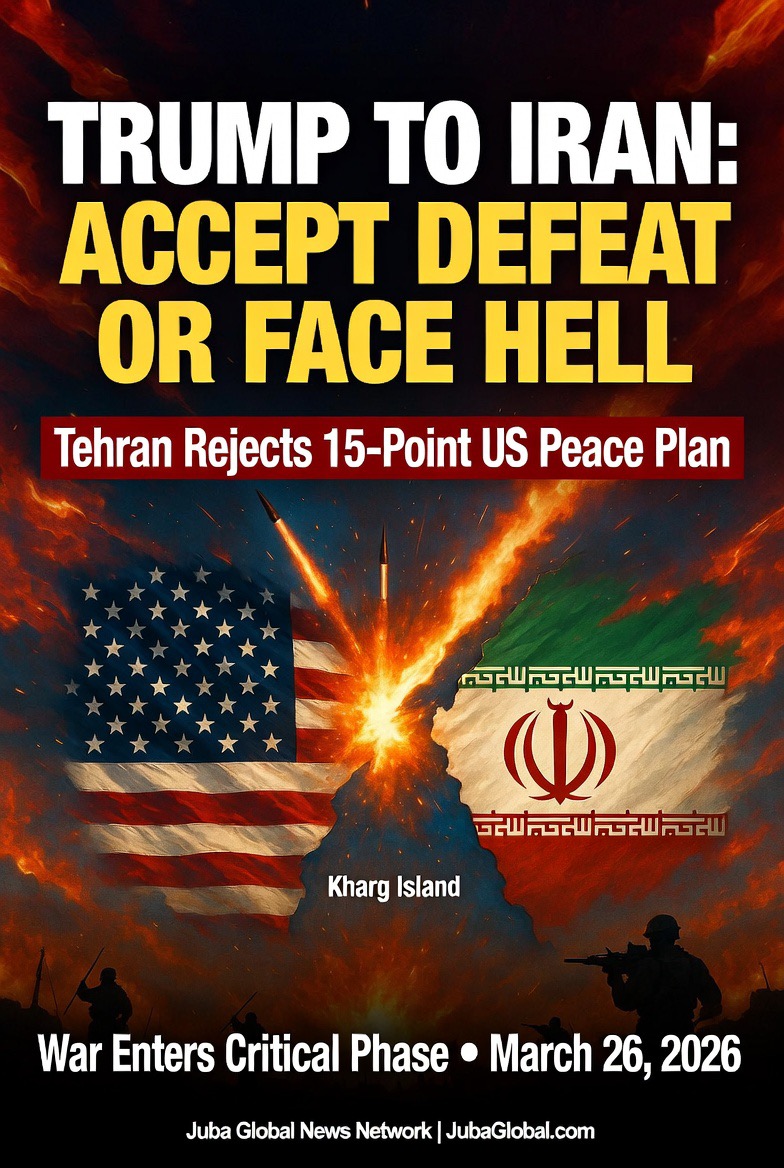
Trump Demands Iran ‘Accept Defeat’ or Face ‘Hell’ as Tehran Rejects 15-Point US Peace Plan
By Juba Global News Network | JubaGlobal.com March 26, 2026 WASHINGTON — In a sharp escalation of rhetoric amid the ongoing US-Israel war with Iran, the Wh
By Juba Global News Network | JubaGlobal.com
March 26, 2026
WASHINGTON — In a sharp escalation of rhetoric amid the ongoing US-Israel war with Iran, the White House has issued a stark warning to Tehran: accept military defeat or prepare to be hit harder than ever before. White House Press Secretary Karoline Leavitt delivered the message bluntly on March 25, stating that President Donald Trump “does not bluff” and is “prepared to unleash hell” if Iran fails to recognize the reality of its battlefield setbacks.
The tough talk comes just days after reports emerged that the Trump administration transmitted a detailed 15-point peace proposal to Iran via intermediaries, including Pakistan, which had offered to host renewed talks. According to multiple sources, the plan includes major concessions on Iran’s nuclear program, ballistic missiles, support for regional proxies, and reopening the strategically vital Strait of Hormuz. In exchange, the US reportedly offered sanctions relief and other economic incentives.
Conflicting Narratives on Negotiations
President Trump has repeatedly claimed progress in indirect talks, telling reporters that there are “like 15 points” of potential agreement, with preventing Iran from acquiring a nuclear weapon listed as priorities one, two, and three. He has described some Iranian responses as offering a “very significant prize” related to oil, gas, and maritime security.
However, Iranian officials and state media have flatly rejected the proposal, describing it as “excessive,” “maximalist,” and “unreasonable.” Tehran insists it will not accept a ceasefire dictated by Washington and has instead outlined its own five conditions for ending the conflict:
• Complete halt to all US and Israeli attacks and assassinations.
• Mechanisms to guarantee the war does not resume.
• Compensation for damages inflicted during the conflict.
• Cessation of attacks on Hezbollah in Lebanon and Iranian-backed militias in Iraq and elsewhere.
• Broader recognition of Iran’s regional security interests.
Iranian state television and senior officials emphasized that “Iran will end the war when it decides to do so and on its own terms.” One diplomat reportedly called the American plan “not even beautiful on paper.”
The White House has pushed back against claims of outright rejection, with Leavitt describing recent conversations as “productive” while downplaying some media reports about the plan’s details. At the same time, the administration has postponed certain planned strikes on Iranian energy infrastructure to allow diplomatic space, even as military pressure continues.
Military Reality on the Ground
The war, now in its fourth week, began with surprise US-Israeli airstrikes on February 28, 2026, targeting Iranian nuclear sites, military installations, and command structures. US forces claim to have struck over 10,000 targets, significantly degrading Iran’s air defenses, missile capabilities, and nuclear infrastructure. Iran has responded with waves of missile and drone attacks on Israel, Gulf states, and US positions, though many have been intercepted.
Despite the heavy blows, Iran has not capitulated. Tehran continues to fire missiles toward Israel and has maintained disruptions in the Strait of Hormuz, a chokepoint responsible for roughly 20% of global oil trade. This has driven oil prices higher and raised fears of a broader energy crisis.
Compounding the tension, reports indicate Iran is actively preparing defenses on Kharg Island — the country’s primary oil export terminal, which handles about 90% of its crude shipments. Sources say Iranian forces are laying traps, reinforcing positions, and moving additional air defenses in anticipation of a possible US ground or amphibious operation to seize or blockade the island. Such a move would represent a major escalation, putting US troops in direct proximity to Iranian forces in a confined and high-risk area.
The Pentagon has already deployed thousands of Marines and, more recently, ordered around 1,000-2,000 soldiers from the 82nd Airborne Division to the region, signaling readiness for prolonged operations or potential ground actions if diplomacy fails.
High Stakes for the Region and Global Economy
Analysts warn that the current impasse carries enormous risks. A prolonged conflict could lead to further disruptions in global energy markets, higher inflation, and potential spillover into Lebanon (where Israel continues operations against Hezbollah) and other proxy battlegrounds.
Trump has signaled a desire to wrap up the conflict in the coming weeks, but his administration’s maximalist demands — including the complete dismantling of Iran’s nuclear and ballistic missile programs and the severing of support for regional allies — clash directly with Tehran’s insistence on sovereignty and resistance.
Some observers note that the 15-point framework echoes elements of earlier nuclear negotiations from 2025 that collapsed before the current war erupted. Whether the current version can bridge the gap remains highly uncertain.
What’s Next?
As of March 26, 2026, the situation remains fluid and dangerous. Missiles continue to fly, diplomatic channels through third parties like Pakistan remain active, and military buildups proceed on both sides.
President Trump’s “accept defeat or face hell” stance reflects a classic maximum-pressure approach that defined much of his first term’s Iran policy. Yet Iran’s history of resilience under sanctions and military pressure suggests Tehran may calculate that it can absorb further punishment while waiting for political or economic fatigue to set in on the American side.
For now, the world watches closely. Any miscalculation — by either Washington or Tehran — could push the conflict into even more destructive territory, with consequences far beyond the Middle East.
