

Trump Claims Iran War ‘Way Ahead of Schedule’ Amid Mixed Signals on Endgame
By Juba Global News Network | JubaGlobal.com March 14, 2026 President Donald Trump delivered yet another optimistic assessment of the ongoing US-Israel mil
By Juba Global News Network | JubaGlobal.com
March 14, 2026
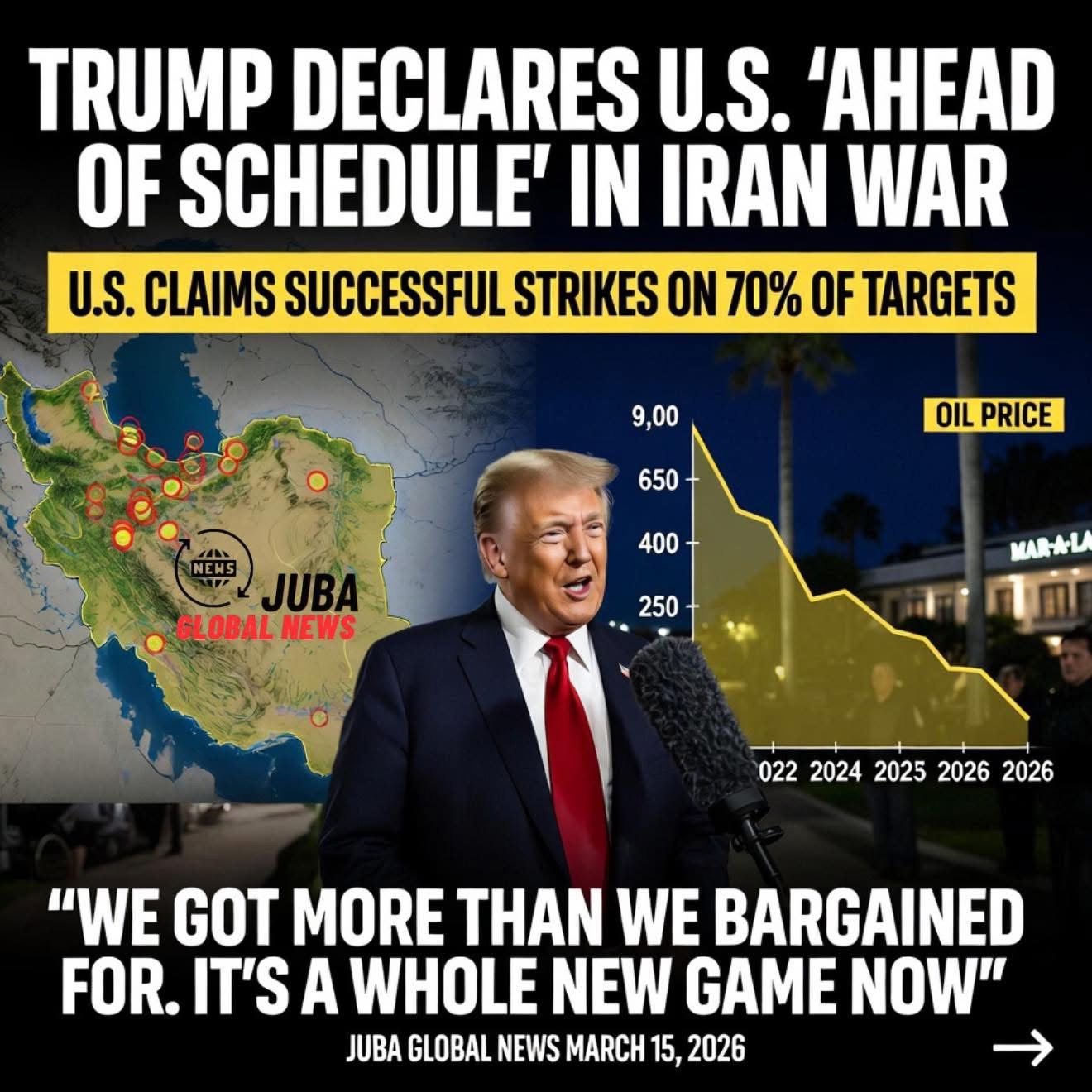
President Donald Trump delivered yet another optimistic assessment of the ongoing US-Israel military campaign against Iran on Friday, declaring that American forces are “way ahead of schedule” in achieving their objectives. Speaking to reporters during a brief gaggle outside his Mar-a-Lago resort in Florida, Trump described the war—now in its third week—as progressing far faster than initial projections, with Iran’s military capabilities “decimated” and the regime left reeling from relentless airstrikes.
“We’re way ahead of schedule. Way ahead,” Trump said emphatically. “Our military is the greatest in the world… Nobody’s ever seen anything like it.” He reiterated claims that joint US-Israeli operations have destroyed over 90-95% of Iran’s ballistic missile production capacity, drone stockpiles, and key defense infrastructure, leaving Tehran with “practically nothing left” to threaten the region or global shipping lanes.
The president’s comments come as the conflict, launched on February 28 with devastating strikes that eliminated Supreme Leader Ali Khamenei and triggered the ascension of his son Mojtaba Khamenei, shows no immediate signs of de-escalation. Despite Trump’s upbeat tone, the administration has sent conflicting signals about the war’s duration, endgame, and ultimate goals—fueling uncertainty among allies, markets, and even within the US government.
Shifting Timelines and Victory Claims
Trump’s initial estimates in late February placed the campaign at four to five weeks, but he has repeatedly accelerated expectations. In early March interviews with CBS News and Axios, he described the war as “very complete, pretty much” and suggested it could wrap up “very soon” because “there’s practically nothing left to target.” At a Kentucky rally earlier this week, he proclaimed “we’ve already won in many ways,” only to pivot moments later: “We don’t want to leave early, do we? We’ve got to finish the job.”
Defense Secretary Pete Hegseth echoed the progress narrative, stating that US forces are “quickly and expeditiously executing these objectives well ahead of schedule.” However, Hegseth stressed that the final decision rests with the commander-in-chief: operations will end “when the commander in chief determines the military objectives have been met, fully realized, and that Iran is in a position of complete and unconditional surrender—whether they say it or not.”
Trump himself has leaned into a more intuitive standard, telling reporters the war will conclude “when I feel it in my bones.” This personal benchmark has drawn criticism from analysts who argue it lacks strategic clarity in a high-stakes conflict with profound global implications.
Diverging US and Israeli Objectives
Adding complexity, Trump acknowledged for the first time on Friday that US and Israeli goals in the war “may be a little different.” While the United States has framed its mission primarily as military—neutralizing Iran’s nuclear ambitions, ballistic missile arsenal, naval forces, and ability to threaten shipping through the Strait of Hormuz—Israel has pursued broader aims.
Israeli officials emphasize degrading the regime’s leadership structures, economic foundations, and proxy networks like Hezbollah in Lebanon, with the long-term vision of reshaping the regional security environment and preventing future Iranian threats. Some experts describe Israel’s approach as leaning toward regime change or permanent weakening of Tehran’s influence, while the US appears more focused on achievable military degradation and reopening vital waterways.
“The US can pack up and leave to turn its attention to other priorities,” noted former NSC official Michael Singh. “Israel lives next door—its definition of success extends to dismantling the broader threat ecosystem.”
This divergence raises questions about coalition cohesion. As strikes continue—including recent heavy bombardments on Iranian security infrastructure and military sites—Israel has shown willingness to sustain operations indefinitely if needed, while Trump hints at an off-ramp once core US objectives are secured.
Economic Stakes and Regional Fallout
The mixed messaging coincides with mounting economic pressure from Iran’s partial blockade of the Strait of Hormuz, which has kept Brent crude above $100 per barrel and contributed to rising global inflation fears. Trump has threatened escalation, including potential US Navy escorts for tankers or direct strikes on remaining oil facilities if disruptions persist.
Iran, meanwhile, vows prolonged resistance. New Supreme Leader Mojtaba Khamenei and IRGC commanders frame the conflict as existential, with retaliatory missile strikes continuing against Israel and US-allied targets in the Gulf. Civilian casualties in Iran have surpassed 1,400 according to Tehran, with widespread displacement and humanitarian concerns growing.
Russia has bolstered Tehran diplomatically, with President Putin offering mediation while condemning US actions. European allies express alarm over energy security, and Gulf states brace for spillover.
Looking Ahead: No Clear End in Sight?
As day 15 unfolds, Trump’s confidence in rapid progress contrasts with the reality on the ground: no ceasefire talks, ongoing Iranian defiance, and proxy attacks widening the theater. Critics warn that without a defined political end-state—beyond vague calls for “unconditional surrender”—the war risks becoming protracted, costly, and destabilizing.
Trump insists the US holds the initiative and can dictate terms. Yet his oscillating rhetoric—from “we’ve won” to “finish the job” to “way ahead of schedule”—underscores the challenge of aligning military success with a viable exit strategy.
Juba Global News Network will continue tracking developments. With oil markets volatile, regional tensions high, and diplomatic channels limited, the coming days could prove decisive in determining whether this conflict ends on Trump’s timeline or drags into a longer, more unpredictable phase.
