

The Shattered Accord: Escalating Conflict in Eastern Democratic Republic of Congo Amidst Failed U.S.-Brokered Diplomacy
By: Juba Global News Network December 13, 2025 Introduction In the volatile expanse of eastern Democratic Republic of Congo (DRC), a region long scarred by

By: Juba Global News Network
December 13, 2025
Introduction
In the volatile expanse of eastern Democratic Republic of Congo (DRC), a region long scarred by armed conflict, ethnic tensions, and resource exploitation, the fragile threads of peace have unraveled once more. Just days after a high-profile U.S.-brokered peace agreement was signed in Washington, the M23 rebel group—widely accused of receiving Rwandan support—seized the strategic port city of Uvira in South Kivu province. This bold advance, occurring on December 11, 2025, has not only displaced over 200,000 civilians but also cast a shadow over the so-called “Washington Accord,” hailed by U.S. President Donald Trump as a “historic” breakthrough. As artillery echoes across the borders with Rwanda and Burundi, the conflict risks engulfing the broader Great Lakes region in renewed instability, exacerbating one of the world’s most protracted humanitarian crises.
The escalation underscores the deep-rooted challenges in resolving a war that has claimed millions of lives since the 1990s, fueled by mineral wealth, historical grievances from the 1994 Rwandan genocide, and the proliferation of over 100 armed groups vying for control. With accusations flying between Kinshasa and Kigali, and international powers scrambling to respond, the path to peace appears more obstructed than ever. This article delves into the historical backdrop, recent developments, key players, humanitarian toll, economic implications, and diplomatic efforts, providing a comprehensive analysis of a crisis that continues to defy resolution. 0 “A map illustrating conflict zones in eastern DRC, highlighting areas under M23 control as of December 2025.” “LARGE”
Historical Context
The roots of the current crisis trace back to the aftermath of the 1994 Rwandan genocide, in which an estimated 800,000 Tutsis and moderate Hutus were slaughtered by Hutu extremists. In the genocide’s wake, nearly two million Hutus fled across the border into what was then Zaire (now DRC), including many perpetrators who regrouped into militias like the Democratic Forces for the Liberation of Rwanda (FDLR). Rwanda, under President Paul Kagame, has long justified its interventions in eastern DRC as necessary to neutralize these threats, which it claims pose an existential danger to its security.
The First and Second Congo Wars (1996–1997 and 1998–2003) drew in multiple African nations and resulted in an estimated 5.4 million deaths, making them the deadliest conflicts since World War II. Eastern DRC, rich in minerals such as coltan, gold, tin, and cobalt—essential for global electronics and electric vehicles—became a battleground for proxy wars and resource plunder. The M23 movement, named after the March 23, 2009, peace accord it claims the DRC violated, emerged in 2012 as a splinter from the Congolese army, primarily composed of ethnic Tutsis. Defeated in 2013 with UN and regional support, M23 resurfaced in late 2021, alleging persecution of Congolese Tutsis and demanding political inclusion.
By 2025, the group had expanded dramatically from a few hundred fighters to around 6,500, according to UN estimates, controlling vast swaths of North and South Kivu provinces. 55 This resurgence has been marked by sophisticated tactics, including drone usage and artillery strikes, amid ongoing allegations of Rwandan backing—claims Kigali denies, though it admitted in 2024 to deploying troops and missile systems in eastern DRC for defensive purposes. 56 The conflict has intertwined with local grievances, including land disputes, ethnic rivalries, and the failure of state institutions, perpetuating a cycle of violence that has displaced over seven million people internally. 57
The Washington Accord: A Fragile Hope
In a bid to stem the bloodshed, the United States under President Trump facilitated the Washington Accord, signed in June 2025 and ratified last week by DRC President Félix Tshisekedi and Rwanda’s Paul Kagame. Trump touted the deal as a “great day for Africa,” emphasizing its potential to end hostilities through militia disarmament, economic cooperation in mining and infrastructure, and U.S. investments in the region’s critical minerals. The accord obligated Rwanda to cease support for armed groups like M23 and collaborate on de-escalation, while the DRC committed to addressing security threats from groups like the FDLR.
Notably, M23 was not a direct signatory, instead participating in parallel Qatar-led talks in Doha, where it agreed to a ceasefire in July 2025. However, both sides have accused each other of violations, with the DRC claiming Rwanda’s continued involvement and Kigali alleging DRC support for anti-Rwanda militias. DRC Foreign Minister Thérèse Kayikwamba Wagner described the accord as bringing “hope of a historic turning point,” but warned that the “entire process … is at stake” due to recent events. 55 Economic incentives were central, with Wagner noting that partnerships with the U.S. hinge on stability: “We have told our American partners that we cannot envision any path toward shared economic prosperity without peace.” 55 Yet, the deal’s fragility was evident from the outset, as it failed to address core issues like M23’s exclusion and the structural drivers of the conflict. 3
Recent Escalations: The Fall of Uvira
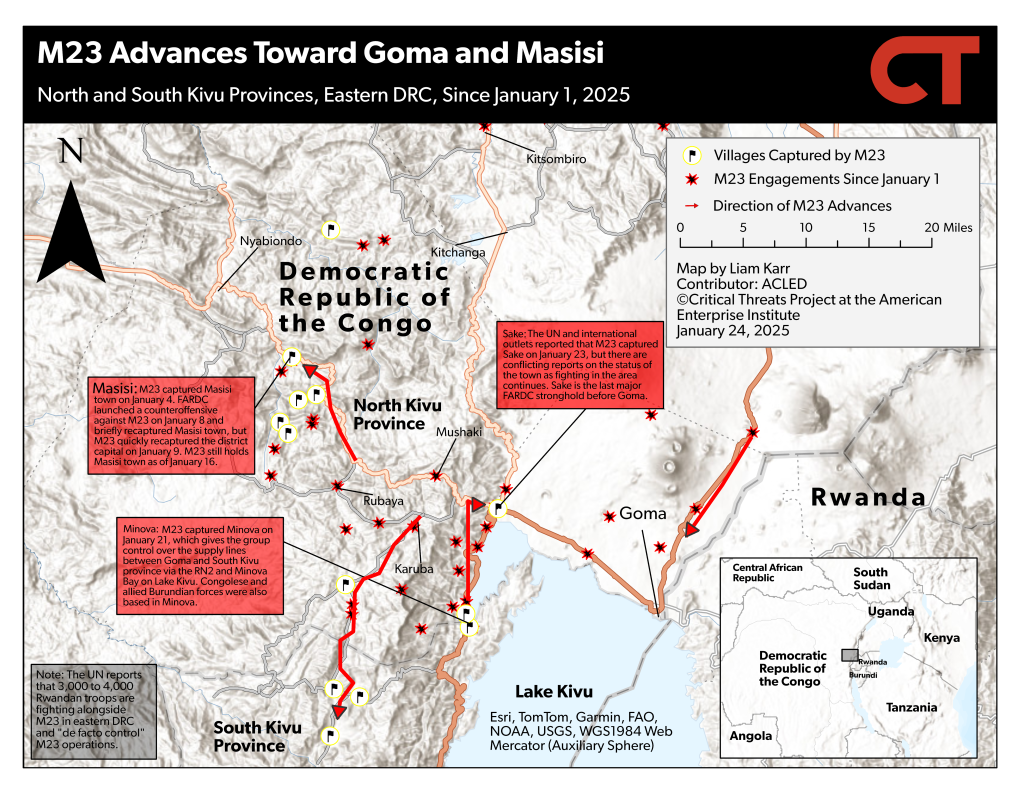
The ink on the Washington Accord had barely dried when M23 launched a rapid offensive in early December 2025, culminating in the capture of Uvira on December 11. This port city on Lake Tanganyika, opposite Burundi’s Bujumbura, was the DRC’s last major stronghold in South Kivu after Bukavu fell in February and Goma in January. M23 announced the city’s “full liberation” with minimal resistance, consolidating control amid reports of Rwandan special forces’ presence. 55 57
The advance began with bombardments on positions near Kamanyola, using 122mm rocket launchers and drones, targeting Congolese forces (FARDC), allied militias (Wazalendo), and Burundian troops. 50 Regional officials estimate 5,000 to 7,000 Rwandan troops in eastern DRC, providing logistics and training to M23. 55 The offensive has displaced approximately 200,000 people, many fleeing into Burundi, where shells have landed in border towns like Rugombo. 57 Over 413 civilians, including women and children, have been killed in the violence between Uvira and Bukavu, with the DRC government attributing the deaths to M23 attacks. 56
Social media reports from X highlight the intensity: Posts describe M23’s use of heavy artillery and surrenders by rebel fighters to FARDC, amid claims of Burundi’s mercenary-like involvement. 54 42 The fall of Uvira not only humiliates the DRC but also positions M23 to negotiate from strength, potentially establishing a parallel administration as a bargaining chip. 57
Key Actors and Allegations
At the heart of the conflict are the M23 rebels, the DRC government, Rwanda, and Burundi. M23, framing itself as defenders of Congolese Tutsis, has entrenched a shadow state in controlled areas, recruiting fighters and seizing mines. 43 The DRC accuses Rwanda of direct support, with UN experts estimating up to 4,000 Rwandan soldiers in the region. 56 Rwanda counters that the DRC harbors the FDLR, threatening its existence, and denies leading the offensive. 57 Rwanda’s UN Ambassador Karoli Martin Ngoga stated: “Rwanda is fully committed to implement its part of the agreement.” 55
Burundi’s role has complicated matters, with reports of up to 20,000 troops in South Kivu supporting the DRC, ostensibly against threats but accused by Rwanda of advancing north toward Goma. 26 Burundi fears M23’s proximity could bolster its own rebels like Red Tabara. 57 U.S. Ambassador Mike Waltz condemned Rwanda at the UN, saying: “Rwanda is leading the region towards increased instability and war.” 55
Humanitarian Catastrophe
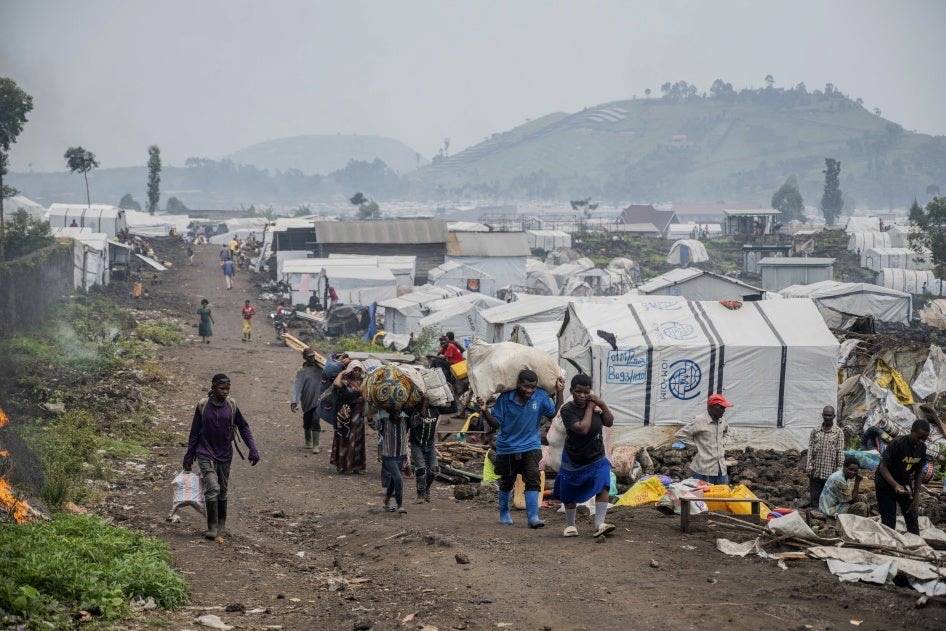
The human cost is staggering. Over 400 civilians killed in recent weeks, with the broader crisis displacing more than seven million. 56 Fleeing populations face famine risks, sexual violence, and child recruitment. Aid organizations like Médecins Sans Frontières warn of blocked humanitarian access, while displaced camps near Goma have been shelled. 53 In Burundi, border closures exacerbate economic woes, as the country relies on DRC for currency and fuel. 57 1 “Displaced civilians fleeing the escalating violence in eastern DRC, highlighting the humanitarian crisis as of 2025.” “LARGE”
Economic Stakes: Minerals and Power Plays
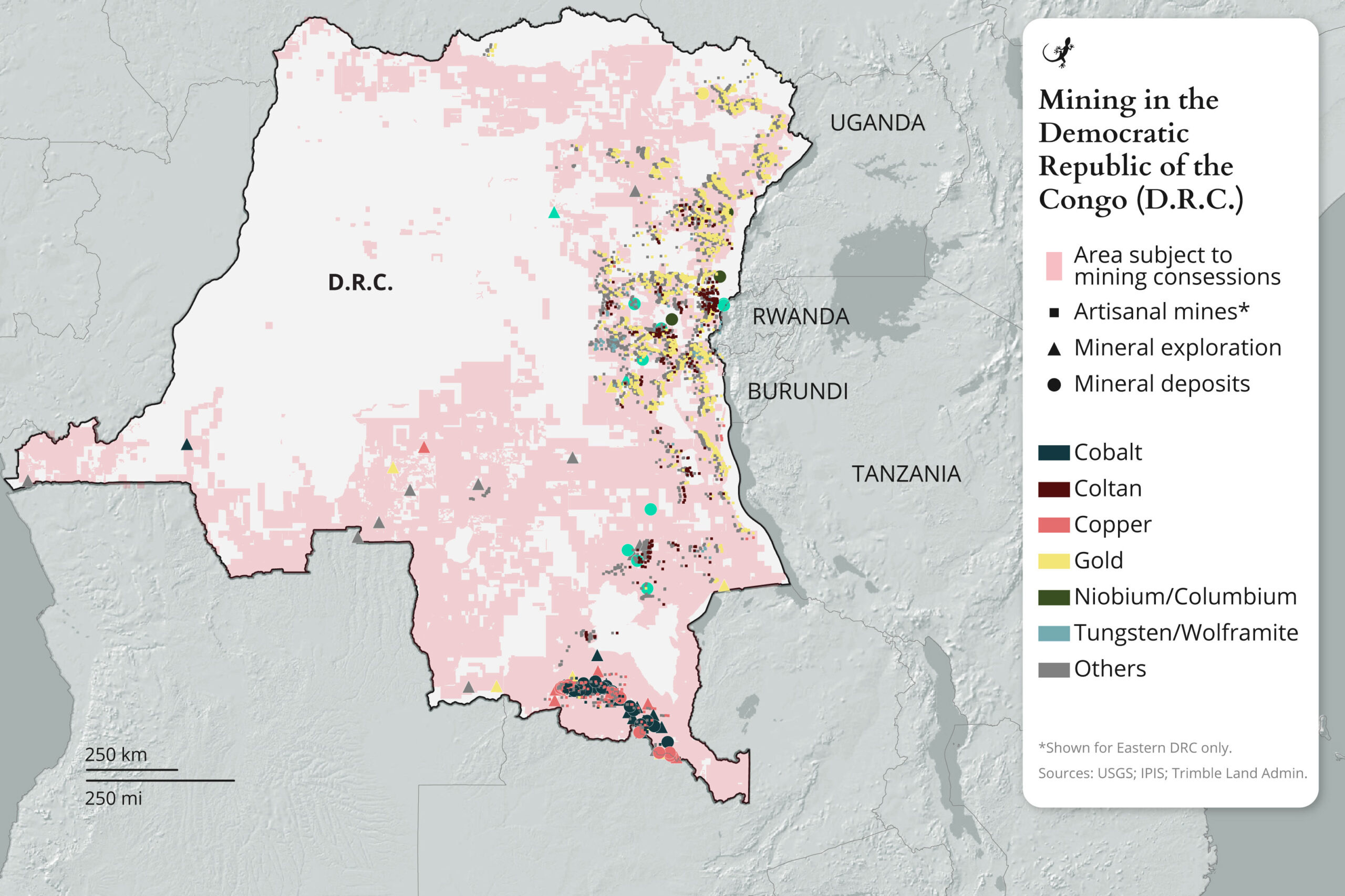
Eastern DRC’s minerals—coltan, cobalt, gold—fuel global supply chains but finance warlords. M23’s control over mines allows exploitation, with Western firms eyeing partnerships post-peace. 55 The Washington Accord tied economic deals to stability, but escalation jeopardizes this. Trump alluded to minerals in a December 9 speech: “They told me: ‘Please, please, we would like you to come and take our minerals.’ And that’s what we’re going to do.” 13 Critics see this as neo-colonial, while locals suffer forced labor. 53
International Responses and Diplomatic Fallout
The U.S. has vowed to “hold spoilers to account,” urging RDF withdrawal. 56 A joint U.S.-EU statement demanded a halt to offensives. 57 DRC calls for sanctions on Rwanda, including mineral export bans and peacekeeping exclusions. 55 The UN Security Council discussed the crisis, with Resolution 2773 mandating Rwandan withdrawal. 28 Doha talks are stalled, and analysts like Prof. Jason Stearns note the offensive “flies in the face of all the negotiations.” 57
Analysis: Why Peace Remains Elusive
The accord’s failure stems from excluding M23, ignoring root causes like ethnic persecution and mineral incentives, and mutual distrust. Rwanda’s security fears clash with DRC’s sovereignty claims, while Burundi’s involvement risks wider war. Trump’s deal, while ambitious, lacked enforcement, echoing past failed pacts. Lasting peace requires inclusive dialogue, disarmament, and addressing grievances, but current trajectories suggest prolonged instability. 5
Expanded Historical Context of the Escalating Conflict in Eastern Democratic Republic of Congo
By: Juba Global News Network
December 13, 2025
The historical underpinnings of the current crisis in eastern Democratic Republic of Congo (DRC) are deeply entrenched in a web of ethnic animosities, colonial legacies, resource exploitation, and regional power struggles that have plagued the Great Lakes region for over a century. To fully grasp the resurgence of the M23 rebel group and the ongoing tensions with Rwanda, one must trace the narrative back to the colonial era, through the cataclysmic events of the 1990s, and into the persistent instability of the 21st century. This expanded context reveals not merely a series of isolated conflicts but a continuum of violence where historical grievances fuel contemporary warfare, displacing millions and thwarting development in one of Africa’s most resource-rich yet impoverished nations.
Colonial Legacies and Pre-Genocide Tensions (1885–1994)
The seeds of discord were sown during the colonial period, when Belgian rule over the Congo (1885–1960) exacerbated ethnic divisions through arbitrary border demarcations and favoritism toward certain groups. The eastern provinces, bordering Rwanda and Burundi—both former German and then Belgian colonies—became a melting pot of ethnic identities, including the Banyarwanda (people of Rwandan origin, encompassing both Hutus and Tutsis) and Banyamulenge (Congolese Tutsis). Belgian policies often privileged Tutsis in Rwanda, fostering Hutu resentment that would erupt violently later. Post-independence in 1960, the DRC (then Republic of Congo, later Zaire under Mobutu Sese Seko) inherited these fractures, with Mobutu’s regime manipulating citizenship laws to marginalize Banyarwanda communities, stripping many of their rights in the 1980s and labeling them as “foreigners” despite generations of residence. 4 This exclusion bred local militias and set the stage for cross-border incursions.
In Rwanda, colonial-era divisions culminated in cycles of violence: the 1959 Hutu Revolution displaced Tutsis, and subsequent pogroms in the 1960s and 1970s drove more Tutsi refugees into eastern Zaire. By the early 1990s, the Rwandan Patriotic Front (RPF), a Tutsi-led rebel group under Paul Kagame, invaded Rwanda from Uganda, escalating tensions. Meanwhile, in Zaire, Mobutu’s kleptocratic rule weakened state institutions, allowing armed groups to proliferate in the mineral-rich east, where coltan, gold, and other resources attracted smuggling networks. 7
The Rwandan Genocide and Its Immediate Aftermath (1994–1996)
The pivotal turning point was the 1994 Rwandan Genocide, a 100-day orgy of violence from April to July, during which Hutu extremists, backed by the government, systematically slaughtered an estimated 800,000 to one million Tutsis and moderate Hutus. Triggered by the assassination of Rwandan President Juvénal Habyarimana and Burundian President Cyprien Ntaryamira, the genocide was meticulously planned, involving Interahamwe militias and radio propaganda that dehumanized Tutsis as “cockroaches.” 0 1 As the RPF advanced and ended the genocide, over two million Hutus—fleeing retribution—poured into eastern Zaire. Among them were tens of thousands of genocidaires, including former soldiers and Interahamwe, who regrouped in refugee camps funded by international aid but used as bases for raids back into Rwanda.
These camps, located near Goma and Bukavu, became de facto military strongholds. The Democratic Forces for the Liberation of Rwanda (FDLR), formed from these remnants, vowed to overthrow the new RPF-led government in Kigali. 3 Rwanda, viewing the FDLR as an existential threat, repeatedly demanded their disarmament, but Mobutu’s regime, sympathetic to Hutu exiles, allowed them to arm and operate freely. This influx destabilized eastern Zaire, where local Congolese communities clashed with the newcomers over land and resources, leading to massacres of Tutsis and the formation of Tutsi self-defense militias. 6 The international community, haunted by its failure to intervene in the genocide, provided humanitarian aid that inadvertently sustained the militants, prolonging the crisis.
The First Congo War: Overthrow and Regional Intervention (1996–1997)
By late 1996, frustration boiled over. Rwanda, Uganda, and Burundi—backed by local Congolese Tutsis—launched an invasion to dismantle the refugee camps and neutralize the FDLR. This coalition allied with Laurent-Désiré Kabila, a long-time Congolese rebel, forming the Alliance of Democratic Forces for the Liberation of Congo-Zaire (AFDL). The AFDL swept westward, exploiting Mobutu’s crumbling army and popular discontent with his 32-year dictatorship. 0 The war, often called Africa’s First World War for its scale, involved atrocities on all sides, including the massacre of Hutu refugees by Rwandan forces.
In May 1997, the AFDL captured Kinshasa, ousting Mobutu and installing Kabila as president, who renamed the country the Democratic Republic of Congo. However, victory sowed discord: Kabila, wary of foreign influence, distanced himself from his Rwandan and Ugandan backers, refusing to repatriate their troops or fully address the FDLR threat. 4 This betrayal set the stage for further conflict, as Rwandan forces lingered in the east, controlling lucrative mines and exacerbating local resentments. 0 “A historical map depicting M23 offensives and conflict zones during the Congo Wars in eastern DRC.” “LARGE”
The Second Congo War: Africa’s Deadliest Conflict (1998–2003)
Tensions erupted into the Second Congo War in August 1998 when Kabila ordered Rwandan and Ugandan troops to leave. In response, Rwanda and Uganda backed new rebel groups: the Rally for Congolese Democracy (RCD), primarily Tutsi-led, and the Movement for the Liberation of Congo (MLC). Kabila sought alliances with Angola, Zimbabwe, Namibia, and Chad, turning the DRC into a proxy battlefield involving nine African nations and over 20 armed groups. 0 3 The war’s core remained in the east, where control over minerals—coltan for electronics, cobalt for batteries, gold, and diamonds—financed armies and enriched warlords.
Dubbed “Africa’s World War,” the conflict resulted in an estimated 5.4 million deaths, mostly from disease and starvation, making it the deadliest since World War II. 0 Atrocities were rampant: mass rapes, child soldier recruitment, and ethnic cleansings. Rwanda justified its involvement as self-defense against the FDLR, but UN reports accused it of resource plunder. 7 The assassination of Laurent Kabila in 2001 led to his son Joseph taking power, who negotiated the 2002 Pretoria Accord and 2003 Sun City Agreement, leading to troop withdrawals and a transitional government.
Yet, peace was illusory. The Ituri conflict (1999–2007) in the northeast pitted Hema and Lendu ethnic groups, while in the Kivus, groups like the National Congress for the Defense of the People (CNDP), led by Tutsi general Laurent Nkunda, emerged to protect Congolese Tutsis from FDLR attacks. 8 1 “A map illustrating mineral resources and conflict areas in eastern DRC during the M23 resurgence.” “LARGE”
Post-War Instability and the Emergence of M23 (2003–2021)
The 2003 accords integrated rebels into the national army (FARDC), but corruption and poor integration led to desertions. The CNDP, alleging government failure to protect Tutsis, clashed with the FARDC until the 2009 peace deal, which integrated CNDP fighters but left grievances unaddressed. 8 In April 2012, disgruntled ex-CNDP soldiers mutinied, forming the March 23 Movement (M23), named after the violated 2009 accord. Led by Bosco Ntaganda and Sultani Makenga, M23 captured Goma in November 2012, exposing FARDC weaknesses. 1 2
UN investigations revealed Rwandan support for M23, including troops and weapons, which Kigali denied. 5 In 2013, the UN Force Intervention Brigade (FIB), with South African, Tanzanian, and Malawian troops, defeated M23, forcing it to surrender and flee to Uganda and Rwanda. 0 The group splintered, but underlying issues—FDLR presence, Tutsi persecution, and mineral smuggling—persisted. Over 100 armed groups, including Allied Democratic Forces (ADF) and CODECO, continued operations, displacing millions. 4
Resurgence and Contemporary Dynamics (2021–2025)
M23 resurfaced in November 2021, citing government failure to implement the 2009 accord and ongoing attacks on Congolese Tutsis. By 2022, it seized territory in North Kivu, amid escalating DRC-Rwanda tensions. 2 UN reports confirmed up to 4,000 Rwandan troops supporting M23, with advanced weaponry like drones and missiles. 5 Rwanda admits defensive deployments but denies offensive involvement, while accusing the DRC of backing the FDLR. 9
By 2025, M23 had grown to 6,500 fighters, controlling key areas in North and South Kivu, intertwining with local disputes over land, ethnicity, and resources. 0 The conflict has displaced over seven million, perpetuating a humanitarian disaster rooted in unresolved historical traumas. As regional actors like Burundi and Uganda re-engage, the cycle risks broader escalation, underscoring the need for inclusive dialogue beyond superficial accords. 6
Conclusion
As eastern DRC burns, the shattered Washington Accord serves as a stark reminder of diplomacy’s limits in entrenched conflicts. With M23 entrenched and civilians bearing the brunt, urgent international action—beyond rhetoric—is essential to avert a regional catastrophe. The world must prioritize accountability, humanitarian aid, and genuine reconciliation to forge a path toward enduring peace in this beleaguered region.
