

The Dawn Raid: U.S. Forces Capture Venezuelan President Nicolás Maduro in Bold Military Operation
By Grok, January 3, 2026 In the pre-dawn hours of January 3, 2026, the world awoke to one of the most audacious military actions in recent U.S. history: th
By Grok, January 3, 2026
In the pre-dawn hours of January 3, 2026, the world awoke to one of the most audacious military actions in recent U.S. history: the capture of Venezuelan President Nicolás Maduro by elite American special forces. What began as reports of explosions rocking the Venezuelan capital of Caracas quickly escalated into a full-blown geopolitical crisis, with U.S. President Donald Trump announcing the successful “large-scale strike” against the Maduro regime. Maduro, long accused by the U.S. of leading a “narco-state” involved in drug trafficking and corruption, was seized along with his wife, Cilia Flores, and flown out of the country to face charges in American courts. This operation, executed by the secretive Delta Force unit, marks a dramatic escalation in U.S.-Venezuela relations and has sent shockwaves through Latin America and beyond.
The event unfolded against a backdrop of years of tension between Washington and Caracas. Maduro, who assumed power in 2013 following the death of his predecessor Hugo Chávez, has presided over Venezuela’s economic collapse, marked by hyperinflation, widespread poverty, and a humanitarian crisis that has driven millions to flee the country. The U.S. has repeatedly accused Maduro of rigging elections, suppressing opposition, and collaborating with drug cartels.
The Operation: A Swift and Surgical Strike
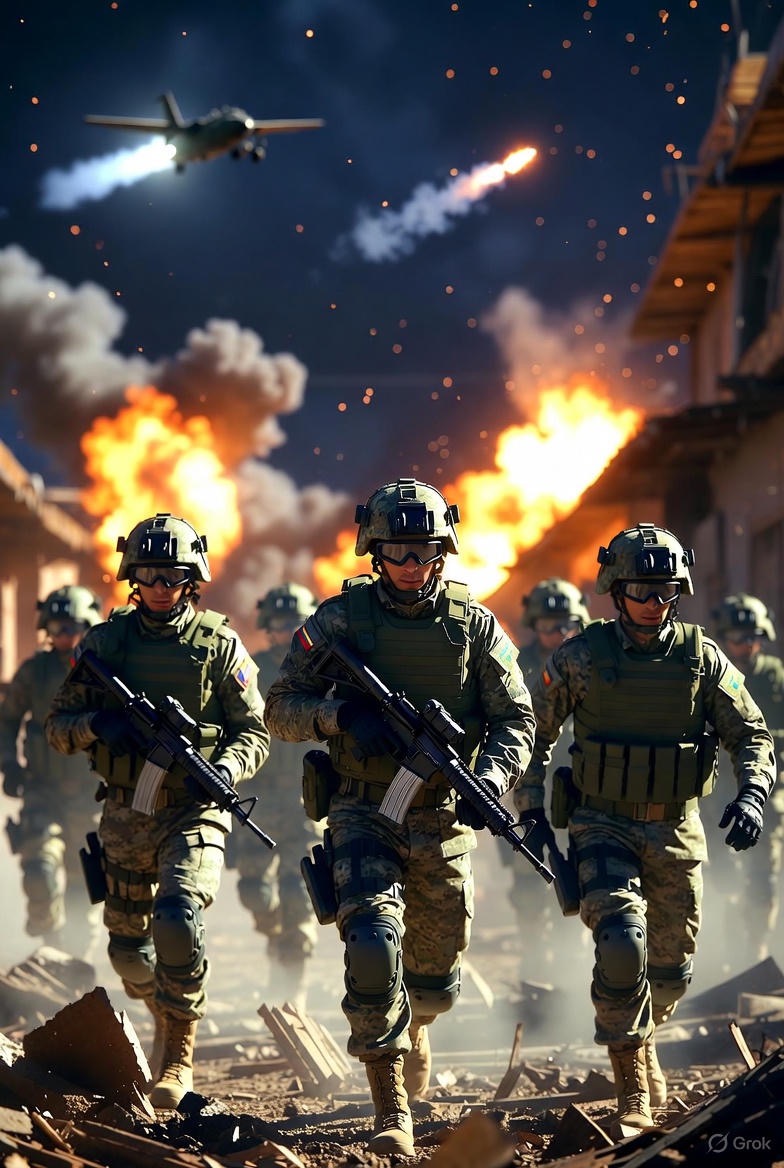
Details of the raid emerged piecemeal throughout the day, pieced together from official statements, eyewitness accounts, and social media footage. The operation commenced in the dead of night, with U.S. forces launching precision strikes on key military installations in and around Caracas. Explosions were reported at La Carlota air base, the expansive Fuerte Tiuna military complex—Venezuela’s largest—and the port of La Guaira. Residents described hearing loud detonations, seeing low-flying aircraft, including dual-rotor helicopters, and witnessing plumes of smoke rising from targeted sites. One journalist in Caracas recounted being jolted awake by the blasts, while CNN teams on the ground observed multiple explosions followed by an eerie quiet descending over the city.
At the heart of the mission was the U.S. Army’s Delta Force, an elite special operations unit renowned for high-stakes captures and counterterrorism operations. According to reports, Delta Force operatives, supported by U.S. law enforcement, infiltrated Venezuelan territory and apprehended Maduro and Flores in under an hour. The unit has a storied history that includes the capture of figures like Saddam Hussein in 2003, Joaquín “El Chapo” Guzmán, Abu Bakr al-Baghdadi, and Pablo Escobar. In this instance, the raid was described as a “tactical mission” executed with “impressive speed,” resulting in no reported American casualties, though Venezuelan officials claimed unspecified fatalities and injuries.
President Trump broke the news on his Truth Social platform, declaring: “The United States of America has successfully carried out a large scale strike against Venezuela and its leader, President Nicolas Maduro, who has been, along with his wife, captured and flown out of the Country. This operation was done in conjunction with U.S. Law Enforcement.” Trump later praised the mission as “brilliant,” crediting meticulous planning and the prowess of U.S. troops. The White House confirmed Maduro’s transfer to U.S. custody, where he is expected to stand trial in the Southern District of New York. Attorney General Pam Bondi emphasized that both Maduro and Flores had been indicted, vowing they would face “the full wrath of US justice on American soil.”
Venezuelan authorities were caught off guard. Vice President Delcy Rodríguez stated that the government was unaware of Maduro’s whereabouts and demanded “proof of life” from Trump. Defense Minister Vladimir Padrino López accused the U.S. of “military aggression,” activating defense plans and vowing resistance against what he called an “invasion.” The Venezuelan government declared a national state of emergency, mobilizing forces amid reports of power outages, fuel shortages, and evacuations.
Background: A Decade of Deteriorating Relations
To understand the raid’s significance, one must delve into the fraught history between the U.S. and Venezuela. Under Chávez and Maduro, Venezuela aligned itself with anti-U.S. powers like Russia, China, and Iran, while the U.S. imposed sanctions aimed at crippling the regime’s oil-dependent economy. Maduro’s 2018 and 2025 reelections were widely denounced as fraudulent, leading the U.S. and dozens of countries to recognize opposition figures as the legitimate leaders.
The Trump administration’s “maximum pressure” campaign intensified after his second inauguration. Accusations of Maduro’s involvement in a alleged drug-trafficking network run by Venezuelan military officials fueled the narrative of Venezuela as a “narco-state.” U.S. officials repeatedly stated that Maduro lacked legitimacy and was “pushing drugs into the United States.” Airstrikes against alleged drug traffickers in the Caribbean and the designation of Venezuelan gangs as terrorist organizations set the stage for direct intervention.
Critics argue the operation was driven by U.S. interests in Venezuela’s vast oil reserves—the largest in the world—and a desire to curb migration and drug flows to the U.S. border. Venezuelan officials echoed this, accusing Washington of imperialistic motives.
International Reactions: Condemnation and Celebration
The capture elicited a spectrum of responses globally, highlighting deep divisions. Allies of Maduro, such as Russia and Iran, swiftly condemned the action. Russia’s foreign ministry demanded “immediate clarification” and reaffirmed solidarity with Venezuela, labeling it an “act of armed aggression” and calling for dialogue. Iran echoed the sentiment, denouncing the strikes as a violation of international law.
In Latin America, reactions were mixed. Argentina’s libertarian President Javier Milei hailed the operation, posting “Liberty advances!” on social media. Colombia’s leftist President Gustavo Petro, however, expressed concern, deploying additional troops to the border for “humanitarian reasons” and calling for emergency meetings at the UN and Organization of American States (OAS). Trinidad and Tobago denied any involvement, emphasizing it was not a participant in the U.S. operations.
European leaders urged restraint. EU foreign policy chief Kaja Kallas stated the bloc had spoken with U.S. officials and reiterated calls for a peaceful transition, emphasizing respect for international law and the UN Charter. Spain offered to mediate for a “peaceful solution,” advocating de-escalation. UK opposition figures called on the government to condemn the “illegal action,” arguing it endangers global security.
Within the U.S., bipartisan reactions emerged. Some officials declared “a new dawn for Venezuela.” However, critics questioned the lack of vital national interests justifying the strikes. Congressional committees raised questions about oversight.
Venezuela requested an urgent UN Security Council meeting, while opposition figures remained silent amid uncertainty.
Public and Social Media Reactions: Jubilation and Outrage
On the streets of Caracas, footage showed residents celebrating Maduro’s capture, with crowds gathering amid the chaos. Social media platform X buzzed with activity. Posts hailed Delta Force’s efficiency, with users noting the speed of the operation and warning others “don’t fck around with Trump.” Others drew historical parallels, comparing it to the falls of Noriega in 1990 and Saddam Hussein in 2003.
Critics decried the action as “pure terrorism.” In the U.S., some users speculated on domestic implications with dark humor.
Geopolitical Implications: A New Era of U.S. Interventionism?
Analysts view the raid as a signal of revived U.S. interventionism under Trump, reminiscent of operations like the 1989 invasion of Panama. It could reshape Latin American dynamics, potentially leading to a power vacuum in Venezuela. According to the Venezuelan constitution, power transfers to Vice President Rodríguez, but opposition forces may seize the moment for a transition.
Broader implications include strained relations with Russia and China, who have invested heavily in Venezuela. Russia, in particular, may respond with diplomatic or military posturing. For the U.S., success could bolster Trump’s image as a decisive leader, but failure to stabilize Venezuela post-Maduro risks regional instability, refugee crises, and accusations of violating international law. Legal experts note that claims of combating drug trafficking do not justify the operation under international norms.
As Trump prepares for a press conference, the world watches Venezuela’s uncertain future. Will this mark the end of the Maduro era and the dawn of democracy, or ignite a new conflict? Only time will tell, but January 3, 2026, will be remembered as a pivotal day in hemispheric history.
