

Thailand-Cambodia Border Clashes: Airstrikes Signal Potential Collapse of Trump-Brokered Peace
By Juba Global News Network International Desk December 8, 2025 BANGKOK/PHNOM PENH – In a dramatic escalation that has sent shockwaves through Southeast As
By Juba Global News Network International Desk
December 8, 2025
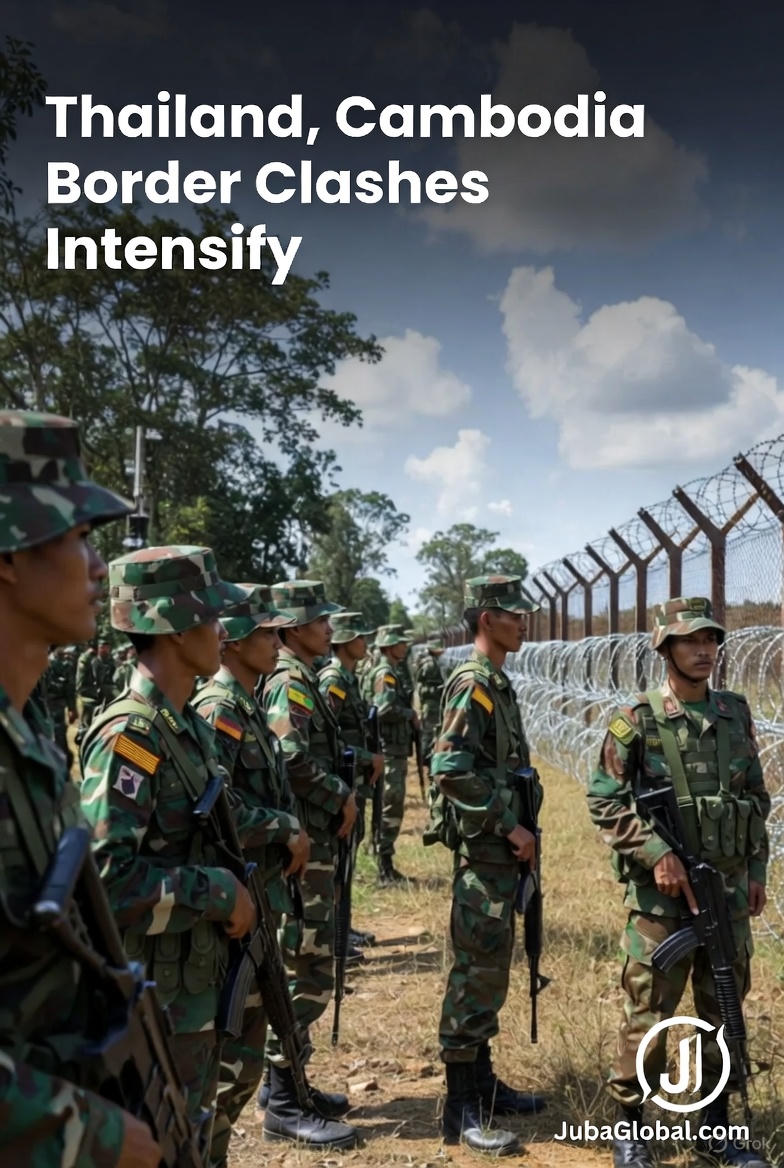
BANGKOK/PHNOM PENH – In a dramatic escalation that has sent shockwaves through Southeast Asia, Thailand’s military launched airstrikes on Cambodian positions along their disputed border early Monday morning, December 8, 2025. The strikes, described by Thai officials as “precision operations” targeting military infrastructure, came in the wake of deadly clashes that claimed the life of at least one Thai soldier and injured several others. This flare-up threatens to unravel a fragile ceasefire agreement brokered just two months ago by U.S. President Donald Trump, raising fears of a broader regional conflict in an area already strained by historical animosities and geopolitical rivalries. 20 21
The incident marks the most serious breach of the peace since a five-day war in July 2025 that left at least 48 people dead and displaced an estimated 300,000 civilians on both sides of the 817-kilometer (508-mile) frontier. 23 As evacuations accelerate and international mediators scramble to respond, the clashes underscore the deep-seated territorial disputes that have simmered between the two nations for over a century. With Thailand’s Royal Thai Air Force (RTAF) deploying fighter jets for the first time since the summer conflict, analysts warn that the situation could spiral into prolonged hostilities, disrupting trade, tourism, and ASEAN stability.
A Timeline of Monday’s Deadly Escalation
The violence erupted around 5 a.m. local time in the Chong Bok area of Thailand’s easternmost Ubon Ratchathani province, near the Cambodian provinces of Preah Vihear and Oddar Meanchey. According to the Thai military, Cambodian forces initiated the attack with small arms fire, machine guns, mortars, and artillery, targeting the Anupong Operations Base. “Cambodian troops fired first into Thai territory in multiple areas,” said Thai Army spokesperson Major General Winthai Suvaree, who reported one soldier killed and four wounded in the initial exchange. 22 26 A second Thai soldier later succumbed to injuries, bringing the confirmed death toll to two. 29
In retaliation, Thailand’s Suranaree Task Force coordinated with the RTAF to conduct airstrikes on “military targets in several areas,” including weapon depots, command centers, and logistical routes in Cambodia’s Chong An Ma Pass region. Air Marshal Jackkrit Thammavichai, RTAF spokesperson, emphasized that the operations were “planned and executed in accordance with security protocols and relevant international laws,” with a focus on minimizing civilian harm. 27 Thai F-16 fighter jets were scrambled for precision strikes, marking the first use of air power since the July war. 32
Cambodia’s Defense Ministry offered a starkly different account, accusing Thailand of launching the dawn assault without provocation. “The Thai military forces launched the attack on the Cambodian forces at approximately 5 a.m. in the morning of December 8, 2025,” the ministry stated, adding that Cambodian troops “did not retaliate” despite “numerous provocative actions” by Thailand in recent days, including an incident the previous day in the Prorlean Thmar area. 25 28 Phnom Penh claimed the strikes hit positions in Preah Vihear province, with no immediate reports of Cambodian casualties, though unverified social media videos from the Choam Ksant district captured sounds of gunfire and explosions echoing across the border. 11
By midday, clashes had spread to additional sectors, including Sisaket and Surin provinces in Thailand, and Oddar Meanchey in Cambodia. Thai officials reported Cambodian BM-21 rocket fire targeting civilian areas in Ban Kruat, Buri Ram, though no civilian casualties were confirmed. 31 In response, Thailand ordered the evacuation of approximately 385,000 civilians from border towns, with 70% already relocated by evening. 20 Cambodian authorities similarly urged residents to flee, with motorbikes ferrying families from Preah Vihear amid scenes of chaos. 24
Roots of the Dispute: A Century-Old Colonial Legacy
At the heart of the conflict lies a patchwork of undemarcated borders drawn during French colonial rule over Cambodia in the early 20th century. The 1907 Franco-Siamese treaty, which mapped much of the frontier, has long been contested by Thailand (formerly Siam), which argues the lines were inaccurate and imposed unilaterally. 23 Flashpoints like the 11th-century Preah Vihear Temple – awarded to Cambodia by the International Court of Justice (ICJ) in 1962 – have repeatedly ignited nationalist fervor on both sides. 28
Tensions boiled over in July 2025, when skirmishes near the Prasat Ta Muen Thom temple complex escalated into a five-day war. Artillery duels and rocket exchanges killed dozens, including 13 Thai civilians, and displaced hundreds of thousands. 36 A ceasefire was hastily brokered in late July by Malaysian Prime Minister Anwar Ibrahim, with U.S. President Trump claiming pivotal intervention during a golf outing in Scotland – a narrative he later amplified to tout his “peacemaking hobby.” 40
The Kuala Lumpur Peace Accords, signed on October 26, 2025, under Trump’s watchful eye at the ASEAN Summit, expanded the truce. Key provisions included the deployment of ASEAN border observers, the removal of heavy weapons from the frontier, and Thailand’s release of 18 detained Cambodian soldiers. 42 45 Trump hailed it as a “historic” achievement, linking it to reciprocal trade deals with both nations and even earning a Nobel Peace Prize nomination from Cambodia’s Prime Minister Hun Manet. 44 Yet, Thai Foreign Minister Sihasak Phuangketkeow downplayed it as merely “a pathway to peace,” reflecting Bangkok’s reluctance to accept external mediation. 41
The accord’s fragility was exposed in November, when a landmine blast in Sisaket province maimed four Thai soldiers. Thailand suspended implementation, accusing Cambodia of planting fresh explosives in violation of demining commitments. 47 Phnom Penh denied the charges, insisting the devices dated to earlier conflicts, but the incident halted joint patrols and troop withdrawals. 12
Human Cost and Immediate Fallout
The human toll extends beyond the battlefield. In Ubon Ratchathani and Surin provinces, provincial chambers of commerce warn that prolonged fighting could last 3-5 days, crippling year-end tourism and local economies reliant on cross-border trade. 7 The Bank for Agriculture and Agricultural Cooperatives (BAAC) shuttered 12 branches in Buri Ram, Surin, and Ubon Ratchathani, citing security risks. 7 Thailand’s Ministry of Education ordered the closure of 641 schools and academies in five southern provinces, affecting thousands of students. 13
On the Cambodian side, former Prime Minister Hun Sen – father of current leader Hun Manet and a towering political figure – urged restraint, labeling Thailand the “aggressor” and warning against being “pulled into retaliation.” 31 Social media footage from Choam Ksant district captured the eerie sounds of gunfire, amplifying public anxiety. 14 Malaysian officials, hosting the upcoming SEA Games, expressed concerns for athlete safety but issued no new advisories. 1
Geopolitical Ripples: U.S. Influence, Chinese Ties, and ASEAN’s Dilemma
The clashes arrive at a precarious moment for U.S. foreign policy in Asia. Trump’s personal stake in the peace process – touted as one of eight conflicts his administration has “resolved” – now hangs in the balance, potentially undermining his narrative as a global dealmaker. 42 The White House has yet to comment, but analysts suggest renewed U.S. mediation could be forthcoming, especially given Thailand’s status as a non-NATO major ally. 22
Cambodia’s close alignment with China adds another layer of complexity. Beijing, which has invested heavily in Cambodian infrastructure, could exploit the crisis to expand influence, while ASEAN – chaired by Malaysia – faces a litmus test in maintaining bloc unity. 22 The July war already strained regional ties; this escalation risks fracturing economic cooperation amid global supply chain pressures.
Paths to De-escalation: A Fragile Hope?
As night fell on Monday, both militaries reinforced positions, with Thailand deploying additional ground troops and Cambodia mobilizing reserves. International calls for calm poured in, with the UN urging “immediate dialogue” and ASEAN pledging to reconvene border observers. 0
Experts like Gregory B. Poling of the Center for Strategic and International Studies (CSIS) warn that without addressing core issues – like ICJ-mandated demarcation – truces will remain ephemeral. 36 “Air power isn’t a warning shot; it’s a statement of dominance,” noted one OSINT analyst on X, highlighting Thailand’s superior air capabilities. 4 Yet, Hun Sen’s plea for restraint offers a glimmer: perhaps cooler heads can prevail before the July death toll is eclipsed.
For the border communities – farmers, traders, and families long scarred by mines and mistrust – the airstrikes are a grim reminder that peace, like their frontier, remains contested territory. As Trump-era diplomacy faces its sternest test, Southeast Asia holds its breath, wondering if history’s echoes will drown out calls for calm.
