Strait of Hormuz Tensions Rise: Iran Claims ‘Complete Control’ and Threatens Ships – A Tanker Attempts Passage to UAE Amid Warnings of Escalation
Juba Global News Network | Dubai / March 4, 2026 DUBAI — The Strait of Hormuz, the narrow maritime chokepoint through which roughly one-fifth of the world’
Juba Global News Network | Dubai / March 4, 2026
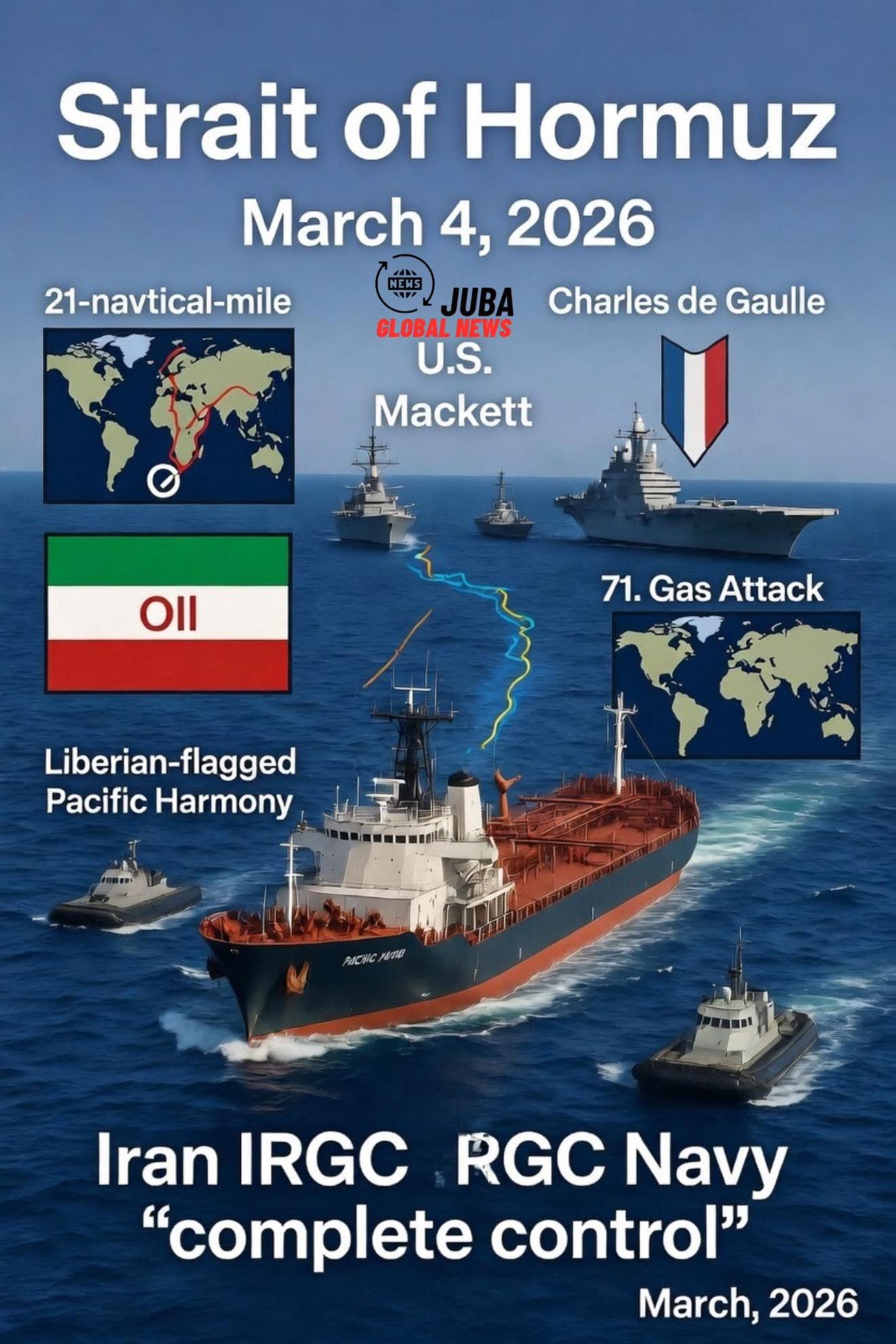
DUBAI — The Strait of Hormuz, the narrow maritime chokepoint through which roughly one-fifth of the world’s daily oil consumption flows, has become the most dangerous flashpoint in the rapidly expanding U.S.-Israel war with Iran. On March 4, 2026—the sixth day of major military operations—Iran’s Islamic Revolutionary Guard Corps (IRGC) Navy declared it now exercises “complete control” over the strait and issued explicit threats to commercial shipping that fails to comply with new Iranian directives.
In a televised statement from Bandar Abbas, IRGC Navy Commander Rear Admiral Tangsiri warned: “Any vessel attempting to transit the Strait of Hormuz without coordination with Iranian authorities will be considered hostile and treated accordingly. The security of this vital waterway is now under the full sovereignty and protection of the Islamic Republic.” The declaration came hours after satellite imagery and AIS (Automatic Identification System) data showed a significant slowdown in tanker traffic and the first reported attempt by a commercial vessel to force a transit under the new conditions.
A High-Stakes Test: The ‘Pacific Harmony’ Passage
Early on March 4, the Liberian-flagged crude oil tanker Pacific Harmony (carrying approximately 1.2 million barrels of Iraqi crude destined for South Korea via Fujairah, UAE) departed Khawr al-Zubayr terminal in southern Iraq and entered the Strait heading southbound. AIS tracking showed the vessel maintaining a speed of 12 knots through the 21-nautical-mile-wide shipping lane, flanked by Iranian fast-attack craft and at least one IRGC hovercraft maintaining parallel course at approximately 3–4 nautical miles distance.
At 03:47 UTC, Iranian naval radio communications—intercepted and later confirmed by maritime security firms—demanded the tanker identify itself, state its destination, and acknowledge Iranian “transit oversight.” The Pacific Harmony responded with standard IMO protocols, asserting its right to innocent passage under the UN Convention on the Law of the Sea (UNCLOS). No immediate boarding or interdiction occurred, and as of 05:00 UTC the vessel continued toward the Gulf of Oman, shadowed by Iranian units.
Maritime risk consultants at Lloyd’s List Intelligence and Dryad Global assessed the passage as “the first real-world test of Iran’s claimed control.” Analysts noted that while the tanker was allowed to proceed, the presence of armed Iranian craft and the absence of any U.S. Navy escort vessels in the immediate vicinity underscored the dramatic shift in the balance of power in the strait since the conflict began.
Global Energy Markets on Edge
The threats have already produced tangible effects. Daily transits through the strait, which averaged 21 million barrels of oil and petroleum products in January 2026, fell by an estimated 35–40% in the 48 hours following Iran’s declaration. Several major oil companies—including BP, Shell, and TotalEnergies—have instructed their chartered tankers to hold position in the Arabian Gulf or divert to longer routes around Africa, adding 10–14 days to delivery times and driving up freight rates for very large crude carriers (VLCCs) by more than 200%.
Brent crude futures surged another 4.8% in early Asian trading on March 4, briefly touching $84.20 per barrel before paring gains to settle near $82. The price spike compounds the already severe energy shock triggered by the war: Brent has risen more than 28% since February 27. Analysts at Goldman Sachs and JPMorgan now assign a 45–60% probability to a “material disruption” scenario in which Iran attempts to close or severely restrict the strait for an extended period, potentially pushing prices toward $110–$140 per barrel.
Qatar, the world’s largest exporter of liquefied natural gas (LNG), has also seen its shipping patterns disrupted. Approximately 110 billion cubic meters of LNG transit the strait annually; delays and rerouting are already contributing to spot LNG price spikes in Asia and Europe.
U.S. and Allied Naval Posture
The U.S. Fifth Fleet, headquartered in Bahrain, has maintained a heightened state of alert but has not yet attempted to force a large-scale convoy through the strait. Two Arleigh Burke-class destroyers (USS Porter and USS Gravely) and the guided-missile cruiser USS Philippine Sea are positioned near the strait’s eastern approaches, conducting freedom-of-navigation patrols. A U.S. defense official, speaking anonymously, said: “We are monitoring Iranian actions closely. Any attempt to close the strait or interfere with lawful international commerce will be met with a proportionate response.”
France, which authorized forward deployment of nuclear-capable Rafale fighters to the region earlier in the week, has positioned the aircraft carrier Charles de Gaulle task group in the northern Arabian Sea as a visible deterrent. The United Kingdom has similarly increased RAF Typhoon patrols from RAF Akrotiri.
Iran’s Strategic Calculus
Iranian officials frame the strait threats as defensive retaliation for U.S. and Israeli strikes that have already destroyed significant portions of Iran’s navy, missile production facilities, and air defenses. Tehran has repeatedly stated that it does not seek to close the strait permanently—doing so would also choke its own remaining oil exports, primarily to China—but reserves the right to impose “security oversight” until the “aggression against the Islamic Republic ceases.”
Military analysts caution that Iran retains asymmetric tools capable of inflicting serious disruption: fast-attack craft swarms, anti-ship cruise missiles (including the Qader and Ghadir systems), naval mines, and kamikaze-style drone boats. Even limited mining or harassment could raise insurance premiums to prohibitive levels and force de facto closure without a formal blockade.
Outlook: A Dangerous New Normal?
As the Pacific Harmony continues its tense transit and Iranian forces maintain close shadowing, the world watches to see whether Tehran will allow safe passage or escalate to direct interdiction. A successful unmolested transit could temporarily calm energy markets; any attack or forced boarding would almost certainly trigger a direct U.S. military response and send oil prices into uncharted territory.
With civilian casualties in Iran already exceeding 1,000, U.S. casualties mounting, and global supply chains buckling under energy uncertainty, the Strait of Hormuz has become the single most consequential piece of water on Earth. The next few hours—and the fate of every tanker that follows—may determine whether this war remains largely contained or spirals into a broader energy and economic catastrophe.
Juba Global News Network will continue to monitor vessel movements, official statements, and market reactions from Dubai and the Gulf region.