

Senate Advances Bipartisan War Powers Resolution to Curb Trump Administration’s Military Actions in Venezuela
By: Juba Global News Network | JubaGlobal.com Juba, South Sudan – January 8, 2026 In a rare display of bipartisan unity, the United States Senate voted 52-
By: Juba Global News Network | JubaGlobal.com
Juba, South Sudan – January 8, 2026
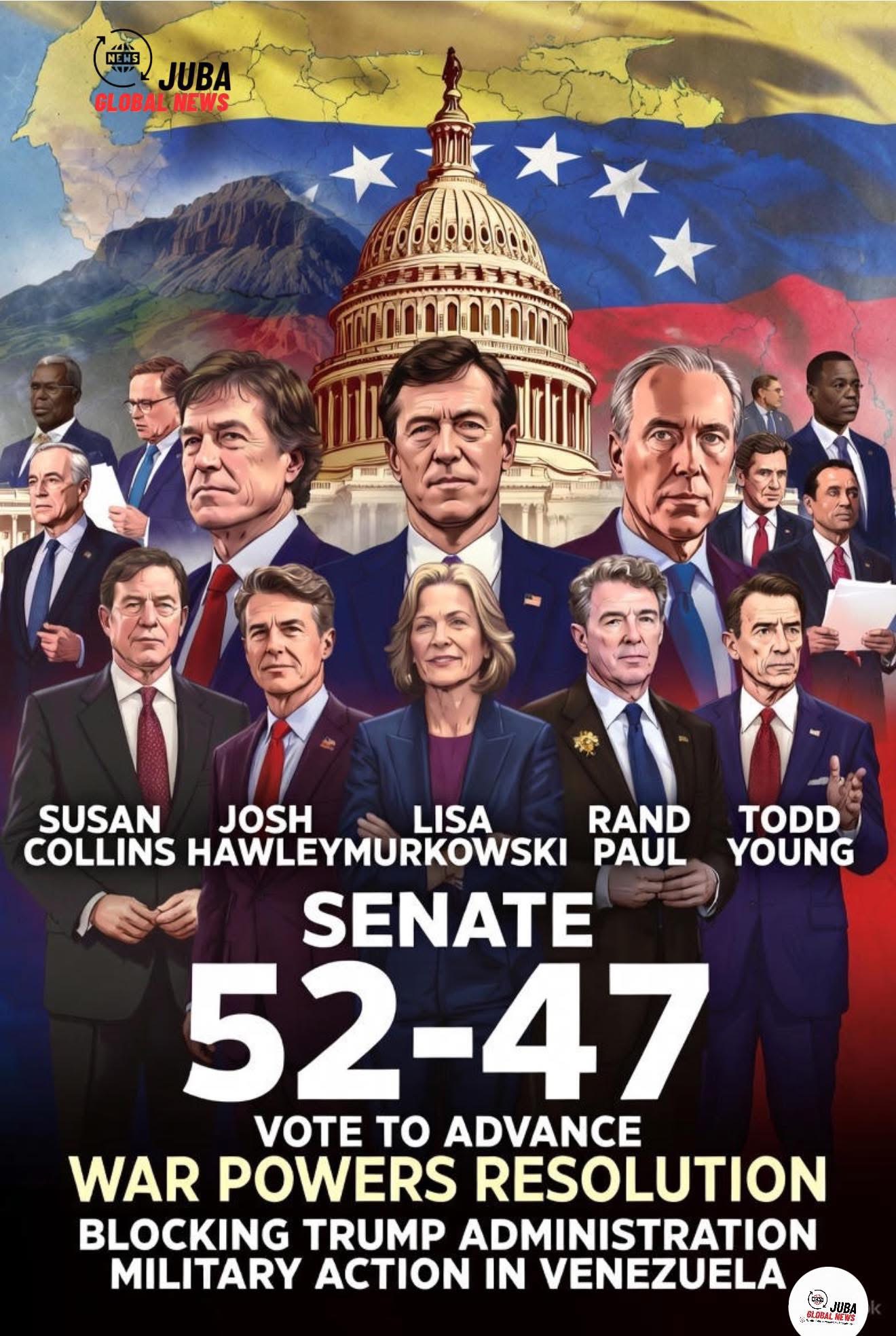
In a rare display of bipartisan unity, the United States Senate voted 52-47 on Thursday to advance a war powers resolution aimed at preventing President Donald Trump from engaging in further unauthorized military actions against Venezuela. The procedural vote, which sets the stage for a full debate and likely passage next week, comes just days after a daring U.S. military operation that resulted in the capture of Venezuelan President Nicolás Maduro and his wife, Cilia Flores.
The resolution, introduced by Senator Tim Kaine (D-VA) in December, would mandate the removal of U.S. Armed Forces from any hostilities “within or against Venezuela” unless explicitly authorized by Congress through a declaration of war or specific statutory approval. Five Republican senators—Susan Collins (ME), Josh Hawley (MO), Lisa Murkowski (AK), Rand Paul (KY), and Todd Young (IN)—joined all 47 Democrats in supporting the measure’s advancement, signaling growing unease even within the president’s own party over the escalating U.S. involvement in the South American nation.
Background: From Boat Strikes to Regime Change
The resolution’s origins trace back to reports of controversial U.S. military strikes on suspected drug-smuggling vessels in the Caribbean. In September 2025, the Trump administration initiated a series of airstrikes on boats allegedly linked to Venezuelan narcotrafficking networks, including a high-profile “double-tap” incident where a second strike targeted survivors clinging to wreckage. These operations, part of a broader buildup dubbed Operation Southern Spear, drew criticism for lacking congressional oversight and raising questions about compliance with international law.
Tensions culminated on January 3, 2026, with Operation Absolute Resolve—a nighttime raid on Maduro’s fortified residence in Caracas. Elite U.S. special forces, supported by airstrikes on Venezuelan military infrastructure, captured Maduro and Flores, who were swiftly transported to New York to face federal charges of narcoterrorism and drug conspiracy. President Trump, monitoring the operation from his Mar-a-Lago resort alongside key advisors including CIA Director John Ratcliffe, hailed it as a triumph, declaring that the U.S. would temporarily “run” Venezuela to facilitate a transition and secure its vast oil reserves.
The raid, executed without prior notification to Congress, sparked immediate backlash. Critics, including Senator Kaine, argued it violated the War Powers Resolution of 1973, which requires presidential consultation with lawmakers before introducing forces into hostilities and allows Congress to direct withdrawal absent authorization.
The Vote: A Rebuke to Executive Overreach
Thursday’s vote marks a significant, albeit procedural, rebuke to the Trump administration. While the Senate’s Republican majority has largely supported the president’s aggressive stance on Venezuela—viewing Maduro as a corrupt dictator tied to drug cartels—the capture operation appears to have crossed a threshold for some GOP members.
Senator Susan Collins explained her support by affirming the Maduro raid’s success but opposing “long-term military involvement” without congressional approval. Similarly, Senator Rand Paul, a longtime advocate for restraining executive war powers, co-sponsored the resolution alongside Kaine.
President Trump swiftly condemned the defecting Republicans on social media, stating they “should be ashamed” and that the vote “greatly hampers American Self Defense and National Security.” He has vowed to veto any final measure, calling the 1973 War Powers Resolution “unconstitutional.”
Senate Minority Leader Chuck Schumer (D-NY) praised the vote as a “constitutional” act, warning that Trump’s actions risk “sliding straight into another” endless war in South America.
Challenges Ahead: House, Veto, and Broader Implications
Even if the Senate passes the resolution next week—as the procedural vote suggests it will—the path to enactment remains arduous. The measure must clear the Republican-controlled House of Representatives, where support for Trump’s Venezuela policy is stronger. House Speaker Mike Johnson has defended the Maduro operation as lawful law enforcement with military support.
Should it reach his desk, President Trump’s threatened veto would require a two-thirds supermajority in both chambers to override—an unlikely prospect given partisan divisions.
The vote also highlights broader concerns about U.S. foreign policy under Trump. Administration officials, including Secretary of State Marco Rubio, have justified the actions as necessary to combat narcoterrorism and secure hemispheric stability. Yet international reactions have been sharply critical: Acting Venezuelan President Delcy Rodríguez denounced the raid as a “kidnapping,” while allies like Cuba reported casualties among their personnel.
Experts warn that unchecked escalation could destabilize the region, drawing in neighbors like Colombia and straining relations with Latin America. Domestically, the episode revives longstanding debates over the balance of war powers between the executive and legislative branches—a tension dating back to the Vietnam era.
A Pivotal Moment for Congressional Authority
As the Senate prepares for full debate, this resolution represents Congress’s most assertive pushback yet against Trump’s unilateral approach to Venezuela. Senator Kaine, a member of the Armed Services and Foreign Relations Committees, framed it starkly: “Congress must reassert its constitutional role in matters of war and peace.”
Whether this bipartisan momentum holds—or succumbs to partisan pressures and presidential veto—will test the limits of executive power in an increasingly volatile global landscape.
Juba Global News Network continues to monitor this developing story, with implications for U.S. democracy, regional stability, and international norms.
Sources: The Guardian, ABC News, The New York Times, POLITICO, Reuters, Congress.gov, and official statements as of January 8, 2026.
