

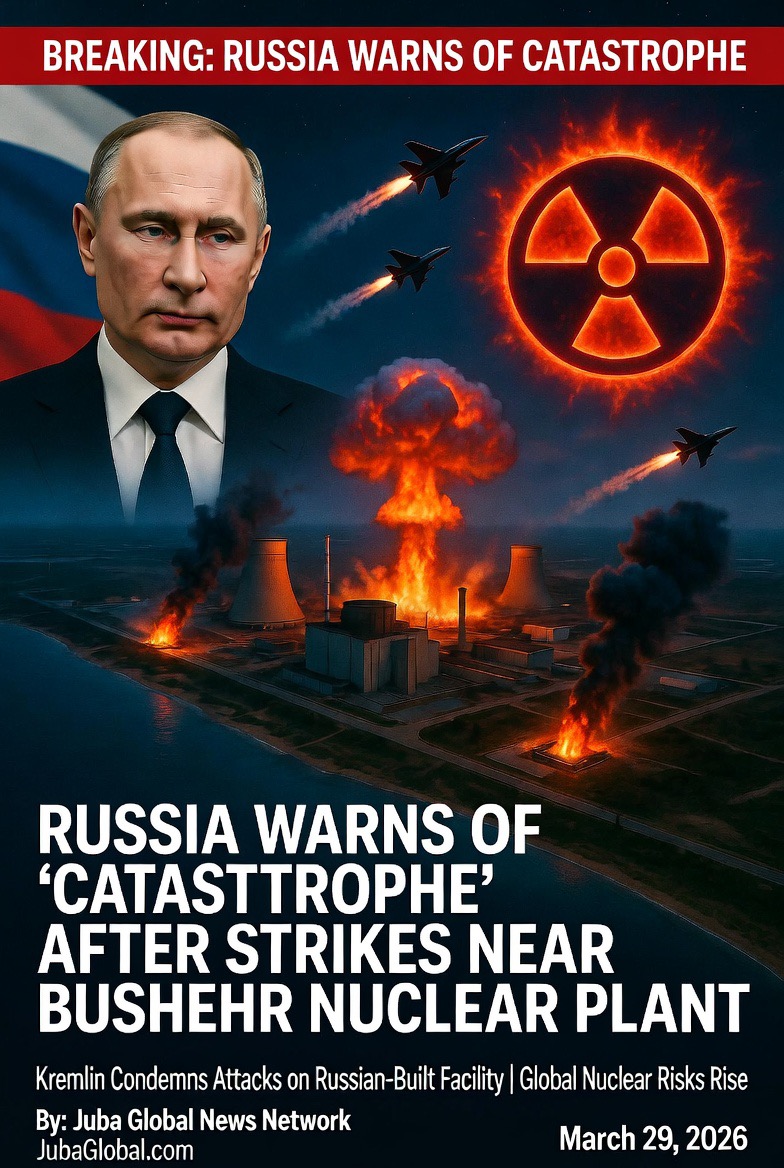
Russia Warns of ‘Catastrophe’ After New Strikes Near Iran’s Bushehr Nuclear Plant
By Juba Global News Network | JubaGlobal.com March 29, 2026 MOSCOW / BUSHEHR, Iran — Russia issued its strongest warning yet on the escalating US-Israeli w
By Juba Global News Network | JubaGlobal.com
March 29, 2026
MOSCOW / BUSHEHR, Iran — Russia issued its strongest warning yet on the escalating US-Israeli war with Iran, cautioning of potential “catastrophe” following fresh reported strikes near Iran’s Bushehr Nuclear Power Plant. The Kremlin and Russian Foreign Ministry described the incidents as “extremely dangerous” and “reckless,” accusing Washington and Tel Aviv of risking a nuclear disaster in the region.
Russian officials stated that multiple strikes have occurred in close proximity to the Bushehr facility in recent days — with some reports indicating the third incident in less than ten days. While Iranian authorities and the International Atomic Energy Agency (IAEA) have so far reported no damage to the reactor itself, no radiation leaks, and no casualties, Moscow has expressed growing alarm that the attacks are creeping dangerously closer to the operating power unit.
Russia’s Sharp Condemnation
Russian Foreign Ministry spokeswoman Maria Zakharova condemned the strikes, stating that Moscow “strongly condemns continued strikes against what it described as peaceful nuclear facilities in Iran.” She warned of the risks of large-scale radioactive contamination and called for an immediate halt to such actions.
Earlier statements from the ministry described the strikes as “an extremely outrageous manifestation of a disastrous course.” Kremlin spokesman Dmitry Peskov echoed this, telling reporters that strikes near nuclear facilities are “potentially extremely dangerous” and that Russia has repeatedly voiced its concerns directly to the United States.
Russia’s state nuclear energy corporation, Rosatom — which helped construct and continues to support operations at Bushehr — also issued a strong rebuke. Rosatom chief Alexey Likhachev warned that the incidents signal “red lines are shifting” and urged all parties to de-escalate around the sensitive site.
In one particularly pointed video statement circulating widely, Russian commentators framed the warning bluntly: “Be ready for catastrophe.” Moscow has reportedly begun evacuating additional Russian personnel from the jointly operated facility as a precautionary measure.
Background on Bushehr Nuclear Power Plant
Bushehr, located on the Persian Gulf coast in southwestern Iran, is Iran’s only operational nuclear power plant. The facility houses a Russian-built VVER-1000 pressurized water reactor that went online in 2011. Russia has played a central role in its development, construction, and ongoing maintenance, making the site a symbol of long-standing Russo-Iranian nuclear cooperation.
The plant provides a significant portion of Iran’s electricity and is subject to IAEA safeguards. Iranian officials insist the facility is used exclusively for peaceful energy generation. However, its location and technical ties to Russia have made it a focal point of international concern amid the current conflict.
Strikes near Bushehr are not entirely new in this war. Reports indicate previous incidents occurred as close as a few meters from energy units, raising fears that a direct or near-direct hit could compromise containment systems and release radioactive material.
Heightened Nuclear Risks in a Widening War
The warnings come as the US-Israeli military campaign against Iran enters its second month (Day 29 as of March 29). The conflict, which began with targeted strikes on Iranian leadership and military infrastructure on February 28, has expanded to include repeated airstrikes on missile production sites, air defenses, and other strategic targets across Iran, including areas near Tehran, Isfahan, and now increasingly sensitive nuclear-related locations.
Analysts point out that while Israel and the US have emphasized that their operations target military capabilities rather than civilian nuclear infrastructure, the proximity of some strikes to Bushehr has blurred those lines in the eyes of Russia and international observers.
A radiation release at Bushehr would not only threaten local populations in Iran but could also have cross-border consequences, potentially affecting neighboring Gulf states, the Persian Gulf marine environment, and even reaching parts of Russia’s southern regions via wind patterns or the Caspian Sea — an area Russian Foreign Minister Sergei Lavrov has already flagged as a potential spillover zone.
The IAEA has been monitoring the situation closely and has confirmed no detectable radiation leaks following the latest reported incidents. However, the agency has also stressed the importance of all parties exercising maximum restraint around nuclear facilities during armed conflict.
Broader Geopolitical Implications
Russia’s vocal opposition serves multiple purposes. As a close partner of Iran and a key player in its nuclear program, Moscow has strategic interests in protecting Bushehr. The strong rhetoric also positions Russia as a responsible international actor on nuclear safety issues, contrasting with what it portrays as reckless Western and Israeli actions.
This stance comes amid Russia’s own ongoing war in Ukraine, where nuclear safety concerns around facilities like Zaporizhzhia have been a recurring theme. Some observers suggest Moscow is drawing parallels to highlight perceived double standards in global nuclear security norms.
The warning adds another layer of diplomatic tension to an already complex conflict. While the United States and Israel have not publicly commented in detail on the specific Bushehr incidents in recent statements, the Pentagon and IDF continue to stress that their operations aim to degrade Iran’s military threat capabilities, including its ballistic missile program and nuclear ambitions.
Meanwhile, the conflict has already triggered wider regional effects: Houthi rebels in Yemen have launched missiles at Israel, air raid sirens have sounded in Gulf states, and oil prices remain elevated above $100 per barrel due to threats around the Strait of Hormuz.
Calls for De-escalation and International Response
Russia has called on the international community to provide an “objective and hardline assessment” of the strikes and to pressure all sides toward de-escalation. Chinese officials have also expressed concern over nuclear risks in the region, while several Muslim-majority countries are holding diplomatic meetings to explore cease-fire pathways.
Iranian officials have used the incidents to rally domestic support and accuse the US and Israel of endangering global security. The Islamic Revolutionary Guard Corps (IRGC) has vowed to defend Iran’s nuclear sites while maintaining that the facilities serve only peaceful purposes.
Environmental and humanitarian organizations have raised alarms about the potential long-term consequences of any radiological incident, urging immediate diplomatic intervention to create a safety zone around Bushehr and other sensitive sites.
What Lies Ahead?
As strikes continue across Iran and the US bolsters its military presence with additional Marine deployments, the risk of accidental or intentional escalation around nuclear infrastructure remains a grave concern. Military analysts note that while current reports indicate no major damage at Bushehr, the repeated close calls suggest the margin for error is narrowing.
For now, Russia’s warnings serve as a loud diplomatic signal: further strikes near nuclear facilities could trigger unpredictable and catastrophic consequences, not just for Iran but for the broader region and beyond.
Juba Global News Network will continue monitoring the situation at Bushehr, diplomatic responses from Moscow, and any updates from the IAEA. The story remains highly fluid.
