

Russia-Ukraine War: Relentless Energy Infrastructure Attacks Continue as Winter Deepens Humanitarian Crisis
By Juba Global News Network Staff JubaGlobal.com February 11, 2026 – Juba, South Sudan As the third winter of full-scale war grips Ukraine, Russian forces
By Juba Global News Network Staff
JubaGlobal.com
February 11, 2026 – Juba, South Sudan
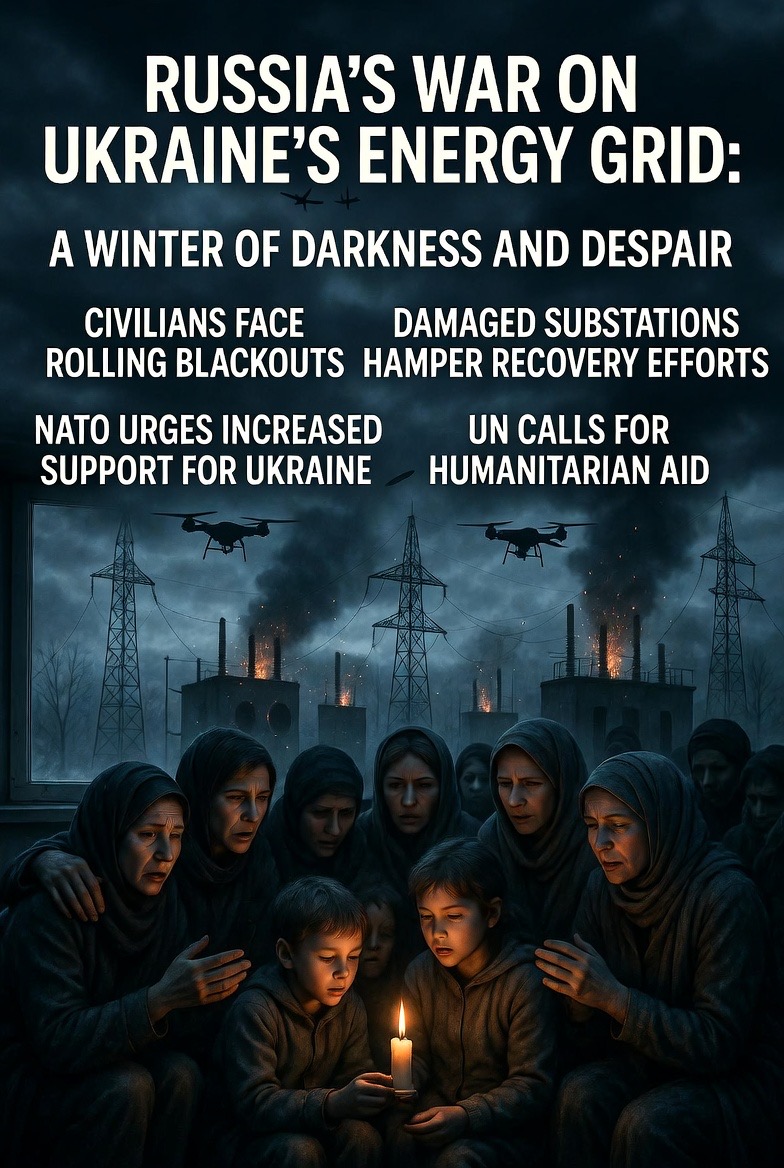
As the third winter of full-scale war grips Ukraine, Russian forces have intensified their campaign against the country’s energy infrastructure, launching one of the largest combined drone and missile barrages of the conflict in recent days. On February 10–11, 2026, at least three civilians were killed and dozens injured in strikes that targeted power substations, transformer facilities, and natural gas infrastructure across multiple oblasts. The attacks have plunged large parts of Ukraine into rolling blackouts once again, destroyed critical repair capacity, and deepened an already severe humanitarian emergency as temperatures drop below -15°C in many regions.
Ukrainian President Volodymyr Zelenskyy described the latest wave as “deliberate terror against civilians,” accusing Moscow of trying to “freeze Ukrainians into submission” ahead of any potential spring offensive or diplomatic breakthrough. In a late-night video address, he renewed urgent appeals for additional Western air-defense systems, particularly Patriot batteries and NASAMS units, stating: “Every delayed launcher means more destroyed homes, more dead children, more darkness in hospitals.”
Scale and Impact of the Latest Strikes
According to Ukraine’s Energy Ministry and state grid operator Ukrenergo, the overnight assault involved more than 90 Shahed-type kamikaze drones and at least 35 cruise and ballistic missiles. Key targets included:
- High-voltage substations in Kyiv, Kharkiv, Zaporizhzhia, and Dnipropetrovsk oblasts
- Several gas compressor stations and pipeline nodes in central and eastern Ukraine
- Thermal power plants already operating at reduced capacity after previous damage
Ukrenergo reported that emergency blackouts were immediately imposed in 14 of Ukraine’s 24 oblasts plus the city of Kyiv. In some areas, households are receiving electricity for only 2–4 hours per day. Hospitals in Kharkiv and Sumy oblasts switched to diesel generators, while water supply systems failed in several districts due to loss of pumping power.
The Ukrainian Air Force claimed to have shot down 62 of the 90+ drones and 22 of the 35 missiles—a roughly 70% interception rate—but noted that even single missile strikes on already-damaged high-voltage equipment can cause cascading failures across regions. Repair crews face extreme danger: several linemen and engineers have been killed or wounded while working under fire in recent weeks.
Russian Perspective and Strategic Logic
Moscow has never officially acknowledged targeting civilian energy infrastructure, instead framing strikes as “precision operations against military-logistics objects and decision-making centers.” Russian military bloggers and state media, however, have openly celebrated the campaign as a legitimate way to degrade Ukraine’s war-fighting capacity and impose economic & psychological pressure.
Independent analysts argue the strategy has several interlocking goals:
- Deprive frontline units of stable power → radar, communications, drone charging stations, field hospitals, and repair workshops suffer
- Force Ukraine to divert air-defense missiles away from frontline positions to protect cities and grid nodes
- Create humanitarian pressure → large-scale blackouts in winter increase civilian suffering, potentially fueling domestic discontent or refugee flows
- Destroy months of expensive Western-supplied repair equipment → transformers and autotransformers cost tens of millions of dollars each and have long lead times (12–24 months)
Despite heavy losses of its own long-range aviation assets and cruise-missile stockpiles, Russia continues to receive fresh Shahed drones from Iran and reportedly assembles modified versions domestically. Some analysts estimate Moscow can sustain 80–120 large-scale energy strikes per winter season at current production rates.
Ukraine’s Response and Winter Survival Strategy
Ukrainian authorities have implemented a multi-layered survival plan for the 2025–2026 winter:
- Decentralized generation → thousands of small gas turbines, solar panels, and diesel generators installed at critical facilities
- Import of electricity → maximum possible imports from Poland, Slovakia, Romania, Moldova, and Hungary (currently ~1.7–1.9 GW, near technical ceiling)
- Demand management → strict quotas for industry, scheduled blackouts, and public appeals to conserve power
- Underground & mobile repair teams → crews now work mostly at night and relocate frequently to avoid targeting
- Starlink & Starshield terminals → used to maintain command & control even when terrestrial networks fail
Despite these measures, officials privately admit that prolonged outages of more than 12–18 hours per day would push many urban areas toward collapse: sewage systems freeze, water pipes burst, and coal/gas heating plants go offline.
International Reaction and Aid Efforts
The United Nations Office for the Coordination of Humanitarian Affairs (OCHA) warned that continued attacks on energy infrastructure could push an additional 1.5–2 million Ukrainians into acute humanitarian need this winter. The EU announced an emergency €300 million package for grid repair equipment and generator procurement, while the United States fast-tracked delivery of additional transformers and mobile substations under the Ukraine Security Assistance Initiative.
NATO Secretary General Jens Stoltenberg reiterated that “deliberate attacks on civilian energy infrastructure constitute war crimes under international humanitarian law.” Several Western capitals are reportedly considering new sanctions packages targeting third-country suppliers of drone components to Russia and Iran.
Outlook: No End in Sight
With neither side showing willingness to de-escalate attacks on critical civilian infrastructure, experts predict that energy terror will remain a central feature of the war through at least March 2026. Ukraine’s ability to keep essential services running—and Russia’s capacity to keep destroying them—may prove decisive in determining whether the country can hold its defensive lines and maintain societal cohesion until potential diplomatic openings emerge later in the year.
For millions of Ukrainians facing another dark, freezing winter, the war is measured not only in territory lost or gained, but in hours of light, warmth, and running water.
Juba Global News Network will continue to monitor the situation on the ground and provide balanced reporting on the human cost and strategic dynamics of this devastating campaign against Ukraine’s energy lifelines.
