

Russia Launches Massive Drone and Missile Attack on Kyiv: Over 370 Projectiles Reported as Power Outages Hit Millions on Day 1,427 of the War
By: Juba Global News Network | JubaGlobal.com January 21, 2026 In one of the most intense aerial assaults of the ongoing conflict, Russian forces unleashed
By: Juba Global News Network | JubaGlobal.com
January 21, 2026
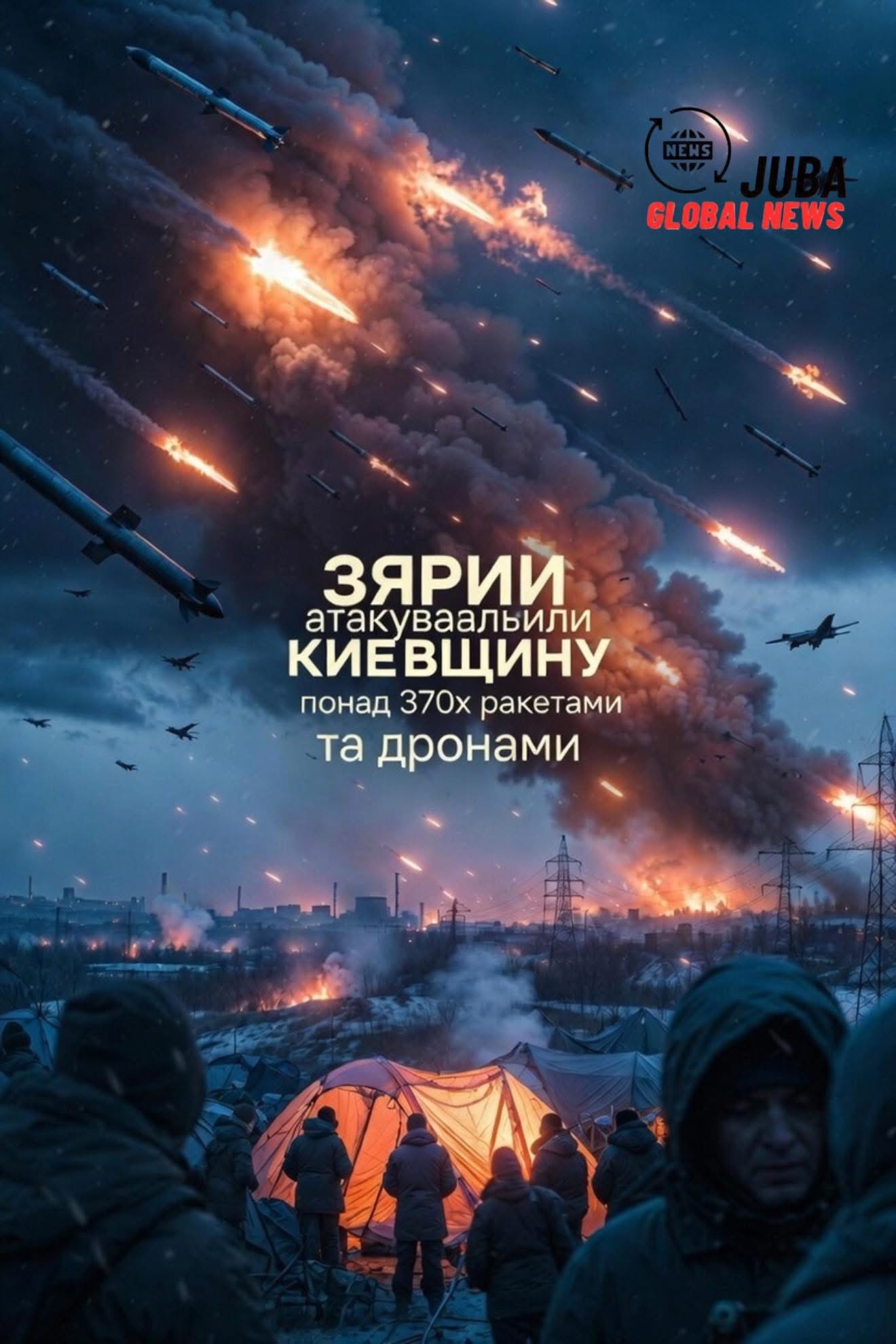
In one of the most intense aerial assaults of the ongoing conflict, Russian forces unleashed a massive combined drone and missile barrage on Ukraine overnight into January 20-21, 2026, with the Ukrainian capital Kyiv bearing the brunt of the attack. Ukraine’s Air Force reported that Russia launched more than 370 aerial threats—including ballistic missiles, cruise missiles, and hundreds of attack drones—primarily targeting critical energy infrastructure in and around the city. The strike, occurring on day 1,427 of Russia’s full-scale invasion, plunged large swathes of Kyiv into darkness and cold amid subfreezing winter temperatures, exacerbating an already dire humanitarian situation.
According to detailed breakdowns from Ukraine’s Air Force and military officials, the assault involved 18 Iskander-M/S-300 ballistic missiles, 15 Kh-101 cruise missiles, one Zircon hypersonic anti-ship missile, and approximately 339 drones (with around 250 being Shahed-type loitering munitions). Ukrainian defenses intercepted an impressive number—downing 14 ballistic missiles, 13 cruise missiles, and 315 drones—but several projectiles penetrated, causing widespread damage. The Zircon missile, noted for its extreme speed and difficulty to intercept, reportedly struck an infrastructure target in Vinnytsia Oblast, while debris and direct hits affected multiple sites in Kyiv and surrounding oblasts.
The primary objective appeared to be Ukraine’s battered energy grid. Strikes targeted substations, power generation facilities, and distribution networks, leaving more than one million households in Kyiv without electricity, according to President Volodymyr Zelenskyy in his nightly address. Over 5,600 high-rise residential buildings lost heating, and the entire left bank of the Dnipro River in the capital was cut off from water supplies. Kyiv Mayor Vitali Klitschko confirmed disruptions to power and water on the east bank, with emergency crews racing to restore services under freezing conditions reaching -10°C or lower. Power outages also rippled across other regions, including Odesa, Dnipropetrovsk, Sumy, Rivne, Kharkiv, and Zaporizhzhia oblasts.
The humanitarian toll was immediate and severe. At least one person was killed in the Kyiv region (a 50-year-old man northwest of the capital), with additional civilian casualties reported elsewhere: three in Zaporizhzhia, and injuries in Dnipro and other areas. Fires broke out in multiple locations, smog blanketed parts of Kyiv’s left bank from burning debris and infrastructure damage, and residents scrambled for warmth and water. Government aid points, including heated tents and charging stations, were set up across the city, while Deputy Prime Minister Oleksii Kuleba reported deploying 68 repair brigades and over 1,400 emergency warming stations.
Zelenskyy condemned the attack as deliberate winter terrorism, highlighting that some missiles used—including those produced in 2026—demonstrated Russia’s continued ability to replenish stockpiles despite Western sanctions. He noted “updated tactics” in the strike pattern and vowed to share details with allies, including the United States, while urging tougher measures to curb Moscow’s military production. The president also warned of the nuclear risks: the assault damaged substations linked to off-site power for the decommissioned Chornobyl Nuclear Power Plant, prompting the International Atomic Energy Agency (IAEA) to monitor the site’s vulnerability closely. Though no immediate radiation threat was reported, the incident underscored Moscow’s willingness to target energy systems tied to nuclear facilities, using the specter of disaster as leverage.
This latest barrage fits a pattern of intensified Russian winter strikes on Ukrainian infrastructure, aimed at breaking civilian morale and forcing concessions amid grinding frontline battles and diplomatic pressures—including U.S. negotiations under President Trump. Russia has dramatically scaled up strike packages in 2025-2026, launching over 40 massive barrages exceeding 300 projectiles last year alone, supported by increased production and supplies from partners like Iran, North Korea, and China.
Ukrainian air defenses performed strongly overall, aided by recent shipments of missiles, but officials stressed the urgent need for more systems—particularly Patriot batteries—to counter ballistic and hypersonic threats. The high interception rate prevented even worse devastation, yet the breaches highlighted gaps in coverage for a geographically vast and persistent drone campaign.
As repair efforts continue in subzero conditions, Kyiv’s residents face another harsh test of resilience. Many have evacuated temporarily—around 600,000 since recent urgings—while those remaining adapt to blackouts, hauling water up stairs and seeking community aid. The attack has drawn fresh international condemnation, with calls for sustained support to Ukraine’s defense and energy resilience.
The war enters its 1,428th day with no signs of de-escalation. Russia continues limited ground operations in various sectors, while Ukraine maintains long-range strikes on Russian assets. This massive assault on Kyiv serves as a grim reminder that civilian infrastructure remains a primary target in Moscow’s strategy to wear down Ukrainian resolve.
Juba Global News Network will provide ongoing coverage of the conflict, including updates on restoration efforts and international responses. For real-time developments, visit JubaGlobal.com.
