Russia Bolsters Arctic Defenses Amid Heightened Greenland Tensions: New Military Infrastructure Signals Strategic Competition in the High North
By: Juba Global News Network | JubaGlobal.com
Published: January 16, 2026
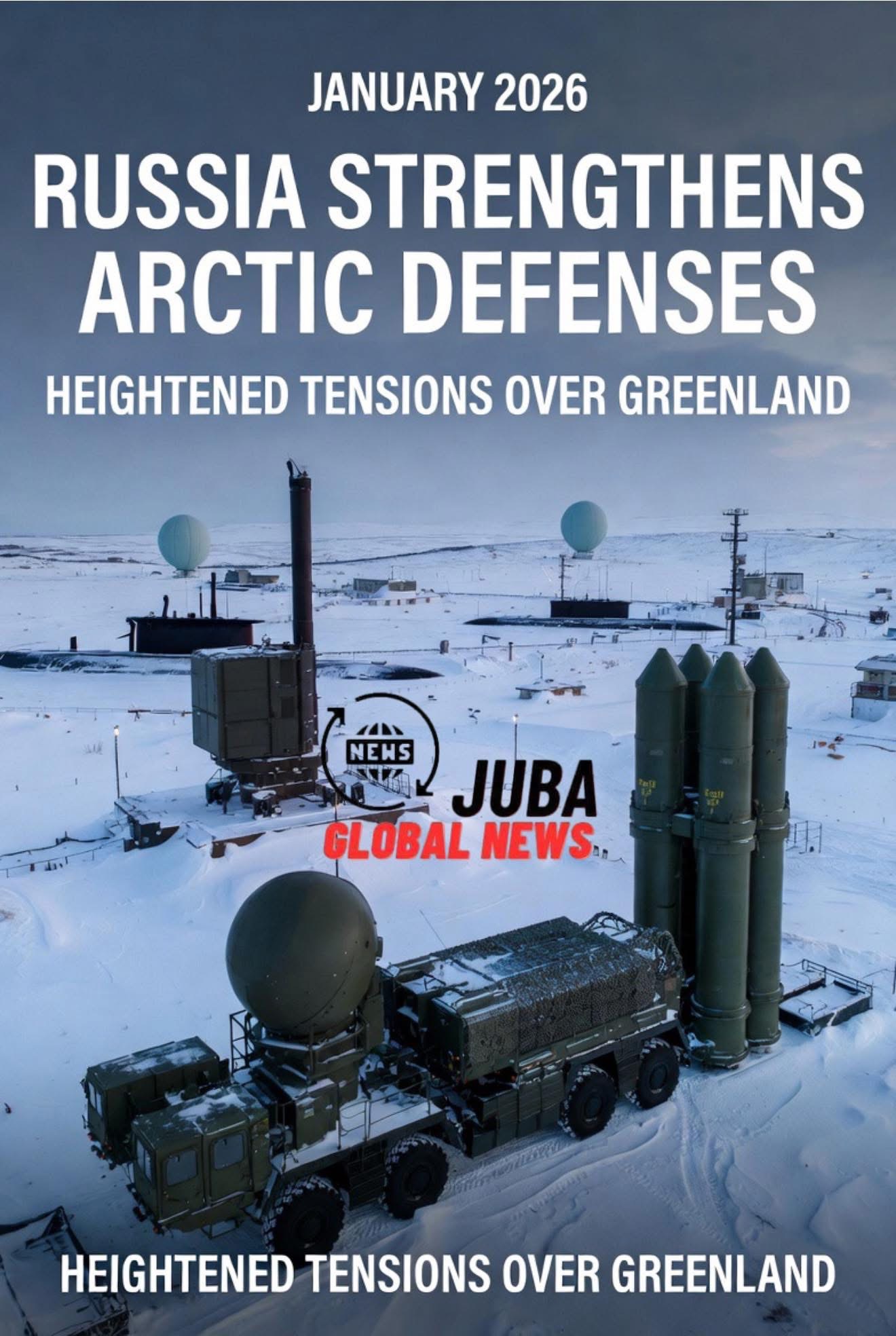
Russia announced a major expansion of its military presence in the Arctic on January 16, 2026, unveiling plans to deploy additional air-defense systems, upgrade Northern Fleet submarine bases, and construct new radar stations and logistics hubs along the Northern Sea Route (NSR). The move, detailed by Defense Minister Sergei Shoigu during a televised briefing from Severomorsk, comes amid escalating diplomatic friction over Greenland, where U.S. interest in strategic basing rights and mineral resources has intensified under the second Trump administration.
Shoigu stated that the enhancements are necessary to “protect Russia’s sovereign interests in the Arctic from growing external military activity and unilateral attempts to challenge established legal regimes.” He specifically referenced “provocative statements and reconnaissance operations” near Russian-controlled territories, widely interpreted as a reference to U.S. and Danish-NATO activities around Greenland and the Fram Strait.
Key elements of the announced buildup include:
- Deployment of additional S-400 Triumph and S-500 Prometheus long-range air-defense systems to Novaya Zemlya, Franz Josef Land, and the Kola Peninsula, extending coverage over the Barents and Kara Seas.
- Modernization of submarine facilities at Gadzhiyevo and Olenya Bay to support Borei-A and Yasen-M class nuclear-powered submarines, including expanded dry-dock capacity and hardened command bunkers.
- Construction of six new radar stations equipped with Voronezh-DM and Container over-the-horizon systems to monitor air and missile traffic across the Arctic Ocean.
- Expansion of the Nagurskoye airbase on Alexandra Land (Franz Josef Land), adding extended runways capable of handling Tu-160M strategic bombers and Il-78 tankers, as well as permanent basing for MiG-31K interceptors armed with Kinzhal hypersonic missiles.
- Increased patrols by nuclear-powered icebreakers armed with Pantsir-S1 missile-gun systems to escort commercial and military convoys along the NSR.
The Russian Ministry of Defense emphasized that the NSR—now ice-free for longer periods due to climate change—handled a record 36 million tons of cargo in 2025, with projections exceeding 80 million tons annually by 2030. Protecting this vital economic artery, which offers a shorter route between Asia and Europe than the Suez Canal, has been framed as a core national-security priority.
Greenland flashpoint
Tensions over Greenland have surged since President Trump’s return to office. In late 2025, the U.S. reopened negotiations with Denmark for expanded military access to Thule Air Base and potential new facilities on Greenland’s northwest coast, citing the need to counter Russian and Chinese activities in the Arctic. Trump has publicly reiterated his 2019 proposal to purchase Greenland, calling it “a great real-estate deal for national security and rare-earth minerals.” Danish and Greenlandic authorities have firmly rejected any sale, but agreed in principle to discuss “enhanced strategic cooperation” under NATO auspices.
Moscow views these developments as encirclement. Russian state media and officials have accused the U.S. of “militarizing the Arctic under the guise of climate cooperation” and attempting to “illegally restrict freedom of navigation” along the NSR, which Russia claims as internal waters under UNCLOS Article 234 (ice-covered areas). The Kremlin has warned that any NATO basing expansion on Greenland could prompt “symmetric responses,” including increased submarine patrols near the GIUK Gap (Greenland-Iceland-UK) and potential deployment of sea-based nuclear forces closer to North American waters.
Broader Arctic competition
The Russian buildup occurs against a backdrop of accelerating great-power rivalry in the High North. China’s “Polar Silk Road” initiative has seen Beijing invest in Russian LNG projects (Yamal LNG, Arctic LNG-2) and seek observer status in Arctic Council working groups. NATO, meanwhile, has strengthened its northern flank: Norway and Finland (now full members) have expanded joint exercises, Sweden has reopened Cold War-era Arctic air bases, and the U.S. has increased submarine port calls in Tromsø and conducted more frequent B-52 overflights.
Climate change is reshaping the strategic calculus. Record-low sea ice in 2025 allowed commercial shipping through the Northeast Passage for nearly six months, but also exposed previously inaccessible coastlines to potential exploitation or sabotage. Melting permafrost has damaged Russian military infrastructure, necessitating costly repairs and new hardened construction.
Environmental and indigenous concerns
Indigenous Sámi, Inuit, and Nenets communities have voiced alarm over the militarization, warning that increased submarine traffic, sonar exercises, and weapons testing disrupt marine mammals and traditional hunting grounds. Greenpeace and other NGOs have called for a demilitarized Arctic zone, though such proposals have gained little traction among the major powers.
As Russia accelerates its Arctic fortress strategy and the U.S. pushes for greater presence in Greenland and Alaska, the High North risks becoming the next major theater of great-power competition. Whether diplomacy—through renewed Arctic Council engagement or bilateral U.S.-Russia channels—can prevent escalation remains uncertain.
Juba Global News Network will continue monitoring military developments, diplomatic exchanges, and environmental impacts in the Arctic as this strategic contest unfolds.
Sources: Russian Ministry of Defense official statements, TASS, RIA Novosti, Reuters, The Barents Observer, High North News, U.S. Department of Defense Arctic Strategy updates, Danish Ministry of Foreign Affairs, Greenland Self-Government statements, NATO press releases, and UNCLOS-related analyses.