Partial Government Shutdown Begins After Funding Impasse on DHS Reforms
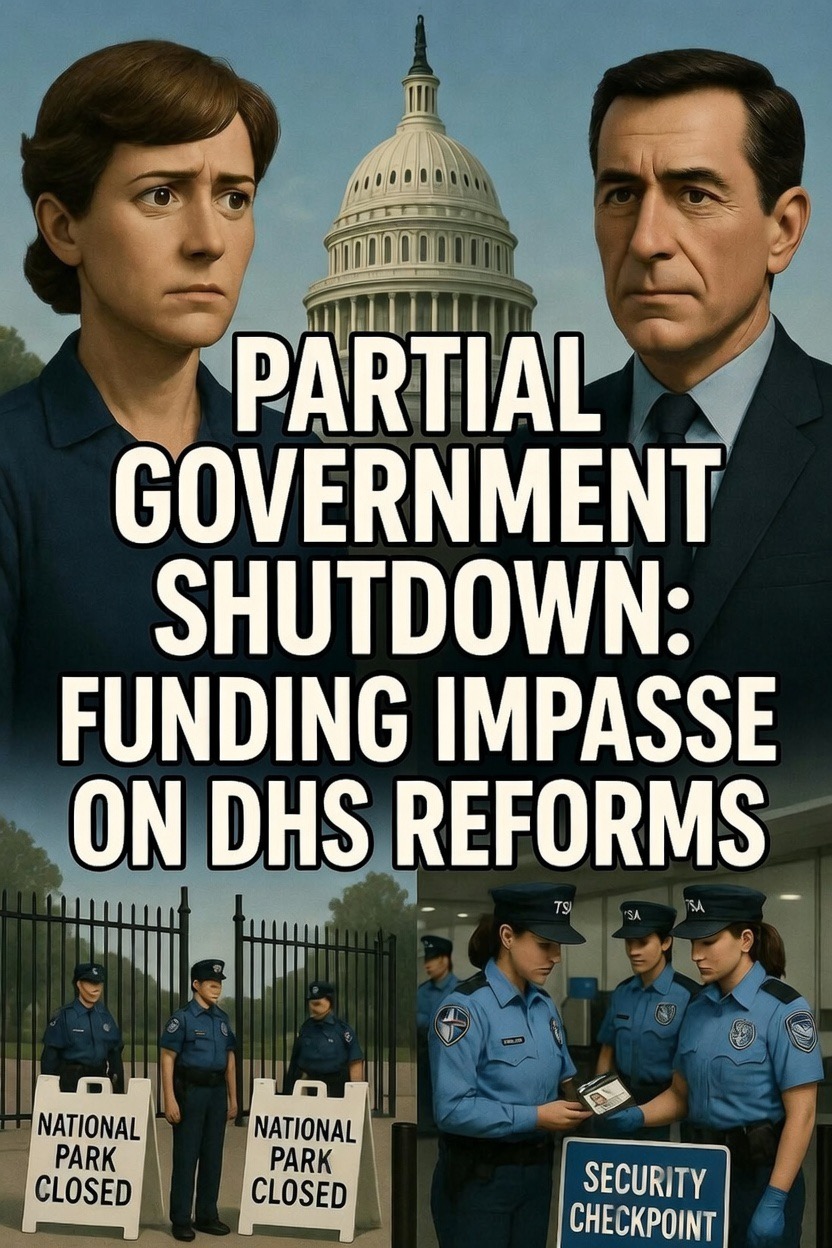
As of midnight on January 31, 2026, the United States entered a partial government shutdown following Congress’s failure to pass full-year funding legislation before the expiration of temporary appropriations. The lapse affects multiple federal agencies, though a bipartisan Senate deal struck late on January 30 provides a pathway to quickly resolve most of the crisis—pending House approval early next week.
The shutdown stems directly from a high-stakes impasse over funding for the Department of Homeland Security (DHS), which oversees Immigration and Customs Enforcement (ICE) and Customs and Border Protection (CBP). Democrats in the Senate refused to support long-term DHS funding without reforms to immigration enforcement practices, citing recent fatal shootings of U.S. citizens by federal agents in Minneapolis—including the deaths of Renée Good and Alex Pretti—as evidence of excessive force and overreach under President Trump’s aggressive deportation push.
How the Shutdown Unfolded
Funding for fiscal year 2026 had been partially addressed earlier, with full appropriations secured for agencies like Agriculture, Veterans Affairs, and the Legislative Branch. However, six key appropriations bills—covering roughly 75-80% of federal discretionary spending—lapsed at midnight January 31 after negotiations stalled.
The critical sticking point was the DHS portion, which funds ICE, Border Patrol, FEMA, TSA, and other security operations. Senate Democrats, leveraging public outrage over the Minneapolis incidents and “Operation Metro Surge” (the deployment of thousands of federal agents to cities), demanded changes such as:
- Requiring body cameras and unmasked agents during operations
- Stricter use-of-force policies aligned with local law enforcement standards
- Limits on “roving patrols” and warrantless searches
- Greater accountability for agent-involved incidents, including independent investigations
Republicans and the Trump administration initially resisted separating DHS funding, arguing it would undermine border security and mass deportation efforts. However, facing a looming shutdown and bipartisan pressure, President Trump endorsed a compromise deal negotiated with Senate Democrats.
Late on January 30, the Senate passed (71-29) a package that:
- Funds most affected agencies (Defense, State, HHS, Education, Transportation, HUD, and others) through September 30, 2026.
- Provides a two-week stopgap extension for DHS at current levels, buying time for negotiations on ICE reforms.
The bill now awaits House action, with the chamber set to reconvene Monday. President Trump has urged swift passage, and leaders expect the measure to reach his desk early next week, limiting the shutdown to a brief weekend-to-early-week disruption.
Immediate Impacts of the Partial Shutdown
While essential functions continue (thanks to prior appropriations and self-funding mechanisms), non-essential operations across several departments are paused or limited:
- Department of Defense — Most military personnel remain on duty and paid (via prior funding mechanisms), but civilian employees face furloughs, delayed training, and halted non-critical contracts.
- Department of Homeland Security — Temporarily funded via the two-week extension, but full operations could face uncertainty if talks fail. TSA airport screening continues (deemed essential), though with potential delays; FEMA disaster response remains active.
- Other agencies — Furloughs hit civilian staff at HHS (non-emergency health programs), Education (grant processing), Transportation (non-safety regulatory work), and HUD (housing assistance processing). National parks close, federal courts limit operations to emergencies, and IRS services (beyond tax refunds) pause.
- Federal workers — Approximately hundreds of thousands could be furloughed without immediate pay, though many expect back pay once funding resumes. Essential employees (e.g., air traffic controllers, border agents) work without pay initially.
The Office of Management and Budget directed agencies to begin shutdown procedures immediately after the lapse, issuing contingency plans to minimize disruption.
Political Dynamics and Broader Context
This marks the second partial shutdown in Trump’s second term, following earlier fiscal battles. Democrats used their Senate leverage—amplified by nationwide “ICE Out” protests—to force concessions on immigration policy, a rare instance of opposition influence amid GOP control of the House and White House.
President Trump praised the deal on social media, calling it a “win for getting most of government funded” while extending DHS temporarily. Senate Majority Leader (assuming GOP control) and Minority Leader Chuck Schumer described it as a step toward “reining in ICE violence.” Some conservative Republicans criticized the short-term DHS extension as capitulation, but bipartisan support in the Senate (including from figures like Sen. Rand Paul) signaled broad desire to avoid prolonged chaos.
The shutdown highlights deepening polarization over immigration: Trump’s administration defends aggressive enforcement as necessary for security, while critics point to citizen deaths and community militarization as evidence of overreach.
What Happens Next?
- House vote expected Monday — If passed quickly and signed by Trump, most agencies could reopen by mid-week, with DHS funded through mid-February for reform talks.
- Ongoing DHS negotiations — Lawmakers will debate ICE reforms in the coming weeks. Failure could trigger another impasse when the two-week extension ends.
- Economic and public effects — Short shutdowns cause limited immediate pain but erode confidence in governance. Markets have shown mild volatility, with hopes pinned on quick resolution.
This partial shutdown—driven by immigration policy clashes rather than traditional budget fights—underscores the volatile intersection of enforcement priorities, civil rights concerns, and congressional gridlock in 2026. While likely brief, it serves as a stark reminder of how flashpoint events like the Minneapolis shootings can paralyze Washington and affect everyday Americans. As Congress returns, all eyes are on whether compromise on DHS reforms can prevent future lapses.