

Outrage Over Settler Violence and Approvals in West Bank: Israeli Minister Greenlights Gun Licenses for Illegal Settlements Amid Escalating Attacks
January 22, 2026 — A wave of international condemnation and protests erupted today after Israel’s far-right National Security Minister Itamar Ben-Gvir anno
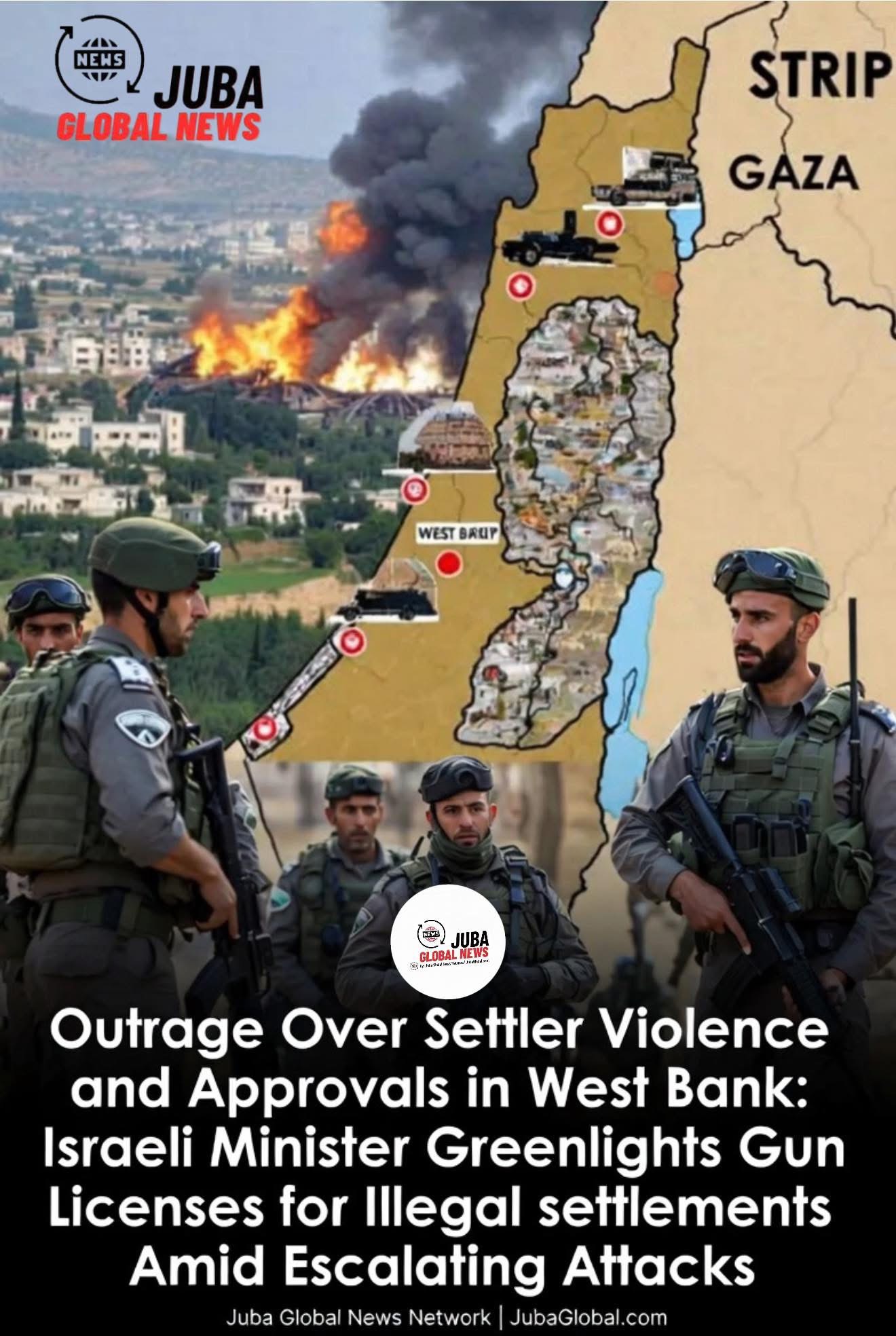
January 22, 2026 — A wave of international condemnation and protests erupted today after Israel’s far-right National Security Minister Itamar Ben-Gvir announced that his ministry would begin issuing firearms licenses to residents of unauthorized (illegal under international law) Jewish outposts and settlements across the occupied West Bank. The decision, confirmed in a late-night statement from the ministry, comes amid a sharp rise in reported settler violence against Palestinian communities, with human-rights organizations documenting dozens of attacks in the first three weeks of 2026 alone.
The move has been described by Palestinian officials, the United Nations, European governments, and leading human-rights groups as “a dangerous escalation” that effectively legalizes and incentivizes settler vigilantism at a time when the region is already on edge following the Gaza ceasefire and shifting U.S. policy under President Trump.
The Announcement and Its Immediate Context
In a televised interview and subsequent ministry press release, Minister Ben-Gvir declared:
“Every Jew in Judea and Samaria [the biblical term for the West Bank] has the right to defend himself and his family. We will no longer leave our people defenseless against terrorist attacks. Starting immediately, we will expedite firearms licenses for residents of outposts and communities that face daily threats.”
The policy change removes previous bureaucratic hurdles and security-vetting requirements that had limited gun ownership in unauthorized outposts. According to ministry figures, more than 1,200 applications from settlers in illegal outposts are expected to be fast-tracked in the coming weeks.
The announcement follows a particularly violent week in the West Bank:
- January 17–20: Settler groups attacked Palestinian villages near Nablus, burning vehicles, damaging homes, and injuring at least 14 people (including three children) with stones, clubs, and live fire.
- January 19: Israeli soldiers reportedly stood by during an assault on the village of Burqa, where settlers set fire to olive groves and livestock pens.
- January 21: A Palestinian shepherd was shot and seriously wounded near Hebron by settlers who claimed he was “trespassing” on land adjacent to an outpost.
According to data compiled by the UN Office for the Coordination of Humanitarian Affairs (OCHA), settler violence incidents in the West Bank have surged by more than 80% compared to the same period last year, with 2025 already recording the highest annual total since systematic monitoring began in 2005.
Palestinian and International Reactions
Palestinian Authority President Mahmoud Abbas called the gun-license decision “a green light for more bloodshed” and accused Israel of “arming terrorists while disarming an entire people.” The PA Foreign Ministry demanded an immediate UN Security Council session.
Leading Palestinian human-rights organizations issued a joint statement:
“This is not about self-defense. It is about arming an already heavily armed settler population that routinely attacks Palestinian civilians with near-total impunity. The Israeli government is transforming settler militias into an official extension of state power.”
The United Nations Special Coordinator for the Middle East Peace Process Tor Wennesland warned that the policy “risks dramatically increasing violence and undermining any prospect of de-escalation.” The UN Human Rights Office in the occupied Palestinian territory described the move as “extremely troubling” and likely to violate international humanitarian law.
European Union foreign-policy chief Josep Borrell condemned the decision as “reckless and inflammatory,” while the foreign ministries of France, Germany, the UK, Ireland, Spain, and Norway issued unusually sharp statements calling on Israel to reverse course.
The Biden administration (still in office until January 20, 2026) expressed “deep concern” but stopped short of explicit condemnation. Incoming Trump officials have remained silent, though President Trump’s recent statements emphasizing strong support for Israeli security have fueled speculation that Washington will not press Israel to reverse the policy.
Legal and Political Dimensions
Under international law, Israeli settlements in the occupied West Bank are illegal. The Fourth Geneva Convention prohibits an occupying power from transferring its civilian population into occupied territory. The International Court of Justice’s 2004 advisory opinion and multiple UN Security Council resolutions (most recently Resolution 2334 in 2016) reaffirm this position.
Israel disputes this interpretation, arguing that the territories are “disputed” rather than occupied and that Jewish communities have historical and biblical claims.
Within Israel, the policy has strong support among the settler movement and the ruling coalition’s far-right partners. Prime Minister Benjamin Netanyahu has not publicly commented but has previously defended expanded settlement construction and security measures for settlers.
Critics within Israel—including opposition leader Yair Lapid and former defense officials—warned that arming settlers in illegal outposts could lead to uncontrolled vigilantism and further erode the already fragile rule of law in the West Bank.
Broader Regional Context
The decision comes at a volatile moment:
- The Gaza ceasefire remains fragile, with sporadic violence and ongoing humanitarian crisis.
- U.S. policy under Trump has shifted toward stronger backing of Israeli security positions.
- Normalization talks between Israel and Saudi Arabia remain stalled partly over Palestinian statehood demands.
- Jordan and Egypt have expressed increasing alarm over settler violence and settlement expansion.
For many Palestinians, the gun-license announcement is seen as the latest evidence that Israel is entrenching permanent control over the West Bank while systematically undermining the possibility of a viable Palestinian state.
Outlook: Escalation or Containment?
The coming weeks will be critical. If settler violence continues or intensifies, Palestinian protests and clashes with Israeli forces could spread. International pressure—particularly from Europe and the UN—may increase, though the incoming U.S. administration’s stance will be decisive.
For now, the image of settlers receiving state-issued firearms while Palestinian communities face daily attacks has become a powerful symbol of the deepening asymmetry and despair in the occupied West Bank. Whether this policy becomes a turning point toward greater violence or is quietly moderated under international scrutiny remains one of the most urgent—and dangerous—questions facing the region in 2026.
