

Oil Prices Remain Volatile Above $100 as Hormuz Disruptions Persist Despite Diplomatic Signals from U.S.-Iran Talks
By Juba Global News Network | JubaGlobal.com Published: March 27, 2026 Global oil markets continued to exhibit sharp volatility on March 27, 2026, with ben
By Juba Global News Network | JubaGlobal.com
Published: March 27, 2026
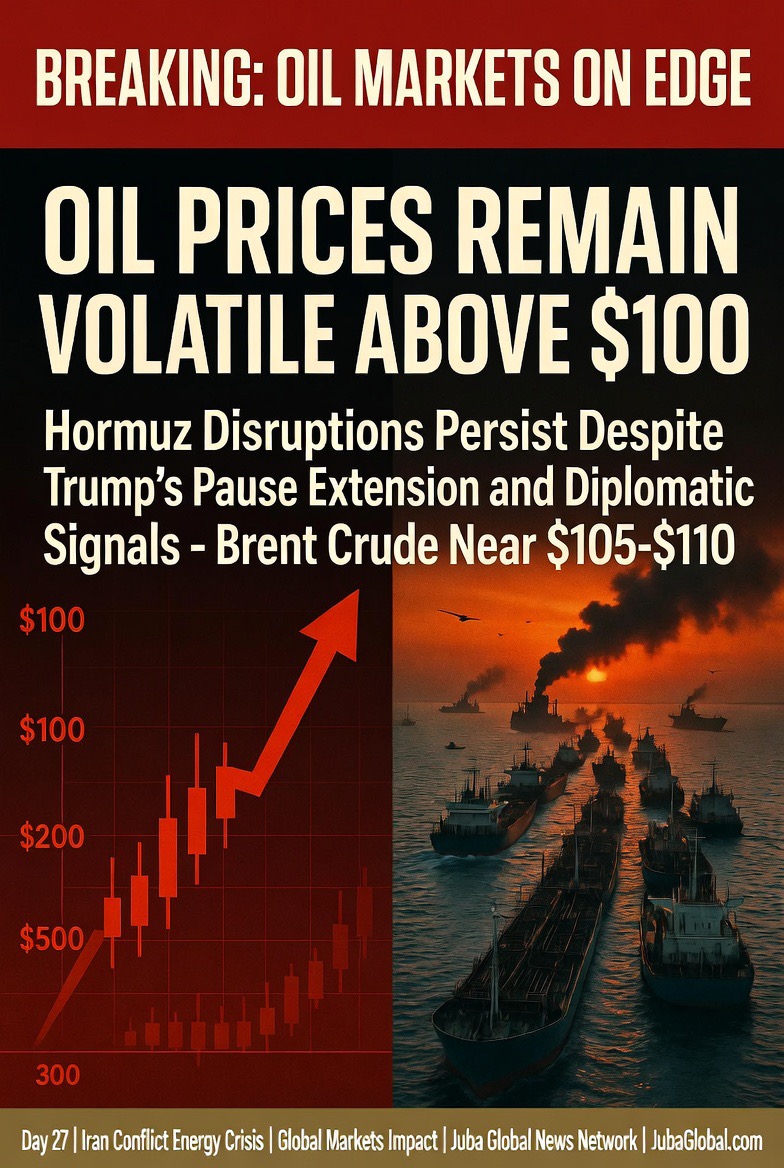
Global oil markets continued to exhibit sharp volatility on March 27, 2026, with benchmark Brent crude trading firmly above $100 per barrel and briefly approaching $110 in intraday sessions. The persistent disruption of shipping through the Strait of Hormuz — caused by Iranian military actions and selective blockades — remains the dominant driver, even as President Donald Trump announced a 10-day extension of the pause on U.S. strikes against Iranian energy infrastructure until April 6.
As of midday trading on March 27, Brent crude futures hovered around $105–$110 per barrel, reflecting a roughly 40–50% surge since the outbreak of the broader Middle East conflict on February 28. West Texas Intermediate (WTI) followed a similar pattern, staying elevated amid fears of prolonged supply constraints. Analysts note that while some diplomatic optimism has provided occasional relief rallies, underlying supply risks and uncertainty have kept prices stubbornly high.
The Hormuz Factor: 20% of Global Oil Supply at Risk
The Strait of Hormuz, a narrow waterway between Iran and Oman, serves as the critical chokepoint for approximately 20% of the world’s daily oil production. Since the early stages of the Iran conflict, Iranian forces under the command of the late IRGC Navy chief Admiral Alireza Tangsiri (killed in an Israeli strike earlier this week) have disrupted commercial shipping through attacks on vessels, naval mine deployments, and declarations of restricted zones.
Iran has permitted limited “approved” transits — primarily for vessels from friendly nations such as China, Iran itself, and select others — often requiring coordination with IRGC intermediaries. This selective approach has led to massive congestion in the Persian Gulf, with reports of around 20,000 seafarers stranded and daily vessel traffic dropping dramatically from pre-conflict averages.
Maritime security firms and shipping insurers have raised premiums sharply, further discouraging tanker movements. Even partial reopenings or diplomatic signals have failed to restore full confidence, as markets price in the risk of sudden escalations or renewed attacks on tankers.
The killing of Tangsiri and other senior IRGC naval officers near Bandar Abbas represents a setback for Iran’s maritime operations, yet Tehran has vowed to maintain pressure on the strait. Iranian officials continue to link any full reopening to broader demands, including war reparations and formal recognition of their security interests in the waterway.
Diplomatic Developments Provide Mixed Signals
President Trump’s announcement extending the pause on strikes targeting Iranian power plants and energy facilities until April 6 has injected some short-term optimism. Trump stated that indirect talks with Tehran are “going very well,” citing the extension as a response to an Iranian government request. However, Iranian state media has rejected key parts of the U.S. 15-point peace proposal and dismissed positive talk as “fake news” designed to calm oil markets.
This mixed messaging has fueled volatility:
• Positive diplomatic headlines trigger brief sell-offs.
• Continued Iranian missile barrages (including the 83rd wave targeting Israel) and Hezbollah’s intensified attacks on Israel’s northern border remind traders of the multi-front risks.
• Israeli operations aimed at degrading Iran’s military capabilities add to uncertainty.
Goldman Sachs and other major banks have revised upward their 2026 oil price forecasts, citing the Hormuz disruptions as a structural factor that could keep prices elevated for months even if a ceasefire is eventually reached.
Broader Economic Ripple Effects
The sustained high oil prices are already transmitting pain across the global economy:
• Inflation pressures: Higher energy costs feed directly into transportation, manufacturing, and consumer goods. Economists warn that prolonged prices above $100 could add 0.5–0.7 percentage points to global inflation.
• U.S. consumers: American drivers are facing higher gasoline prices, while rising energy costs contribute to climbing mortgage rates and broader financial market jitters.
• Europe and Asia: Import-dependent economies, including much of Europe, India, and East Asia, face increased import bills and potential slowdowns in growth. Germany’s Defence Minister recently described the conflict as an “economic catastrophe” for the world.
• Developing nations: Many low-income countries heavily reliant on imported fuel risk social unrest and fiscal strain.
China, a major buyer of Iranian and Gulf oil, has repeatedly called for restraint and a swift resolution to protect global trade routes and economic stability.
Market Reactions and Analyst Views
Oil traders remain cautious despite the diplomatic pause. Futures curves show backwardation in near-term contracts, signaling tight immediate supply conditions. Options markets reflect elevated implied volatility, with traders hedging against both upside spikes (renewed attacks) and downside risks (sudden breakthrough in talks).
Some analysts argue that even limited Hormuz traffic restoration could ease prices significantly, while others warn that Iran’s decentralized naval tactics (speedboats, drones, coastal missiles) could sustain harassment even after leadership losses.
The International Energy Agency (IEA) and OPEC+ members are closely monitoring the situation, with discussions reportedly underway about potential production adjustments or strategic reserve releases if disruptions worsen.
Parallel Conflicts Amplify Uncertainty
The oil market turmoil occurs alongside other escalations on Day 27:
• Iran’s continued ballistic missile attacks on Israeli cities.
• Intensified Hezbollah rocket fire on Israel’s northern border as Israeli forces expand operations in southern Lebanon.
• Warnings from the IAEA about radiological risks at Iranian nuclear sites.
These developments keep risk premiums elevated, as any widening of the conflict could further threaten energy infrastructure across the region.
Outlook: April 6 Deadline Looms Large
With the U.S. energy strike pause now set to expire on April 6 at 8:00 PM Eastern Time, markets face a critical juncture. A failure to achieve meaningful progress in indirect talks — particularly regarding unrestricted Hormuz access — could trigger renewed escalation and even sharper price spikes.
Key variables to watch in the coming days include:
• Volume of actual tanker transits through the strait
• Statements from Iranian and U.S. officials
• Any breakthroughs or breakdowns in backchannel diplomacy
• Israeli military actions against remaining Iranian naval and missile assets
For now, the combination of physical supply risks and geopolitical uncertainty suggests that oil prices will likely remain volatile and elevated well above $100 per barrel in the near term.
Juba Global News Network will continue monitoring energy markets, diplomatic efforts, and military developments in real time. For the latest updates on oil prices, the Strait of Hormuz crisis, and the broader Iran conflict, visit JubaGlobal.com.
