

Oil Prices Hit Record Highs Amid Iran War Supply Disruptions
By Juba Global News Network | JubaGlobal.com March 7, 2026 The ongoing U.S.-Israel military campaign against Iran, now in its second week, has unleashed on
By Juba Global News Network | JubaGlobal.com
March 7, 2026

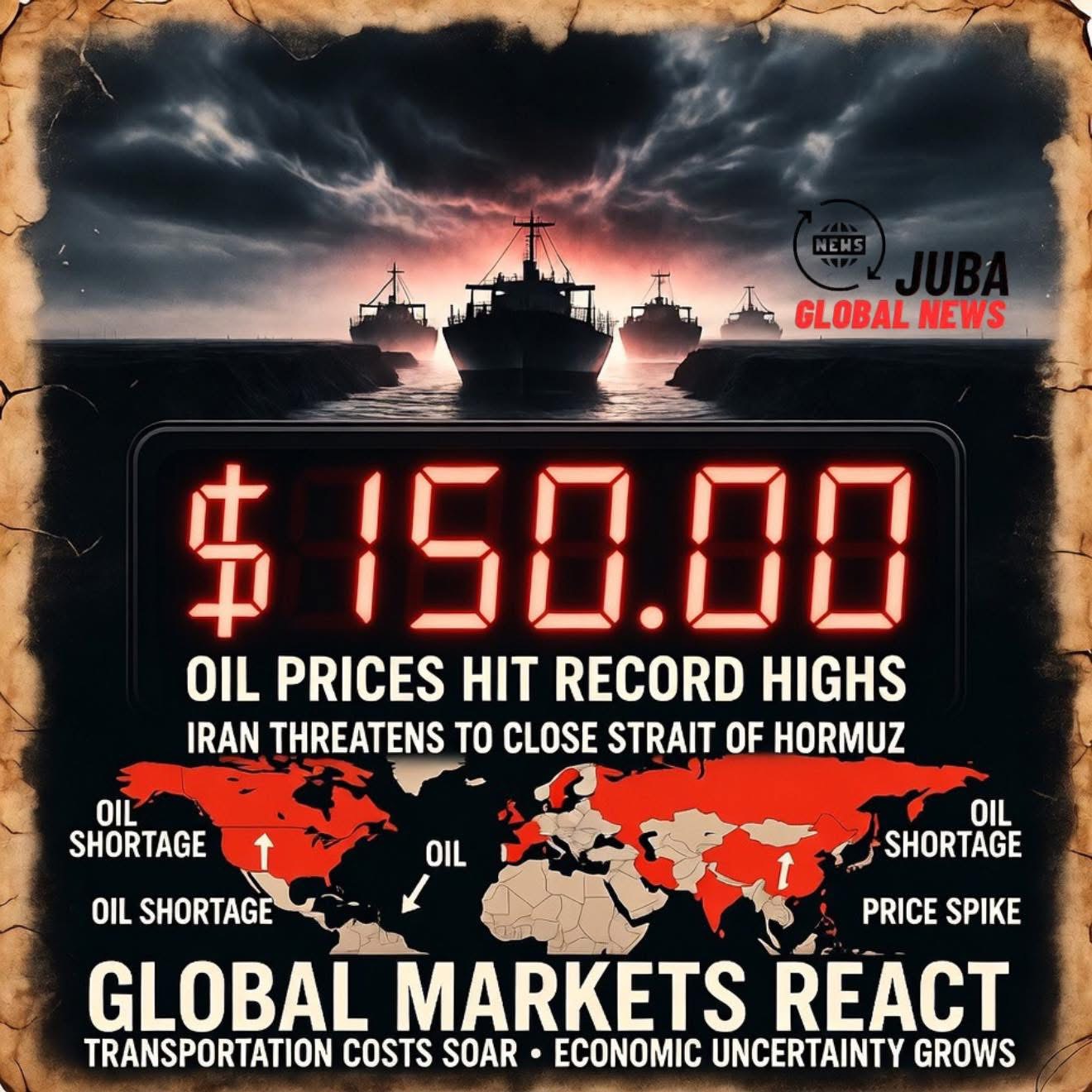
The ongoing U.S.-Israel military campaign against Iran, now in its second week, has unleashed one of the most severe shocks to global energy markets in recent history. Oil prices have surged to multi-year highs, with Brent crude climbing above $84 per barrel and U.S. West Texas Intermediate (WTI) crossing $78, marking some of the sharpest weekly gains since the early days of major geopolitical crises.
The primary trigger: Iran’s retaliatory actions, including threats and attacks that have effectively shut down traffic through the Strait of Hormuz, the narrow chokepoint through which roughly 20% of the world’s seaborne oil and a significant portion of liquefied natural gas (LNG) normally flow. Since the conflict escalated on February 28 with coordinated U.S. and Israeli airstrikes on Iranian targets—including leadership sites and military infrastructure—shipping in the strait has ground to a near standstill. Reports indicate multiple tankers damaged by Iranian drones or projectiles, marine insurers canceling war-risk coverage or hiking premiums dramatically, and vessels anchoring in droves rather than risking passage.
Iran’s Revolutionary Guards have vowed to target any ship attempting to transit, leading to a de facto blockade. This has halted exports from key producers like Saudi Arabia, Qatar, the UAE, and Iraq, forcing shutdowns at major facilities. Qatar halted LNG production and declared force majeure on shipments, while Saudi Aramco shuttered its largest domestic refinery after a reported drone strike. Around 150 ships remain stranded near the strait, exacerbating the supply crunch.
Dramatic Price Spikes and Market Reactions
Brent crude futures have jumped as much as 18.5% in a single week, briefly topping $85 before settling in the low-to-mid $80s range—the highest levels since early 2025. WTI crude has followed suit, rising over 35% in recent sessions to trade above $78 per barrel. These gains represent one of the largest weekly percentage increases in futures trading history, outpacing even some of the spikes seen during past Gulf crises.
European natural gas prices have been even more volatile, surging more than 50% in some contracts as Qatar’s LNG halt ripples through global supplies. U.S. gasoline prices have climbed over 10-15% nationally, with averages now exceeding $3.30 per gallon in many regions—up 34 cents since the war began—and diesel seeing similar jumps. Analysts warn that prolonged disruptions could push Brent well over $100 per barrel, triggering broader inflationary pressures and recession fears worldwide.
The economic fallout is already visible: Stock markets have tumbled in response, with major indices in the U.S., Europe, and Asia posting sharp declines as investors price in higher energy costs, squeezed supply chains, and renewed inflation risks. Defense and oil company stocks have provided some offset, but broader sentiment remains deeply negative.
Why the Strait of Hormuz Matters So Much
The Strait of Hormuz is no ordinary shipping lane—it’s a 21-mile-wide bottleneck at the mouth of the Persian Gulf, connecting the region’s oil and gas riches to global markets. Approximately 20 million barrels of oil per day—equivalent to about one-fifth of global consumption—pass through it under normal conditions, along with substantial LNG volumes from Qatar, the world’s top exporter.
With few viable alternatives (pipelines and overland routes can handle only a fraction of the volume), any sustained blockage creates immediate global tightness. Experts note that even short disruptions inject a massive “geopolitical risk premium” into prices, while prolonged ones erode inventories and force rationing-like dynamics in energy markets.
Iran’s actions appear designed to impose maximum economic pain on adversaries and their allies, but they have backfired regionally—drawing condemnation from Gulf neighbors whose exports are now collateral damage.
Broader Global Energy Crisis Looms
Beyond oil, the crisis is rippling through related commodities. Fertilizer, sugar, and soy prices have risen sharply due to higher transport and energy input costs. Aluminum production in the Gulf—accounting for about 8% of global supply—has faced shutdowns, with companies like Aluminium Bahrain declaring force majeure.
For major importers like Europe, India, and China, the pain is acute. Europe, still recovering from earlier energy shocks, faces renewed gas price spikes that could delay economic recovery. Asia, heavily reliant on Middle East supplies, risks higher trade deficits and inflation. Even the U.S., despite its domestic production boom, is not immune—higher pump prices hit consumers directly, and global slowdowns could curb demand for American exports.
The Trump administration has signaled efforts to mitigate the surge, including pledges to insure tankers and protect shipping lanes, but markets remain skeptical amid ongoing strikes and uncertainty about the war’s duration. Officials have projected the campaign could last 4-6 weeks or more, with no quick resolution in sight.
Looking Ahead: Risks and Uncertainties
Experts diverge on the outlook. A brief conflict might see prices stabilize once traffic resumes, but a prolonged blockade or escalation—including damage to more production facilities—could send Brent toward $100+ and trigger stagflationary pressures worldwide. Central banks face a dilemma: higher energy costs could force tighter policy even as growth slows.
As the war drags into its second week, the energy shock is no longer hypothetical—it’s here. With the Strait of Hormuz effectively closed and no end in sight, the world braces for a new era of energy volatility that could reshape economies for months or years to come.
Juba Global News Network will continue to track developments in this fast-moving crisis. For real-time updates, visit JubaGlobal.com.
Sources: Compiled from reports by Reuters, Bloomberg, The Guardian, CNN, NPR, BBC, Al Jazeera, The New York Times, AP News, and market data as of March 7, 2026.
